Pennsylvania Railroad GG1: History and Design

The Pennsylvania Railroad GG1 is a class of streamlined electric locomotive built for the Pennsylvania Railroad (PRR) in the northeastern United States, used to pull both passenger and freight trains on the railroad's electrified lines. Between 1934 and 1943, General Electric and the PRR's own Altoona Works built 139 GG1s, which entered service in 1935 and went on to run for the PRR's successors Penn Central, Conrail and Amtrak. The class became known for its Art Deco styling, its ability to pull trains at up to 100 mph, and an operating career of almost 50 years.
Why the Pennsylvania Railroad built the GG1
The Pennsylvania Railroad tried several electric locomotive designs before the GG1. Beginning in the late 1910s, the PRR received the FF1, but found it too slow for passenger trains and relegated it to heavy freight service. In the mid-1920s the railroad added the L5 electric, which at the time drew its power from a third rail. The PRR also built the O1 and the P5, and chose the P5 for its ability and power on the rails.
After a grade-crossing accident involving the P5a, the PRR moved its cab to the center and designated the result the P5a (Modified). The P5a's rigid frame did not track well at high speed and began developing cracks, pushing the PRR to look for an improved design. In 1933 the PRR decided to replace its P5a locomotives altogether, challenging General Electric and Westinghouse to design prototypes that weighed less per axle yet delivered more power than the P5a, could reach speeds of at least 100 mph, wore a streamlined shell, and used a single, centrally placed control cab.

Designing and testing the GG1, 1933 to 1943
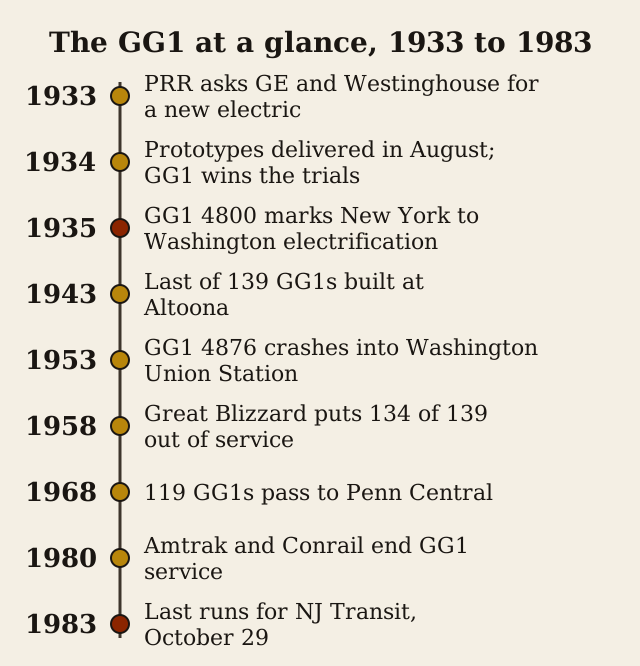
Looking for a better design, the Pennsylvania Railroad borrowed an EP3 locomotive from the New York, New Haven and Hartford Railroad to compare against its own P5a. The mechanical design of the new GG1 was based largely on that EP3. Each company answered the PRR's 1933 specification with a prototype, and both delivered their locomotives to the railroad in August 1934.
Westinghouse's entry was the R1, built by the Baldwin Locomotive Works with Westinghouse electrical equipment; it was little more than an elongated, more powerful version of the P5a, with four driven axles in a rigid frame and an AAR wheel arrangement of 2-D-2. The other entry was the GG1, with its frame built in two hinged halves. Over a ten-week trial, the railroad ran both machines in everyday service linking New York and Philadelphia and put them through additional runs on a test track at Claymont, Delaware. The GG1 was chosen for volume production on the strength of its better tracking and riding qualities.
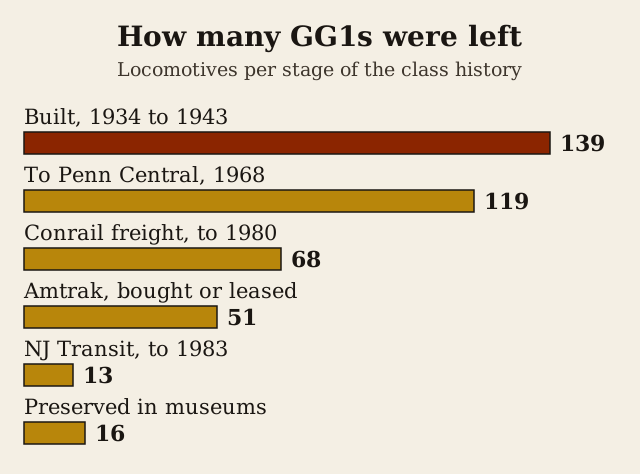
On November 10, 1934, the PRR ordered 57 production GG1s: locomotives assembled by General Electric in Erie, others by the PRR's own Altoona Works, and a further batch built at Altoona pairing electrical gear supplied by Westinghouse's East Pittsburgh plant with chassis produced by the Baldwin Locomotive Works at Eddystone. An additional 81 locomotives followed from Altoona between 1937 and 1943, distinguishable from the first batch by drop coupler pilots on each end. In total the PRR and General Electric built 139 GG1s between 1934 and 1943, of which number 4800, the prototype, was the only one with a riveted body shell; the rest were welded.

The R1 prototype after the competition
Though it lost the competition, the R1 remained in revenue service for years. Originally numbered 4800, it swapped numbers with the winning GG1 prototype to become 4899. In May 1940, to make room for the growing GG1 fleet, the PRR renumbered it again, this time to 4999. For years it typically pulled the Broadway Limited westbound and then returned east at the head of a mail-and-express train.

Its design was close to the earlier and lighter P5, with one more driving axle and lower axle loads. Four-wheel trucks at each end of this double-ended machine guided it at speed, and together with its driving wheels they classed the R1 as a 4-8-4 in Whyte notation, equal to 2-D-2 under AAR rules and 2'Do2' in the UIC system. Its long rigid wheelbase caused occasional derailments at Sunnyside Yard and elsewhere. Besides the R1, the PRR never built or ordered another 4-8-4 locomotive, though the T1 duplex came close, splitting a similar axle count into two separate sets of driving wheels configured as a 4-4-4-4.
How the GG1 was built: frame, wheels and power
The GG1's frame was built in two halves joined by a ball joint, which let the locomotive negotiate sharper curves. The body rested on this frame and was clad in welded steel plates, except on the prototype, which kept its riveted shell. The control cabs sat near the center of the locomotive, flanking the main oil-cooled transformer and an oil-fired train-heating boiler on either side, an arrangement first used on the PRR's Modified P5 class; it gave the crew more safety in a collision and let the locomotive run in either direction.
In Whyte notation, each half of the GG1's frame is a 4-6-0, which the Pennsylvania Railroad's own classification system called a "G"; the GG1 joined two such frames back to back as a 4-6-0+0-6-4. The equivalent AAR wheel arrangement is 2-C+C-2: each frame carried two unpowered axles at the outer ends and three powered axles toward the middle, with the two frames joined at their inner, powered ends by the ball-and-socket hinge. The locomotive also carried a Leslie A200 horn.
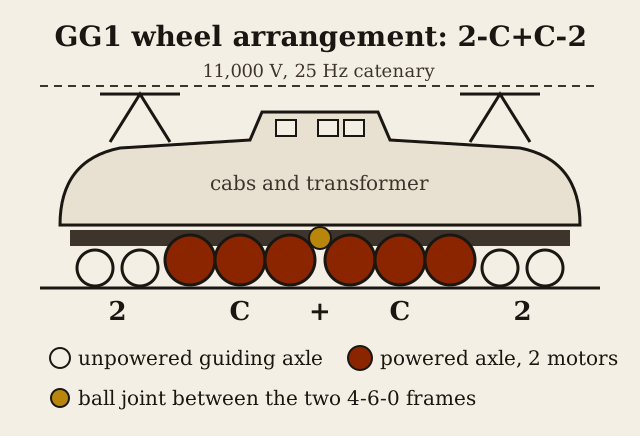
A pantograph on each end of the body collected 11,000-volt, 25 Hz alternating current from the overhead catenary; crews normally kept the leading pantograph lowered and ran on the trailing one, so that if it failed it could not strike the one ahead. A transformer mounted between the two cabs stepped the 11,000 volts down for the traction motors and other equipment. Because of the power involved, the GG1 used two traction motors per powered axle, each a six-pole, 400-volt, 25 Hz unit rated at 385 hp. The motors were mounted on the frame and connected to the sprung driving wheels through quill drives, giving a flexible suspension that let the full weight of each wheel bear on the rail regardless of track condition. Inside the engineer's cab, a controller offering 21 distinct positions let the crew vary how much voltage reached the motors. Four unpowered leading and trailing wheels sat at each end of the locomotive.
In the 1930s passenger cars were heated with steam from the locomotive, and the GG1 carried an oil-fired steam generator to feed its train's steam line. The locomotive could sustain high continuous power, with a much greater short-duration peak, and its top speed was 100 mph in passenger service and 90 mph in freight service.
Raymond Loewy and the GG1's Art Deco styling
Donald Roscoe Dohner was the first designer assigned to the GG1 project; the industrial designer produced initial scale-styling models, though the completed prototype ended up looking somewhat different from his models. At some point the Pennsylvania Railroad hired the noted industrial designer Raymond Loewy to enhance the GG1's aesthetics, work that led to the Art Deco look the class became known for. Until 2009, Loewy was thought to have created that styling alone; Dohner is now understood to have contributed too, because his GG1 designs influenced the modified P5a, which entered service before the GG1, not after it as had been believed.
Loewy said he recommended the smooth, welded body that replaced the riveted shell used on the prototype, and he added five gold pinstripes over a Dark Green Locomotive Enamel paint scheme. Loewy wrote of the urge to sketch locomotives that troubled him as a college student:
Unable to control an irresistible craving to sketch and dream locomotives at the oddest moments, it was a constant source of trouble during my college days, and the despair of my professors.

The GG1's paintwork changed more than once during its career. After the Budd Company delivered sixty new streamlined cars in 1952 for The Senator and Congressional service, the PRR repainted ten GG1s in a five-stripe Tuscan red scheme to match: six locomotives, numbers 4908 to 4913, in 1952, and four more, numbers 4876, 4856, 4857 and 4929, in 1953. In 1955 the PRR repainted the fleet in Dark Green Locomotive Enamel with a simplified single broad stripe and large red keystones, apart from five locomotives kept in other liveries for a time: 4907 and 4916 in Tuscan red with a single broad stripe, and 4866, 4872 and 4880 in a special silver scheme with a red single broad stripe. All of these were eventually repainted into the standard Dark Green Locomotive Enamel livery.

The GG1 in service
On January 28, 1935, the Pennsylvania Railroad celebrated the completion of electrification between Washington, D.C., and New York City with a special train hauled by GG1 number 4800; revenue service on the line began on February 10. The GG1 entered regular service that year and went on to work the PRR's electrified lines for the PRR itself and, later, for Penn Central, Conrail and Amtrak.
The class also hauled two notable funeral trains. In 1945 a PRR GG1 pulled President Franklin D. Roosevelt's funeral train from Washington Union Station to New York's Pennsylvania Station. On June 8, 1968, a pair of Penn Central GG1s pulled the funeral train of Robert F. Kennedy from New York Penn Station to Washington, D.C.

Famous GG1 incidents
The Congressional Limited crash at Frankford Junction, in the Kensington section of Philadelphia, Pennsylvania, happened on September 6, 1943. A hot box, a fire in a journal box, broke out at the front of the seventh of the train's 16 cars; the journal box seized, an axle broke and caught the underside of the truck, and the car was thrown upward into a signal gantry that peeled its roof off along the line of windows. The eighth car wrapped itself around the gantry's upright in a U shape, the next six cars scattered at odd angles across the tracks, and the last two cars stayed undamaged. In total, 79 passengers died, all of them in cars seven and eight, and 117 more were injured, some seriously.
A second serious incident took place on January 15, 1953, when train 173, the overnight Federal from Boston, approached Washington behind GG1 number 4876. When the engineer realized the train was not slowing and that the emergency brake had no effect, he sounded the horn; a signalman who heard it and noted the train's speed phoned ahead to the station master's office. GG1 4876 took several switches at speeds well over the safe limit and entered Washington Union Station at speed. Because the station concourse had been evacuated in time, no one died either in the station or aboard the train. Workers built a temporary floor over the wrecked locomotive and the hole it had made so that the station could host the inauguration of President Dwight D. Eisenhower; 4876 was later dismantled, removed from the basement, and rebuilt with a new frame and superstructure at Altoona.
The only major electro-mechanical breakdown the class suffered came during the Great Blizzard of '58, which swept the northeastern United States on February 15 and 16, 1958, and put 134 of the 139 GG1s out of commission at once.

Retirement: Penn Central, Conrail, Amtrak and NJ Transit
The Pennsylvania Railroad merged with the New York Central Railroad in 1968 to form Penn Central, bringing 119 surviving GG1s into the new company. Penn Central went bankrupt in 1970, and its freight operations later passed to the government-controlled Conrail, which kept 68 GG1s in freight service until electric freight traction ended in 1980.
Amtrak, created in 1971, bought 30 GG1s outright for $50,000 each and leased a further 21, eleven of which worked New York and Long Branch commuter trains. Amtrak first renumbered its purchased GG1s from 900 to 929, then added a prefixed 4; the leased locomotives were renumbered 4930 to 4939, except for 4935, which kept its old PRR and Penn Central number. Amtrak tried and failed to replace the GG1 in 1975 with the General Electric E60. A workable replacement only emerged after Amtrak imported and tested two lightweight European locomotives, an ASEA-built Rc4a from Sweden numbered X995 and a derivative of the French Alsthom-MTE CC 21000 numbered X996; Amtrak ultimately based its new EMD AEM-7 on the Swedish design, and as the AEM-7s arrived it ended GG1 service on April 26, 1980.
The last GG1s in regular use were some of the 13 locomotives, numbers 4872 to 4884, assigned to New Jersey Transit, which ran them on its commuter route linking New York with South Amboy, a line once known as the New York and Long Branch, now called the North Jersey Coast Line. That service ran until October 29, 1983, retiring the GG1 after 49 years of work.
Preserved GG1s
Most GG1s were scrapped, but fifteen production locomotives plus the original prototype were preserved in museums. GG1 number 4800, nicknamed "Old Rivets" for being the only one built with a riveted body, was preserved at the Railroad Museum of Pennsylvania in Strasburg, Pennsylvania. GG1 4859, designated the Pennsylvania state electric locomotive in 1987, was preserved on Track 5 at the Harrisburg Transportation Center on Aberdeen Street in Harrisburg, Pennsylvania.

GG1 4876, the locomotive rebuilt after the 1953 Washington Union Station wreck, was preserved at the National Museum of Railroad History and Innovation in Baltimore, Maryland. GG1s 4877 and 4879 were both preserved by the United Railroad Historical Society of New Jersey in Boonton, New Jersey. GG1 4882, built at Altoona Works in 1939, was bought from New Jersey Rail Operations in 1987 by the National New York Central Railroad Museum in Elkhart, Indiana.
GG1 4890 was preserved at the National Railroad Museum in Green Bay, Wisconsin. GG1 4903, which hauled Robert F. Kennedy's funeral train with GG1 4901 in 1968 and was later renumbered (4)906 by Amtrak, was preserved at the Museum of the American Railroad in Frisco, Texas. GG1 4909, later renumbered 4932 by Amtrak, was preserved at the Leatherstocking Railway Museum in Cooperstown Junction, New York, and GG1 4913 at the Railroaders Memorial Museum in Altoona, Pennsylvania. When the US Post Office issued a series of locomotive stamps in 1999, the GG1 was among the locomotives featured, and the Illinois Railway Museum's GG1 was repainted specially for the occasion.

Rails & Rivals, our game on Steam, is a turn-based railroad strategy board game for 2 to 6 players: each player runs a rail company, lays track across a hex map and carries goods between cities, and the wealthiest company wins. The how to play page has the rules.
Keep reading
Sources
- Pennsylvania Railroad class GG1 (Wikipedia)
- #83 Penn. RR GG1 Electric Locomotive #4800 - Engineering History Landmark (American Society of Mechanical Engineers (ASME))
- Pennsylvania Railroad GG1 Streamlined Electric Locomotive #4859 - National Register of Historic Places asset detail (U.S. National Park Service)
- Train Inventory: Locomotives (City of Elkhart, Indiana / National New York Central Railroad Museum)
- Electric Locomotives - PRR 4927 (Illinois Railway Museum)
- Fleets of Modernism: The Streamliner Era and Beyond (Northwestern University Libraries)
- Pennsylvania Railroad class FF1 (Wikipedia)
- Pennsylvania Railroad class R1 (Wikipedia)
- SNCF Class CC 21000 (Wikipedia)