Puffing Billy: The 1813 Locomotive and Its History

Puffing Billy is a steam locomotive built across 1813 and 1814 at Wylam Colliery near Newcastle upon Tyne. Engineer William Hedley led the project, working alongside enginewright Jonathan Forster and blacksmith Timothy Hackworth, for the colliery's owner, Christopher Blackett. The finished engine hauled coal in chaldron wagons between the Wylam mine and the Tyne-side docks at Lemington. Instead of a rack or a cable, the engine relied on nothing more than the grip of its iron wheels on iron rails.
What Puffing Billy Is and Who Built It
William Hedley served as the resident engineer at Wylam Colliery. Jonathan Forster worked as the colliery's enginewright. Timothy Hackworth worked as its blacksmith on the project. Puffing Billy was one of three similar engines that Hedley built at Wylam to replace the horses that had previously hauled wagons along the colliery's tramway.
Puffing Billy first ran in 1813, moving coal in chaldron wagons between the Wylam pit and the Lemington-on-Tyne docks in Northumberland. Its success led Hedley's team to build a sister engine, Wylam Dilly, for the same colliery line that same year. The two engines are described as prototypes.

The Durham Coalfield Before Puffing Billy
Richard Trevithick built the first steam-powered locomotive to run on rails in either 1802 or 1804. Trevithick's 1804 engine operated close to the Pen-y-Darren Ironworks at Merthyr Tydfil in South Wales, hauling five wagons of iron over nine miles to win a wager, though doubts remain about whether his earlier 1802 locomotive at Coalbrookdale actually worked. The Pen-y-Darren locomotive's excessive weight cracked the iron rails it ran on, which made it impractical, and steam locomotives were not generally adopted at the time. The fuller story of that 1804 run is told in Richard Trevithick and the Penydarren Locomotive of 1804.
Locomotives built before Hedley's time generally proved far too heavy for the track that was then available. Most lines relied on cable haulage worked by stationary engines, though several other schemes had been tried. William Chapman, working for the Butterley Company, attempted in 1812 to build a steam engine that hauled itself along a cable. Brunton, at the same company, built an even less successful 'mechanical traveller,' known as the Steam Horse. Matthew Murray and John Blenkinsop produced the first twin-cylinder steam locomotive, Salamanca, for the Middleton Colliery railway near Leeds in 1812, using a pinion that engaged with teeth along the edge rails, in what became the first rack railway. The Middleton system became the first steam locomotive railway to work successfully, but it proved complex and expensive.

In 1810, a major strike over the Bond system disrupted the Durham coalfield, and the pit at Wylam Colliery stood idle for a time. Christopher Blackett, the colliery's owner, used this idle time to experiment with a locomotive-hauled tramway that worked purely by the adhesion of wheels on rails, rather than adopting a rack system like the one used at Middleton. Puffing Billy later followed that adhesion approach.
William Hedley and the Adhesion Experiments at Wylam
William Hedley, born in Newburn near Newcastle upon Tyne on 13 July 1779, held the post of 'viewer,' or manager, at Wylam Colliery. He counted among the leading industrial engineers of the early 19th century and played a large part in several major advances in early railway development. It was at Wylam that Hedley built the first practical steam locomotive to rely simply on the adhesion of iron wheels on iron rails. Hedley first built a hand-cranked test carriage, converted from a coal wagon chassis with a central drive shaft and geared drives to the axles, to test adhesion under various loads before committing to a full locomotive. That experiment succeeded. Hedley's system of coupling the wheels together was later patented, around the time Puffing Billy and Wylam Dilly were built.
Hedley's first full locomotive used the test wagon's chassis, fitted with a boiler and a single cylinder, following a pattern similar to Trevithick's engines. Its motion proved erratic because of the single cylinder, and it produced insufficient steam. Wylam Colliery's prototype 'travelling engine' was nonetheless successful enough as a demonstration, though it remained underpowered and prone to stalling when overloaded or faced with a gradient. It was convincing enough to encourage Christopher Blackett to fund further locomotives.

Hedley built a second engine with the help of Timothy Hackworth, his foreman smith, and Jonathan Forster, his principal engine wright, adapting the 1812 twin-cylinder plan used by John Blenkinsop and Matthew Murray, along with a return-flue boiler. That second engine was Puffing Billy. Hedley passed away on 9 January 1843 at Burnhopeside Hall near Lanchester; his burial took place at Newburn parish church. Four sons survived Hedley, and his descendants remained involved in the coal-mining industry until nationalisation in the 1940s. A charitable foundation was set up in Hedley's name in 1971, using assets based on the nationalisation compensation.
How Puffing Billy's Drive Mechanism Worked
Puffing Billy was fitted with a pair of upright cylinders, positioned on either side of the boiler and partly enclosed within it, each sized at 9 inches by 36 inches. The cylinders' piston rods extended upward to pivoting beams, which were connected by further rods to a crankshaft mounted beneath the frames. Gears on that crankshaft both drove and coupled the wheels together.
One account describes this as the first use of coupled wheels on any locomotive.

William Hedley reasoned that if the pairs of wheels were connected, as with Trevithick's engines, a pair that began to slip would be counteracted by the other pair. Christopher Blackett had specifically wanted a locomotive worked purely by adhesion rather than the Blenkinsop rack system, and Hedley's coupled-wheel design was the answer to that requirement.
Puffing Billy's driving wheels measured 3 feet 3 inches, or 39 inches, in diameter. The locomotive ran at a working pressure of 50 lb. It weighed approximately 8 tons excluding its tender, a figure recorded elsewhere as 8.25 long tons, or about 8.38 tonnes. Puffing Billy could reach no more than about 5 mph. Puffing Billy is described as the first commercial adhesion steam locomotive, employed specifically to haul coal chaldron wagons from Wylam to the docks at Lemington-on-Tyne. These novel features, patented by Hedley, proved important to the later development of locomotives. The engine itself, however, carried a number of serious technical limitations.
Rebuilds and Working Life Until 1862
Wylam Colliery's cast iron wagonway plates could not cope with Puffing Billy's weight once the locomotive entered service. Christopher Blackett had recently replaced the colliery's wooden waggonway with iron flanged 'L' section plate rails, and Puffing Billy's eight-ton weight broke those plates, drawing criticism from opponents of locomotive haulage. The problem was resolved by doubling the number of axles, redesigning the engine with four axles so that its weight was spread more evenly across the track.

Considerable wear to the track persisted even after that first fix. Puffing Billy and its sister engine were rebuilt in 1815 with extra wheels, carried on twin four-wheeled bogies. Their wheels initially had no flanges, since they ran on the flanged plate rails already in use. Wylam Colliery's line was relaid with stronger edge rails around 1830, and both locomotives were returned to their original two-axle configuration at that point, now fitted with flanged wheels, which became their final working arrangement.
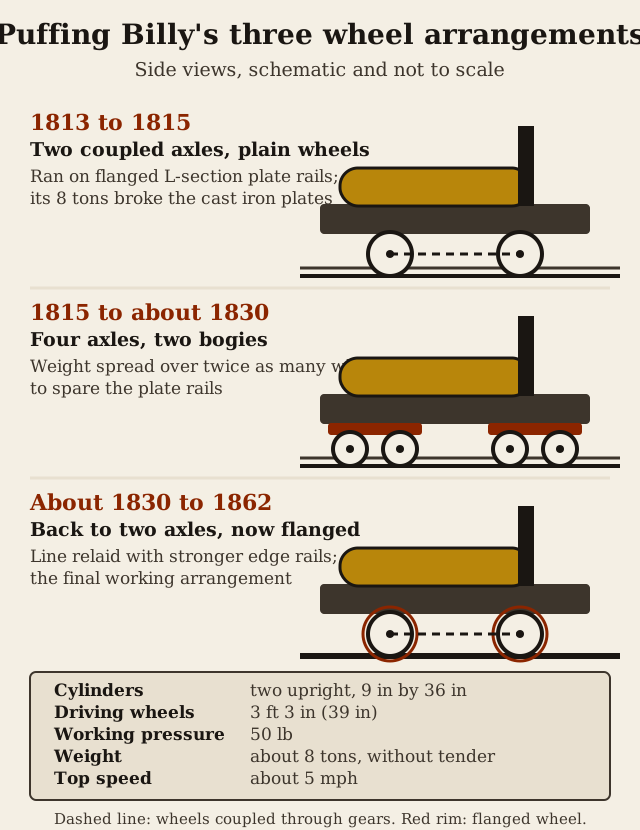
Puffing Billy and Wylam Dilly remained in active service at Wylam Colliery until 1862.
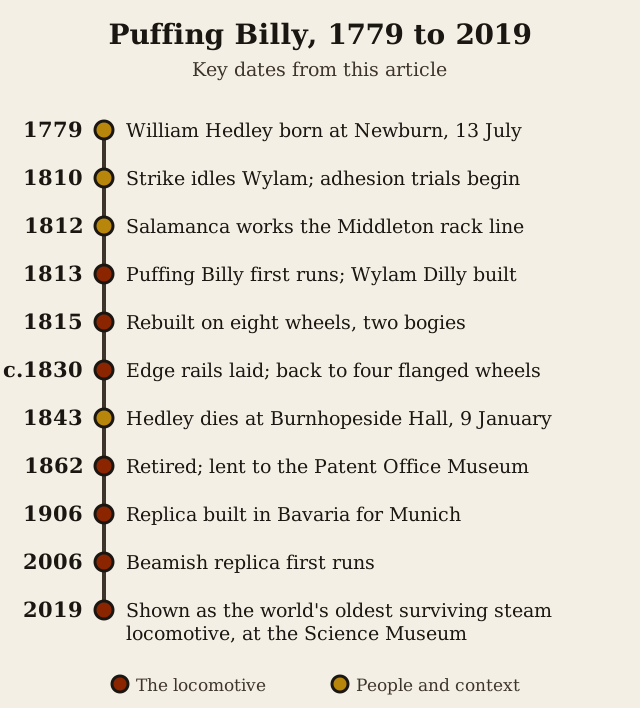
Influence on George Stephenson and Early Railways
George Stephenson lived locally to Wylam Colliery, and Puffing Billy was an important influence on him. Puffing Billy's good performance helped convince other colliery operators across north-eastern England to start adopting steam locomotives of their own. Stephenson's later locomotive work is explored further in Stephenson's Rocket: The Locomotive That Won Rainhill.

On Display at the Science Museum Since 1862
Puffing Billy remained in service at Wylam Colliery until 1862, when Edward Blackett, the colliery's owner at that date, lent the locomotive to the Patent Office Museum in South Kensington, London, which later became the Science Museum. Edward Blackett later sold Puffing Billy to the museum for £200. As of 2019, Puffing Billy was displayed in the Science Museum's Making the Modern World gallery, where it was presented as the world's oldest surviving steam locomotive.

Wylam Dilly, Puffing Billy's sister locomotive, went to the National Museum of Scotland in Edinburgh for preservation. Two replicas of Puffing Billy were also made. One was built in a Royal Bavarian State Railways workshop in 1906 and went to the German Museum in Munich. The other, a replica of Hedley's 1813 Wylam Colliery engine made for Beamish Museum, first ran there in 2006.


Rails & Rivals, our game on Steam, is a turn-based railroad strategy board game for 2 to 6 players: each player runs a rail company, lays track across a hex map and carries goods between cities, and the wealthiest company wins. The how to play page has the rules.
Keep reading
Sources
- Puffing Billy (locomotive) (Wikipedia)
- 'Puffing Billy' Locomotive (Science Museum Group)
- Puffing Billy (Newcastle University (Co-Curate))
- Locomotive: Puffing Billy (Grace's Guide to British Industrial History)
- William Hedley (Wikipedia)
- Puffing Billy at Pockerley Waggonway, Beamish Museum (Newcastle University (Co-Curate))
- Top 5 things to see at the Science Museum if you love transport (Science Museum (London))