Richard Trevithick and the Penydarren Locomotive of 1804

Richard Trevithick (13 April 1771 to 22 April 1833) was a British inventor and mining engineer whose Penydarren locomotive made the world's first locomotive-hauled railway journey on 21 February 1804. The run followed the tramway of the Penydarren Ironworks in Merthyr Tydfil, Wales. The locomotive hauled ten tons of iron and a large number of passengers. The run won a wager for the ironworks owner, Samuel Homfray. It showed that a locomotive powered by high-pressure steam, which Trevithick had patented two years earlier, could haul a heavy load on an iron tramroad. That 1804 trial sits near the start of the railroad history timeline that runs from Trevithick's engine to the railways of today.
Cornwall Roots and the Idea of High-Pressure Steam
Trevithick's birthplace was Tregajorran in Illogan parish, which lies between Camborne and Redruth at the center of one of Cornwall's rich mining districts. Of the six children in the family, he was the only son and the second youngest. His father was a mine captain, and the boy was immersed in mining and engineering from an early age. He did not take much advantage of the village school at Camborne. One of his schoolmasters described him as "a disobedient, slow, obstinate, spoiled boy, frequently absent and very inattentive". Arithmetic was the exception, as he had an aptitude for it.

In 1797 Trevithick married Jane Harvey of Hayle. Jane's father, John Harvey, a former blacksmith from Carnhell Green, had founded the local foundry Harveys of Hayle. The firm earned an international name for its huge stationary beam engines, which mostly pumped water out of mines. Before this, mines relied on steam engines of the condensing, or atmospheric, kind that Thomas Newcomen had invented in 1712.
As his experience grew, Trevithick realized that improvements in boiler technology now allowed the safe production of high-pressure steam. Such steam could move a piston on its own account, instead of relying on near-atmospheric pressure in a condensing engine. Trevithick was not the first to think of so-called strong steam of about 30 pounds per square inch. William Murdoch, his former next-door neighbor, had developed and demonstrated a model steam carriage in 1784, and he demonstrated it to Trevithick in 1794.
Early Engines and Setbacks, 1801 to 1803
On Christmas Eve 1801, Trevithick's first road locomotive, which he named Puffing Devil, carried six passengers up Fore Street in Camborne. His cousin and associate, Andrew Vivian, steered the machine. The demonstration inspired the Cornish folk song Camborne Hill. During further tests three days after the Christmas Eve 1801 run, the vehicle broke down after passing over a gully in the road. Puffing Devil could not maintain sufficient steam pressure for long periods, so it would have been of little practical use.

In 1802 Trevithick and Andrew Vivian were granted a patent covering steam engines that worked at high pressure without a condenser. Trevithick's first models of high-pressure engines used a double-acting cylinder, with steam distribution by means of a four-way valve. Exhaust steam was vented through a vertical pipe or chimney straight into the atmosphere, which avoided a condenser and any possible infringement of Watt's patent. High-pressure engines were more compact than the earlier low-pressure engines, which made steam railway locomotives practicable.
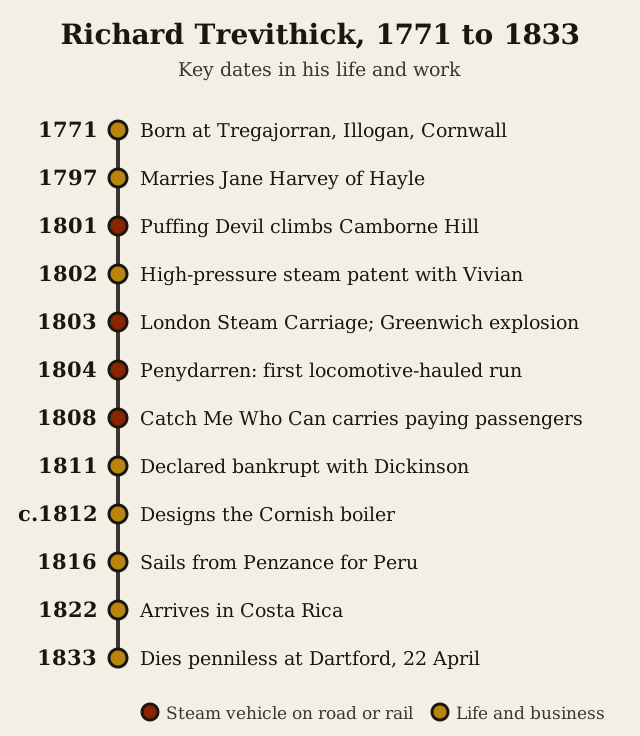
Trevithick's second road locomotive, the London Steam Carriage, ran through the streets of London in 1803. He drove it from Holborn to Paddington and back, and it attracted much attention from the public and the press. Passengers found the ride uncomfortable, and the carriage cost more to operate than one pulled by horses, so the project was dropped. That same year, a stationary pumping engine of Trevithick's working at Greenwich blew up, and four men died. Trevithick believed careless operation, not a design flaw, caused the accident. James Watt and Matthew Boulton, competitors who promoted low-pressure engines, used the explosion to highlight the risks of high-pressure steam. Trevithick responded by fitting two safety valves to his future designs, only one of which the operator could adjust.
Before the Penydarren engine, the Coalbrookdale Company in Shropshire built a rail locomotive for Trevithick, but little is known about it, including whether it actually ran. The only known information comes from a drawing preserved at the Science Museum in London and a letter Trevithick wrote to his friend Davies Giddy. The design used a single horizontal cylinder enclosed in a return-flue boiler. A company workman was killed in an accident involving the engine, and this is said to be why the company did not run it on its existing railway.
The Penydarren Locomotive and the 1804 Wager
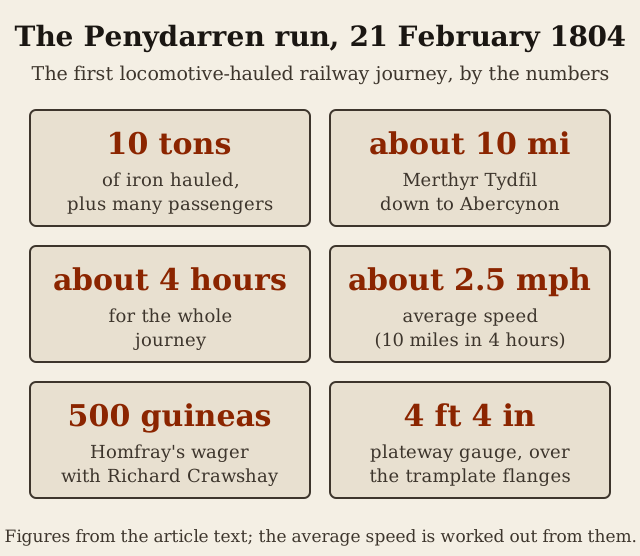
Trevithick built the Penydarren locomotive at the Penydarren Ironworks in Merthyr Tydfil, whose proprietor was the ironmaster Samuel Homfray. Homfray acquired rights in Trevithick's high-pressure engine patent in 1803. Homfray then bet another ironmaster, Richard Crawshay, 500 guineas that the locomotive could haul ten tons of iron along the Merthyr Tramroad from Penydarren to Abercynon. By 13 February 1804 the engine was completed, and Trevithick wrote:
We put it on the tramway. It worked very well.
On 21 February 1804, the Penydarren locomotive made what is described as the first authenticated journey in the world by a steam locomotive. Its load was ten tons of iron plus many passengers, carried down from Merthyr Tydfil to Abercynon over roughly 10 miles in about four hours. It ran on the plateway track of the Merthyr Tramroad, with a gauge of 4 feet 4 inches measured over the flanges of the tramplates. The run won Homfray his 500 guinea bet. Homfray also prevented efforts by Boulton and Watt to have the engine declared unsafe. The locomotive broke some of the tramroad's short cast-iron plates, which were meant only for the lighter axle loads of horse-drawn wagons. After the trial, the engine was converted to drive a hammer in one of the ironworks' workshops.
Later Locomotives: Newcastle and Catch Me Who Can
Word of the Welsh success reached Christopher Blackett, who owned the Wylam colliery near Newcastle, and he wrote to Trevithick to request locomotive designs. Those designs were sent to Trevithick's agent, John Whitfield, at Gateshead. In 1804 Whitfield built what was likely the first locomotive to have flanged wheels. Blackett had laid wooden rails for his tramway, and once again Trevithick's machine proved too heavy for its track.
Around 1805 to 1806, Hazledine and Co of Bridgnorth, Shropshire, a firm with a reputation for high-quality work, built one of Trevithick's high-pressure stationary engines. That engine used steam at approximately 50 pounds per square inch. In 1808, John Hazledine and John Urpeth Rastrick built a new locomotive for Trevithick at Bridgnorth, called Catch Me Who Can. It was probably Trevithick's fourth locomotive, after those used at Coalbrookdale, Penydarren and Wylam. What set Catch Me Who Can apart from the earlier engines was its vertical cylinder, which turned a pair of wheels directly with no flywheel or gearing.
In 1808, Trevithick ran Catch Me Who Can on a circular track on a site south of Euston Road in London. It was the first time in the world that a steam locomotive hauled paying passengers on a railway. Public interest was limited, and the high entrance fee may have put people off.

Images, Models and Replicas
No plans of the Penydarren locomotive survived, so later images and replicas of it were based on a drawing of the earlier Coalbrookdale locomotive. A lithograph of Trevithick's Pen-y-darran locomotive was published by the Mining Journal in 1858, long after the 1804 run. In 1979, National Museum Wales bought a brass model based on a Llewellyn drawing of 1803. The museum used it to show prospective component makers the general form of a Trevithick-designed locomotive while a full-size reconstruction was being planned.
Much later, National Museum Wales built a full-size, live-steam reconstruction of the Penydarren locomotive to commemorate the 1804 run. The museum completed the reconstruction in 1982.

Later Projects, South America and Trevithick's Death
In 1805 the Thames Archway Company chose Robert Vazie, another Cornish engineer, to dig a tunnel beneath the River Thames at Rotherhithe. Vazie struggled badly with water pouring into the workings, and he had only sunk the shafts at each end by the time the directors brought in Trevithick to advise them. In January 1808 the tunnel flooded, and Trevithick, being the last to leave, was nearly drowned. Trevithick's links with the company later ended, and his tunnel was never completed.
Much later, in 1823, Sir Marc Isambard Brunel, assisted by his son Isambard Kingdom Brunel, started the first successful tunnel under the Thames, about three quarters of a mile upstream. Funding problems delayed its completion until 1843. Long after Trevithick's death, his idea of a submerged tube was first used in practice for a crossing of the Detroit River, linking Michigan in the United States with Ontario in Canada. That crossing was the Michigan Central Railway Tunnel.
Trevithick saw opportunities in London and talked his reluctant wife and four children into joining him there in 1808. They stayed two and a half years, living first in Rotherhithe and later in Limehouse. In 1808 Trevithick also entered a partnership with Robert Dickinson, a West India merchant, who supported several of Trevithick's patents. The first was the Nautical Labourer, a paddle-driven steam tug fitted with a floating crane. It did not meet the fire regulations for the docks. Trevithick also researched other uses for his high-pressure engines, including:
- boring brass for cannon manufacture
- stone crushing
- rolling mills and forge hammers
- blast furnace blowers
In May 1810 Trevithick caught typhoid and nearly died. By September 1810 he had recovered enough to travel back to Cornwall by ship. In February 1811 he and Dickinson were declared bankrupt. They were not discharged until 1814, after Trevithick had paid off most of the partnership debts from his own funds. In about 1812 he designed the Cornish boiler, a horizontal, cylindrical boiler with a single internal fire tube. Cornish boilers installed in the Boulton and Watt pumping engines at Dolcoath more than doubled their efficiency.
One of his more unusual projects was an attempt at a so-called recoil engine, which worked on the same principle as the aeolipile that Hero of Alexandria described around AD 50. His version comprised a boiler feeding a hollow axle that routed steam to a catherine wheel fitted with two fine-bore steam jets on its circumference. To get any usable torque, steam had to leave the jets at a very high velocity and in such large volume that the engine did not operate with adequate efficiency.
Trevithick's attention then turned to South America. In 1811, Francisco Uville was in charge of draining the silver mines of Cerro de Pasco in Peru. Low-pressure Boulton and Watt engines were useless at the mines' high altitude and could not be broken into pieces small enough to carry along mule tracks. Uville was sent to England to look into Trevithick's high-pressure engine, bought one for 20 guineas and found it worked quite satisfactorily. On 20 October 1816, Trevithick left Penzance on the whaler Asp, bound for Peru. Uville received him with honor at first, but relations soon broke down. Trevithick left in disgust at the accusations directed at him and traveled widely in Peru as a consultant on mining methods. He later passed through Ecuador on his way to Bogotá in Colombia.
Trevithick arrived in Costa Rica in 1822 hoping to develop mining machinery. For moving ore and equipment, he chose a route that went by the San Juan River, then the Sarapiqui River, and finally by railway. He later sailed home to Falmouth, arriving with few possessions other than the clothes he was wearing.
Back in Britain, Trevithick petitioned Parliament for a grant, but he was unsuccessful. He built a closed cycle steam engine in 1829 and after that a vertical tubular boiler. In 1830 he invented an early form of storage room heater. For his final project, John Hall, founder of J and E Hall Limited, invited him to Dartford, Kent, to work on the engine of a new vessel. The work involved a reaction turbine, for which Trevithick earned 1200 pounds. He lodged at The Bull hotel in Dartford. After about a year there, Trevithick fell ill with pneumonia. Following a week confined to bed, he died on the morning of 22 April 1833. He was penniless at his death, and no relative or friend had come to his bedside while he was ill.
In 1932 Prince George, Duke of Kent, unveiled a statue of Trevithick outside the public library in Camborne. The work of Leonard Stanford Merrifield, it shows him holding one of his small-scale models. On 17 March 2007, Dartford Borough Council asked Phil Hosken, Chairman of the Trevithick Society, to unveil a blue plaque on the Royal Victoria and Bull hotel, which was once The Bull. The plaque marks Trevithick's last years in Dartford and the place of his death. The Trevithick Society is named in his honor and is the successor to groups first formed to rescue the Levant winding engine from being scrapped. The society publishes a newsletter, a journal and books on Cornish engines and the mining industry.

Trevithick and Stephenson's Rocket
Stephenson's Rocket competed at the Rainhill Trials in 1829, twenty-five years after the Penydarren locomotive's 1804 run. Only Rocket completed the trials successfully. It averaged 12 miles per hour and hit a top speed of 30 miles per hour. The Stephensons won the 500 pound prize and the contract to supply locomotives to the Liverpool and Manchester Railway.

Rocket was designed by Robert Stephenson. Our piece on Stephenson's Rocket tells the full story of the Rainhill Trials.

Rails & Rivals, our game on Steam, is a turn-based railroad strategy board game for 2 to 6 players: each player runs a rail company, lays track across a hex map and carries goods between cities, and the wealthiest company wins. The how to play page has the rules.
Keep reading
Sources
- Richard Trevithick (Wikipedia)
- Richard Trevithick (1771-1833) (National Library of Wales / Dictionary of Welsh Biography)
- Trevithick's High Pressure Steam Engine and Boiler, c. 1806 (Science Museum Group)
- Trevithick's Penydarren locomotive, Collections Online (Amgueddfa Cymru, National Museum Wales)
- Trevithick's Penydarren locomotive model, Collections Online (Amgueddfa Cymru, National Museum Wales)
- Samuel Homfray 1762-1822 (Science Museum Group)
- Lithograph of Trevithick's Pen-y-darran Locomotive (Science Museum Group)
- Catch Me Who Can: Trevithick's steam locomotive demonstration of 1808 (British Library)
- Rocket locomotive (Science Museum Group / National Railway Museum)