Stephenson's Rocket: The Locomotive That Won Rainhill

Stephenson's Rocket is an early steam locomotive, designed by Robert Stephenson and built by Robert Stephenson & Co. in Newcastle upon Tyne in 1829, that won the Rainhill trials held in October 1829 to settle how the new Liverpool and Manchester Railway would be powered. Though it was not the first steam locomotive ever built, Rocket brought together in one machine developments such as the multi-tube boiler and the blastpipe, as the Science Museum Group record for Rocket notes, a combination that made it the most advanced locomotive of its day and the template for most steam locomotives built over the following 150 years.
What Stephenson's Rocket Is
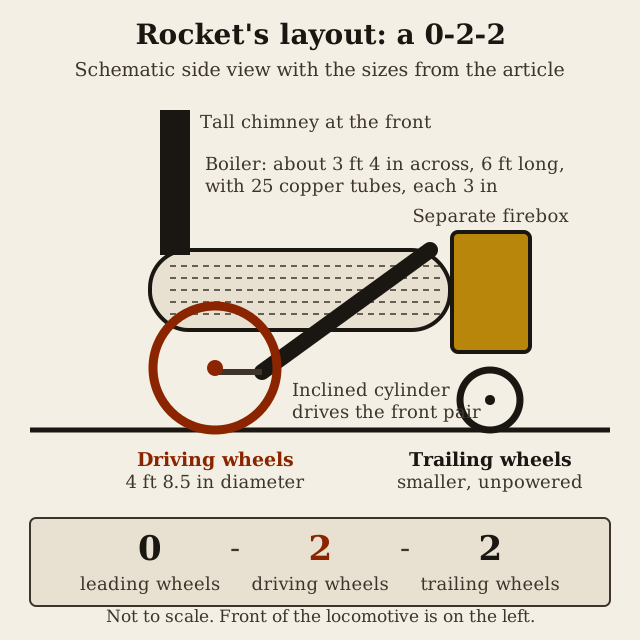
Rocket is classified as a 0-2-2 locomotive, with a single pair of large driving wheels at the front and a smaller, unpowered pair behind, the wheel-counting system explained in our guide to Whyte notation. Its driving wheels were 4 feet 8.5 inches in diameter, and a 16 foot smokestack chimney stood at the front of the locomotive. The boiler itself was about 3 feet 4 inches in diameter and 6 feet long, and it contained 25 copper tubes, each 3 inches across, a feature covered in detail below. One of the cylinders also drove a small 1.25 inch diameter feedwater pump that moved water from the tender to the boiler, with a valve that could be adjusted to control how much water was supplied.
George and Robert Stephenson, and Robert Stephenson and Company
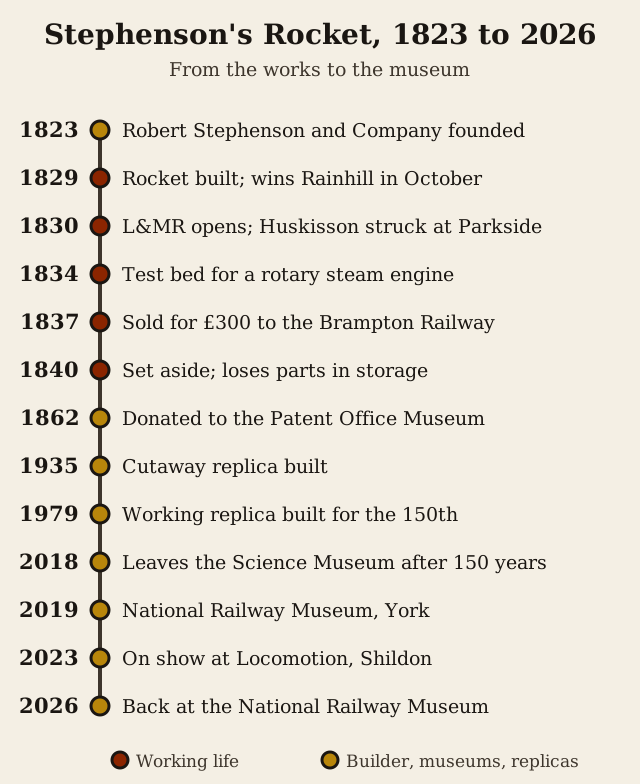
Robert Stephenson and Company was founded on 23 June 1823 by George Stephenson, Robert Stephenson, Edward Pease and Michael Longridge, with workshops established at Forth Street in Newcastle, making it the first locomotive works in the world. From its Forth Street workshops the company went on to lead the development of steam locomotives. Historians credit Robert Stephenson with the majority of Rocket's design, though he was in frequent contact with his father George and likely received advice from him. George himself had designed several locomotives before Rocket, but none as advanced; at the time Rocket was being designed and built at the Forth Banks works, George was living in Liverpool overseeing construction of the Liverpool and Manchester Railway. Robert, back from a period of work in South America, had taken up his post as managing director of Robert Stephenson and Company again, so the day-to-day design and construction of the new locomotive fell to him. Henry Booth, treasurer of the Liverpool and Manchester Railway, may also deserve a large share of the credit, since he is thought to be the person who proposed the multi-tube boiler to Robert Stephenson. Rocket also drew on experience from earlier Stephenson designs, including the Killingworth locomotive Blücher of 1814, Locomotion of 1825, and Lancashire Witch of 1828.

Why the Rainhill Trials Were Held
The Liverpool and Manchester Railway's directors first planned to move trains by cable, pulled along the line by stationary steam engines. They had appointed George Stephenson as engineer of the line in 1826, and he strongly advocated for steam locomotives instead. With the line close to finished, the directors chose to settle the question with a contest that would show if locomotives were up to the work, and it was run at Rainhill from 6 to 14 October 1829. Three engineers were chosen to judge the contest: John Urpeth Rastrick, who built locomotives in Stourbridge; Nicholas Wood of Killingworth, a mining engineer who had a good deal of experience designing locomotives; and John Kennedy, a cotton spinner from Manchester and one of the railway's leading backers. Stephenson designed Rocket specifically around the rules of this contest: because the weight of train a locomotive could haul was capped at three times its own weight, he realized the competition would favor a fast, light locomotive of only moderate hauling power rather than a large, powerful one. Before the trials, Rocket was dismantled at Newcastle and began a long journey to Rainhill: by horse wagon to Carlisle, then by lighter to Port Carlisle, then by the Cumberland steamer to Liverpool, where it was reassembled on 18 September 1829. In the demonstrations that followed, Rocket consistently and easily hauled a carriage carrying over 20 people up the Whiston Incline at over 15 mph, and ran light, without a train, at around 30 mph.

The Rainhill Trials Rules and Rivals
The rules set by the railway company required each locomotive's weight, with a full boiler of water, to be checked on the weighing machine by eight o'clock in the morning, with the load it hauled fixed at three times that weight. Six-wheeled locomotives were limited to six tons and four-wheeled locomotives to four and a half tons. Entrants also had to average at least 10 mph and complete ten trips equal to a 35 mile journey, with 30 miles of it run at full speed. A prize of £500 was offered to the winner.
Ten locomotives were officially entered, but only five were actually on hand to run when the trials opened on 6 October 1829. Cycloped, built by Thomas Shaw Brandreth, was powered by a horse walking on a drive belt and was withdrawn after an accident in which the horse burst through the floor of the engine. Novelty, built by John Ericsson and John Braithwaite and described as the world's first tank locomotive (one of the designs in our guide to steam locomotive types), was lighter and faster than its rivals but was withdrawn after a boiler pipe failed and could not be fixed properly on site. Perseverance, built by Timothy Burstall with a vertical boiler, was damaged in transit, and after its builder spent five days repairing it, the locomotive ran on the sixth day but failed to reach the required 10 mph and was withdrawn, earning a £25 consolation prize. Timothy Hackworth's Sans Pareil managed eight trips before one of its cylinders cracked. Even so, the Liverpool and Manchester Railway later bought it and used it for two years, then leased it to the Bolton and Leigh Railway.
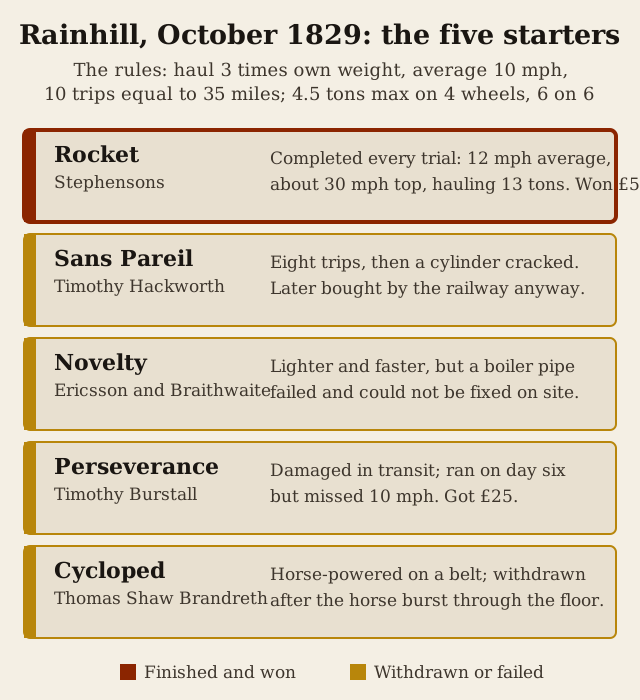
Rocket was the only locomotive to complete the trials, averaging 12 mph and reaching a top speed of about 30 mph while hauling 13 tons, and it was declared the winner. A crowd of 10,000 to 15,000 came to see the trials, and bands played music for the spectators. Winning at Rainhill brought the £500 prize, which Henry Booth and the Stephensons shared, and the Stephensons were given the contract to supply locomotives to the Liverpool and Manchester Railway.
The Design Features That Made Rocket Win
In Rocket's boiler, hot exhaust gas from the firebox passed through 25 copper fire-tubes, each 3 inches in diameter, on its way to the blastpipe and chimney. That put far more heating surface in contact with the boiler water than most earlier locomotives had, since their boilers were usually one flue pipe with water around it (the Lancashire Witch was an exception, with two flues). Stephenson and the French engineer Marc Seguin both have a claim to the multi-tube idea. Seguin had come to see Locomotion on a visit to Stephenson, and before Rocket appeared he had already designed and built two locomotives with multi-tubular boilers for the Saint-Étienne to Lyon railway, though these relied on fans rather than a blastpipe for draught. At Rainhill, Ericsson and Braithwaite's Novelty tried a different route to more heating surface, a single fire-tube folded three times, which gave a larger surface area but poor draught on the fire because of its length. The advantages of the multi-tube boiler were quickly recognized even for heavy, slow freight locomotives, and by 1830 Stephenson's former employee Timothy Hackworth had redesigned his return-flued Royal George as the return-tubed Wilberforce class.

Rocket paired this boiler with a blastpipe that fed exhaust steam from the cylinders into the base of the chimney, inducing a partial vacuum that drew air through the fire and intensified combustion. On Rocket's multi-tube boiler the blastpipe did its job well. Earlier single-flue engines had fared worse with it: the blast tore away the top layer of the fire and sent burning cinders flying from the chimney, which pushed fuel use up sharply. Credit for inventing the blastpipe is itself disputed, though Stephenson had used a version of it as early as 1814.
Rocket's firebox was separate from the boiler and double-walled, with a water jacket between the plates, since Stephenson recognized that the area surrounding the fire itself was the hottest part of the boiler and so the most effective for evaporating water. The firebox burned coke rather than coal. Local landowners already knew the dark smoke of coal-fired stationary engines, and on most new railways they had made it a rule that locomotives must "consume their own smoke." Burning coal directly only became practical 30 years later, once the long firebox and brick arch were introduced. Rocket's two outside cylinders were set at an angle of 38 degrees from horizontal, as on the Lancashire Witch, whereas most earlier designs had placed their cylinders vertically, which gave the engines an uneven, swaying motion as they moved along the track. The pistons connected directly to the driving wheels, an arrangement found in later steam locomotives. Rocket was the first 0-2-2 and the first single driver locomotive, and its single driving axle avoided the added weight of coupling rods while letting the unpowered second axle be smaller and lighter, since it carried only a small portion of the engine's weight. Together, the multi-tube boiler, blastpipe and direct cylinder drive became the template used in almost all future steam locomotives.
Rocket's Service and the Liverpool and Manchester Railway Opening
The Liverpool and Manchester Railway opened on 15 September 1830, with a ceremony that drew the Prime Minister, the Duke of Wellington, and other leading figures from government and industry. Eight trains set out from Liverpool for Manchester, led by Northumbrian with George Stephenson driving, and Rocket was driven by assistant engineer Joseph Locke. The day was marred when William Huskisson, the Member of Parliament for Liverpool, was struck by Rocket at Parkside; he died that evening, 15 September 1830, at Eccles.
National Museums Liverpool describes the opening as a major event in the history of travel and transport, and the line gave the impetus for the period of intense railway building known as Railway Mania. Built as a prototype to win a speed trial, Rocket was soon superseded by improved Stephenson designs, the Northumbrian and Planet classes, both introduced in 1830, and within a few years Rocket itself had been modified to resemble the Northumbrian class, with its cylinders altered to a near-horizontal position, its firebox enlarged, and a drum smokebox fitted. Other Rocket-type engines delivered to the Liverpool and Manchester Railway during 1830 included Arrow, Comet, Dart and Meteor, and Stephenson soon started trying out cylinders mounted at the front. Yet Invicta, the unsuccessful 0-4-0 that followed straight after Rocket in 1829, kept its cylinders angled.
In 1834 Rocket was chosen as the test bed for a rotary steam engine, the design of Admiral Thomas Cochrane, 10th Earl of Dundonald, but the modifications were not a success. The locomotive was sold in April 1837 for £300 and began service on the Brampton Railway, a mineral line near Brampton in Cumberland that had recently converted to Stephenson gauge; in August 1837 it was even used to carry back the results of an election from Midgeholme to Kirkhouse. Too light for mineral trains, it was set aside in 1840, and during its time in storage it lost several parts, among them the rear wheels and the copper plate that surrounded the firebox.
Where Stephenson's Rocket Has Been Displayed, 1862 to 2026
Rocket was kept at the Stephensons' yard in Newcastle until 1862, when the Thompsons of Milton Hall, near Brampton, donated it, incomplete and semi-derelict, to the Patent Office Museum in London, the institution that later became the Science Museum. It was displayed at the Science Museum for 150 years, until 2018, though by then in a much modified form from its appearance at the Rainhill trials. Built in Newcastle in 1829, Rocket returned to the city in summer 2018 for the first time in 150 years, going on display at the Discovery Museum during the Great Exhibition of the North, before moving on to the Museum of Science and Industry in Manchester in September 2018. After a short return to the Science Museum, it went on long-term display at the National Railway Museum in York in 2019. From 2023 to September 2025 it was exhibited at Locomotion in Shildon, County Durham, and as of May 2026 Rocket is back at the National Railway Museum in York. A cutaway replica built in 1935, once displayed alongside the original at the Science Museum, is on display at the National Railway Museum as of 2026, while a working replica built in 1979 for the 150th anniversary celebrations is used for train rides at Locomotion in Shildon.

The contest at Rainhill came down to one question that every railroad builder has faced since: pick an engine, prove it can do the job, then put it to work. Rails & Rivals, our game on Steam, is a turn-based railroad strategy board game for 2 to 6 players: each player runs a rail company, lays track across a hex map and carries goods between cities, and the wealthiest company wins. The how to play page has the rules.
Keep reading
Sources
- Rocket locomotive, steam locomotive (Science Museum Group)
- Robert Stephenson & Co Ltd (Science Museum Group)
- Newcastle exhibition marks bicentenary of Robert Stephenson's company (Rail Engineer)
- Rainhill trials (Wikipedia)
- Stephenson's Rocket (Wikipedia)
- Topics > Transport and Travel > Railway > Locomotives > Rocket (Newcastle University (Co-Curate))
- Rocket: engineering excellence (Science and Industry Museum, Manchester)
- The opening of the Liverpool and Manchester Railway (National Museums Liverpool)
- National treasure on the move: Stephenson's Rocket to remain on long-term display in the North (UK Government (gov.uk))