Fastest Steam Locomotives Ever: Mallard's 126 mph Record

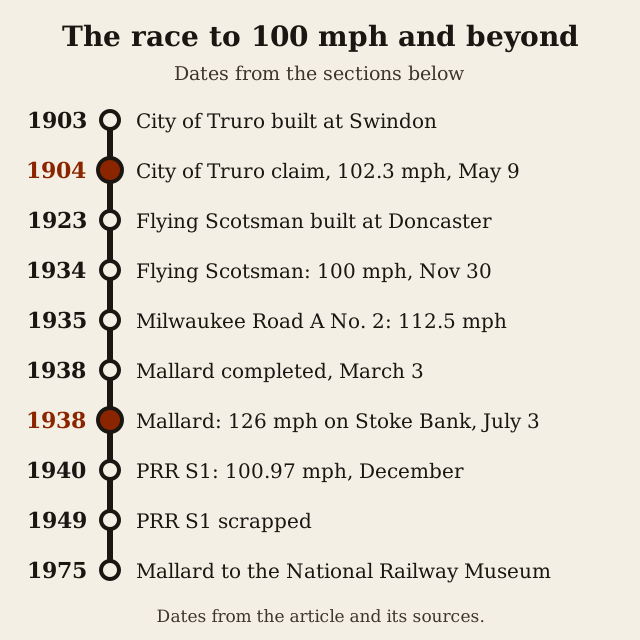
The fastest steam locomotive ever recorded is the LNER Class A4 Pacific Mallard, which reached 126 mph on 3 July 1938 during brake tests on the downward grade of Stoke Bank, south of Grantham, with the speed measured by the LNER's dynamometer car. That figure is still credited to Mallard today by the Science Museum Group, which holds the locomotive at the National Railway Museum in York. Other locomotives, including the Great Western Railway's City of Truro and the Pennsylvania Railroad's S1, carry disputed or unverified claims to speeds near or above that figure, but none has a verified figure that beats it.
Mallard's 126 mph run on 3 July 1938
Mallard is an LNER Class A4 Pacific (4-6-2) locomotive, built at Doncaster and completed on 3 March 1938. The locomotive measures 70 ft long and weighs 165 long tons with its tender attached. Its tractive effort is 35,455 lbf.
Mallard was the 28th of the LNER's Class A4 Pacifics, a design credited to Sir Nigel Gresley. The class eventually ran to thirty-five locomotives, all built at Doncaster Works between 1935 and 1938, meaning Mallard entered service near the very end of that production run just months before its record-breaking performance.
On 3 July 1938, during a series of brake tests, Mallard reached 126 mph on the downward grade of Stoke Bank, south of Grantham. The speed was recorded by the LNER's dynamometer car, which logged the train's speed on paper rolls as it ran. Mallard went to the National Railway Museum in York in 1975 and became one of the museum's highlights.
Precise accounts of the run vary slightly in the decimal figure, though not in substance: one detailed description of the same test puts the exact reading at 125.88 mph, achieved between Barkston, near Grantham, and Essendine on the East Coast Main Line, with 126 mph remaining the figure most commonly associated with the record.
Mallard's working life did not end with the record run. The locomotive later ran in British Railways service as No. 60022, and it joined the national collection after being withdrawn from service. In the 1980s it was restored to working order and hauled a small number of mainline trips, giving later generations a chance to see the record holder in action rather than only on static display at the National Railway Museum. Our Mallard guide tells its full story, from Gresley's wind tunnel tests to the argument over 125 or 126 mph.
City of Truro and the disputed 1904 claim
City of Truro was built at Swindon in 1903, one of a batch of ten locomotives forming the GWR 3700, or 'City', class. As a locomotive alone it weighed 55 long tons 6 cwt, with a tractive effort of 17,800 lbf.
The locomotive's claimed speed was 102.3 mph, reached while descending Wellington Bank in Somerset on 9 May 1904, according to the Science Museum Group. That figure came from the railway journalist Charles Rous-Marten, who timed 8.8 seconds between two quarter-mile posts.
The figure has been debated ever since. Rous-Marten's evidence has been questioned on the power of the locomotive itself and on some contradictions in his passing times, and more recent research suggests City of Truro probably peaked at just under 99 mph around milepost 168. The Science Museum Group still notes that it is generally agreed City of Truro was the first steam locomotive to reach 100 mph. It has been on static display at STEAM, the Museum of the Great Western Railway in Swindon, since late 2015.

Flying Scotsman's officially recorded 100 mph in 1934
Flying Scotsman was built at Doncaster in 1923 as an LNER A3 Pacific locomotive. On 30 November 1934 it became the first steam locomotive officially recorded reaching 100 mph, according to Smithsonian Magazine. That distinction sits apart from City of Truro's earlier, disputed claim three decades before: Flying Scotsman's run is the one treated as officially verified at the time it happened.

Milwaukee Road's Class A and its 1935 speed
Milwaukee Road Class A locomotives were built by the American Locomotive Company (ALCO) with a 4-4-2 (Atlantic type) wheel arrangement. No. 2 of the class reached 112.5 mph on 15 May 1935 while running between Milwaukee and New Lisbon, Wisconsin.
That run was described as the fastest authenticated steam speed of its time, ahead of Flying Scotsman's 1934 figure and still well short of Mallard's mark three years later.

PRR S1: one locomotive, several speed claims
The Pennsylvania Railroad's S1 was built at PRR's own Altoona Works, and only one example was ever produced. The locomotive alone weighed 608,170 lb and had a tractive effort of 76,403 lbf, figures that place it among the subjects covered in our piece on the largest steam locomotives ever built.

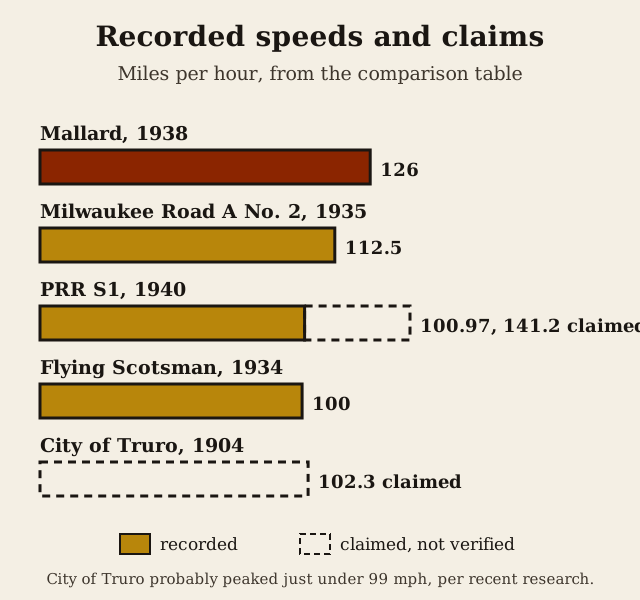
On a documented run in December 1940, the S1 reached 100.97 mph on level track while hauling a 1,350 short ton passenger train. Higher claims of up to 141.2 mph have circulated for the S1, but the railroad itself never claimed that record, which leaves those higher figures unverified rather than confirmed. The locomotive was scrapped in 1949.
Recorded speeds and claimed speeds compared
| Locomotive | Wheel arrangement | Speed | Date | Status | Source |
|---|---|---|---|---|---|
| LNER Class A4 Mallard | 4-6-2 (Pacific) | 126 mph | 3 July 1938 | Recorded | Science Museum Group / National Railway Museum |
| GWR City of Truro | 4-4-0 | 102.3 mph claimed; recent analysis suggests just under 99 mph | 9 May 1904 | Claimed, disputed | Science Museum Group / Wikipedia |
| LNER Flying Scotsman | 4-6-2 (A3 Pacific) | 100 mph | 30 November 1934 | Recorded | Smithsonian Magazine |
| Milwaukee Road Class A No. 2 | 4-4-2 (Atlantic) | 112.5 mph | 15 May 1935 | Recorded, authenticated | Wikipedia |
| PRR S1 | 6-4-4-6 (duplex) | 100.97 mph documented; up to 141.2 mph claimed, never claimed by PRR | December 1940 | Documented / higher claim disputed | Wikipedia |
Why the measuring method matters
Mallard's record rests on the LNER's dynamometer car, a dedicated instrument car that logged speed continuously on paper rolls rather than relying on a single observer with a stopwatch. City of Truro's claimed figure instead came from Charles Rous-Marten manually timing the train over an 8.8 second interval between two quarter-mile posts, a method that leaves more room for error and explains why its 102.3 mph figure has been debated for over a century. For the PRR S1, the 100.97 mph run is the documented figure; the higher numbers that later circulated were never claimed by the railroad.

Rails & Rivals, our game on Steam, is a turn-based railroad strategy board game for 2 to 6 players: each player runs a rail company, lays track across a hex map and carries goods between cities, and the wealthiest company wins. The how to play page has the rules.
Keep reading
Sources
- London & North Eastern Railway steam locomotive 'Mallard' (Science Museum Group / National Railway Museum)
- LNER Class A4 4468 Mallard (Wikipedia)
- LNER Class A4 (Wikipedia)
- 'City of Truro' Steam locomotive (Science Museum Group)
- GWR 3700 Class 3440 City of Truro (Wikipedia)
- Flying Scotsman Made Train History When Its Speedometer Hit 100 (Smithsonian Magazine)
- Milwaukee Road class A (Wikipedia)
- Pennsylvania Railroad class S1 (Wikipedia)