Steam Locomotive Types Explained: Tank, Tender, Articulated

Steam locomotives are sorted two ways: by job, such as switcher, passenger, or freight engine, and by design, such as tank versus tender, articulated versus rigid-frame, and simple versus compound expansion.
Tank engines vs tender engines
The first split is where a locomotive keeps its water and fuel. A tender engine pulls a separate car, the tender, loaded with coal or oil and water, which lets it run long distances between stops. A tank engine carries everything on its own frame, so it is shorter and can run equally well in either direction, but it has to take on water more often. That made tank engines the usual choice for yard work, short branch lines and industrial sites.
A tank engine carries its water in a tank mounted on top of the boiler, rather than on a separate tender car hooked on behind the engine, and that arrangement is where the type takes its name. Whyte notation marks the difference directly in writing: a trailing "T", as in 0-4-0T, indicates a tank engine rather than a tender locomotive, so the wheel arrangement alone tells a reader which kind of locomotive is being described. Frederick Methvan Whyte worked as a mechanical engineer for the New York Central Railroad, and in December 1900 he devised the system to classify locomotives by their wheels; our Whyte notation chart explains how to read it.
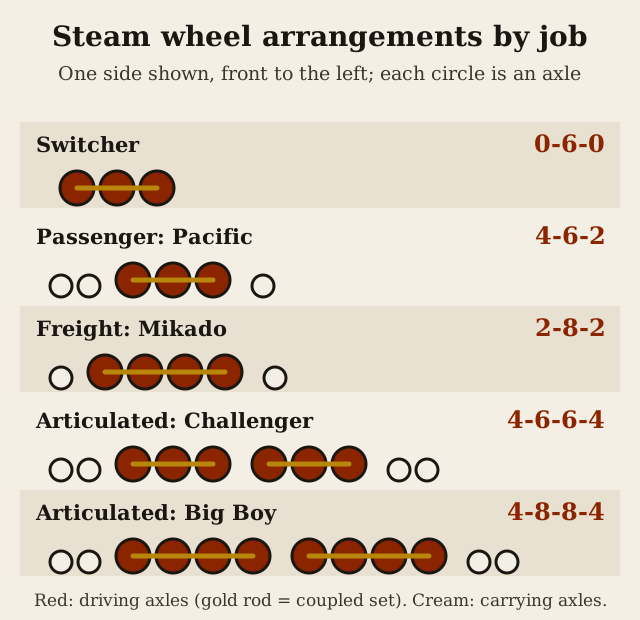
Switcher locomotives
A switcher, called a shunter in Britain, moves cars around a yard: it sorts them, builds trains and breaks them up again. Speed hardly matters in that work, so switchers usually have small driving wheels and no leading or trailing wheels at all, which puts the whole weight of the engine on the drivers for grip. An 0-6-0, with six coupled driving wheels and nothing else, is the classic layout.

The USRA 0-6-0 was the standardized light switcher locomotive issued when the United States government took control of the railroads during World War I, and 255 of these locomotives were built under that government control. Union Pacific switcher No. 4466, an 0-6-0 built by Lima, joined the California State Railroad Museum collection in 1978 and was put on static display there. At the very small end, the Steamtown collection includes a tiny industrial switcher built in 1937 by the H.K. Porter Company for the Bullard Company.
Passenger locomotives
Passenger engines were built for speed. They have large driving wheels, so each turn of the wheels covers more ground, and a leading truck of small wheels in front to guide the engine steadily into curves at speed. The 4-6-2 Pacific became one of the classic passenger layouts; the LNER's Mallard, holder of the steam speed record, is a Pacific too, as told in our article on the fastest steam locomotives.
Southern Railway No. 1401 is a 4-6-2 "Pacific" type passenger locomotive built by the American Locomotive Company in July 1926.
No. 1401 has been on permanent static display at the Smithsonian's National Museum of American History since 1964, where it stands as the sole survivor of the Southern Railway's Ps-4 class.

Freight locomotives
Freight engines trade speed for pulling power. They use smaller driving wheels and more of them, coupled together, to spread a heavy engine's weight over many axles and start long, heavy trains. Layouts such as the 2-8-0 and 2-8-2 were common on American freight lines, and the largest freight engines became articulated, as described below.

Steamtown's oldest locomotive is a freight engine made for the Chicago Union Transfer Railway Company; the American Locomotive Company built it in 1903.
Union Pacific's Challenger, an articulated 4-6-6-4 type, worked mostly in freight service, although the Portland Rose and some other passenger trains had a few of them assigned. Challengers carried 69-inch driving wheels, a size normally reserved for passenger locomotives rather than freight engines, and 105 of them were built in five classes.
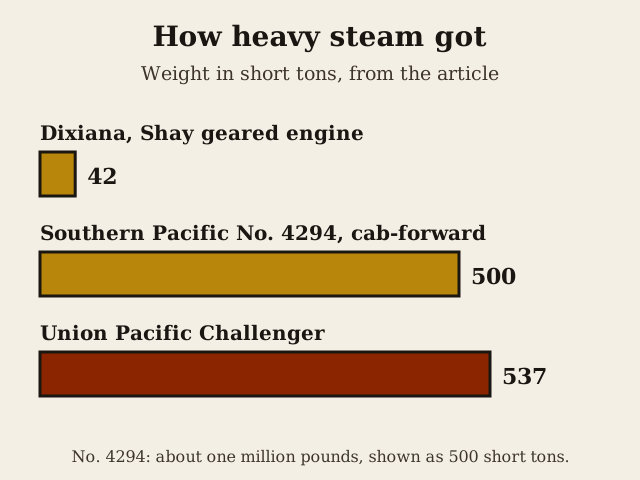
Challenger-class engines were enormous by the standards of switcher and passenger locomotives alike: a single Challenger was nearly 122 feet long and weighed 537 short tons.
Articulated locomotives: Mallet and Garratt
Swiss engineer Anatole Mallet (1837 to 1919) invented the Mallet locomotive, a compound articulated type of steam locomotive. In a Mallet, exhaust steam from the rear high-pressure cylinders is fed into a low-pressure receiver and then sent on to low-pressure cylinders that power the swiveling front engine unit, so the same steam does work twice before it escapes.

Baltimore and Ohio Railroad No. 2400, which the American Locomotive Company built in 1904, was the first Mallet locomotive in the United States. Norfolk & Western's compound Mallet No. 2156, a Y6a 2-8-8-2, was a massive freight engine that moved heavy coal trains across the Blue Ridge Mountains in Virginia and West Virginia until 1960. Its articulated design let the locomotive operate on tracks with tighter curves by allowing its two sets of drive wheels to split and turn independently of each other.
Herbert William Garratt took a different route to the same curve problem, slinging the boiler between two separate pivoting engine units so the locomotive could negotiate very tight bends. Garratt received his full UK patent for the design in June 1909, and Beyer, Peacock & Co. became the sole agent to build and sell Garratt locomotives after recognizing the merit of the layout.
Compound vs simple expansion: the Mallet and the Big Boy
Compound expansion, used on the Mallet above, means the same steam does two jobs: it drives the rear high-pressure cylinders first, and the exhaust steam is then sent on to drive the low-pressure cylinders that power the swiveling front engine unit, before it is finally exhausted. Simple expansion means steam passes through each cylinder only once, and Union Pacific's Big Boy shows the difference clearly: it was articulated like a Mallet locomotive but lacked the Mallet's compounding, since its steam was used only once rather than twice.

The American Locomotive Company completed 20 Big Boys in 1941 and five more in 1944, for a total production run of 25, with the 4-8-8-4 wheel arrangement built to haul freight over Utah's Wasatch Range between Ogden and Green River, Wyoming.
Geared locomotives for logging and mining
A geared locomotive used small, high-speed steam engines connected through gearing down to axles on four-wheel trucks, a setup suited to slow, heavy hauling with high tractive effort on the rough and temporary track of the lumber and mineral industries. The Shay, the Climax and the Heisler were the best known geared designs.
From about 1890 to 1960, geared logging locomotives pulled heavy loads over difficult terrain, until highway trucks took over the job.
The Dixiana illustrates the type well: a 42-ton, two-truck Shay built by Lima in 1912, it served on six shortline railroads in the Smoky Mountains over the course of its working life.

Comparing size across types
Put side by side, these locomotives show how widely steam power ranged in scale. The California State Railroad Museum's own collection makes the point directly: alongside its smaller switcher No. 4466, the museum holds the million-pound articulated cab-forward Southern Pacific No. 4294 as its largest engine. The 42-ton Dixiana Shay sits closer to the small end of that range too, built for logging work rather than the heavy main-line hauling of the Challenger or the Big Boy.
Where to see these locomotives
Several of the locomotives described above are preserved and open to visitors. Southern Railway No. 1401 stands on permanent display at the Smithsonian's National Museum of American History. Union Pacific switcher No. 4466 and Southern Pacific's No. 4294 are both part of the California State Railroad Museum's collection of 19 steam locomotives dating from 1862 to 1944.

Rails & Rivals, our game on Steam, is a turn-based railroad strategy board game for 2 to 6 players: each player runs a rail company, lays track across a hex map and carries goods between cities, and the wealthiest company wins. The how to play page has the rules.
Keep reading
Sources
- Whyte Steam Locomotive Classification System (Travel Town Museum (Los Angeles))
- Roster of Rolling Stock (National Park Service, Steamtown National Historic Site)
- USRA 0-6-0 (Wikipedia)
- Union Pacific 4466 (Wikipedia)
- Locomotive Collection (California State Parks / California State Railroad Museum)
- Southern Railway 1401 (Wikipedia)
- Union Pacific Challenger (Wikipedia)
- Mallet locomotive (Wikipedia)
- Norfolk and Western 2156 (The National Museum of Transportation, St. Louis)
- Herbert William Garratt 1864-1913 (Science Museum Group)
- Union Pacific Big Boy (Wikipedia)
- Geared Locomotives of Heisler, Shay, Climax - Engineering Landmark #134 (ASME (American Society of Mechanical Engineers))