Union Pacific Big Boy 4-8-8-4: History, Survivors, No. 4014

The Union Pacific Big Boy is a class of 25 articulated 4-8-8-4 steam locomotives built by the American Locomotive Company (ALCO) between 1941 and 1944 to haul freight over the Wasatch Range without helper engines. They were the heaviest reciprocating steam locomotives ever built. Eight survive, and one, No. 4014, was restored in 2019 and is the largest operating steam locomotive in the world.
Why Union Pacific Built the Big Boy
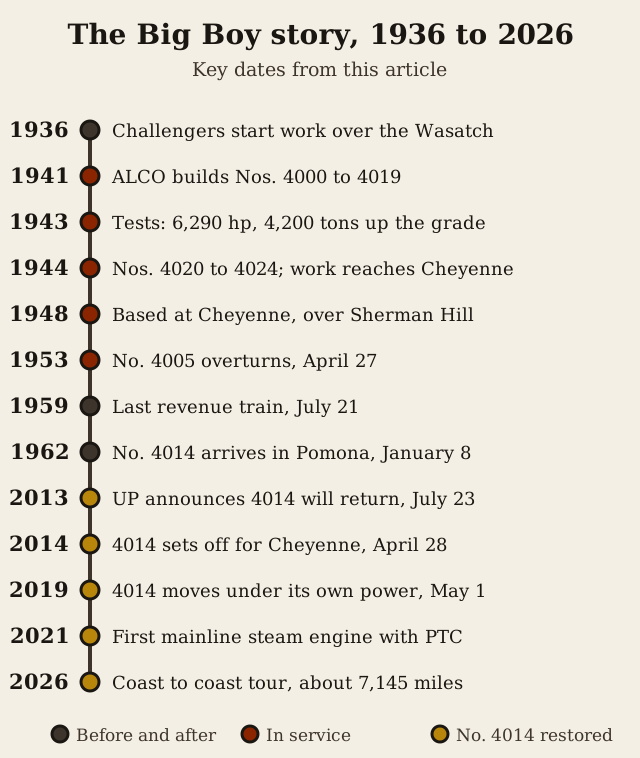
In 1936 Union Pacific put its new 4-6-6-4 Challenger locomotives to work on the main line over the Wasatch Range between Green River, Wyoming, and Ogden, Utah. For most of that route the grade was no steeper than 0.82 percent in either direction, but the eastbound climb out of Ogden into the mountains reached 1.14 percent. A 3,600 ton freight train needed two engines at the front or extra helper locomotives to get up it, which slowed everything down. Union Pacific decided it wanted one locomotive that could do the job alone.

Under the instruction of company president William M. Jeffers, a design team led by Otto Jabelmann, head of research and mechanical standards in Union Pacific's mechanical department, worked with ALCO to rethink the Challenger. They enlarged the firebox to about 150 square feet, raised the boiler pressure to 300 psi, added four more driving wheels and cut the driving wheel diameter from 69 to 68 inches. The new engine was designed to run smoothly and safely at 80 mph, although in freight service the Big Boys normally ran well below 60 mph.
The class was rumored to be named the "Wasatch" after the mountains it was built for. Instead, an unknown ALCO worker chalked "Big Boy" on the smokebox door of No. 4000, the first of the class, while it was being built, and the name stuck.
What 4-8-8-4 Means and How Big the Big Boy Is
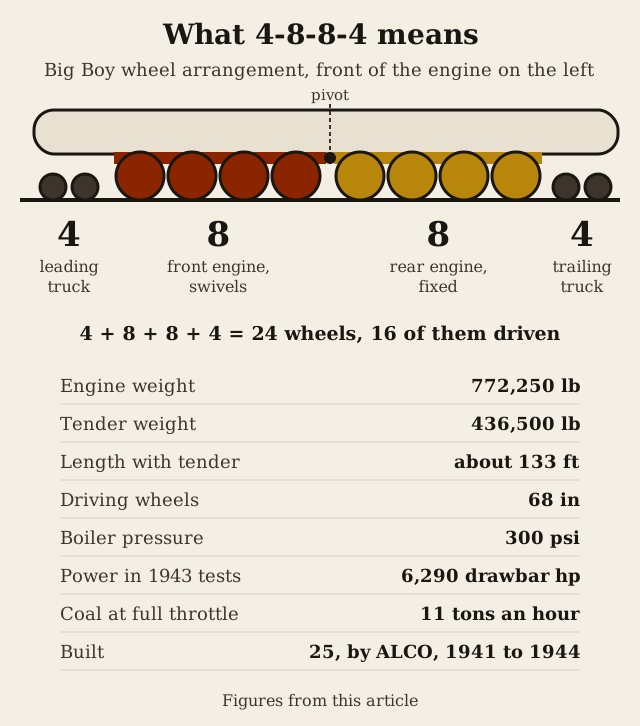
In the Whyte notation for steam locomotive wheel arrangements, 4-8-8-4 means a leading truck with four wheels to guide the engine into curves, two groups of eight driving wheels, and a trailing truck with four wheels to carry the huge firebox. Our Whyte notation guide explains the system. The Big Boys were the only locomotives ever built with this wheel arrangement.
Like a Mallet locomotive, a Big Boy is articulated: the front set of driving wheels sits on its own frame that swivels under the boiler, so the long engine can get round curves. Unlike most Mallets it is a simple expansion engine, with all four cylinders taking steam straight from the boiler. The figures are enormous:
- Weight: the engine weighs 772,250 pounds and the tender 436,500 pounds, about 1.2 million pounds together, more than a Boeing 747.
- Length: about 133 feet with the tender, with the longest engine body of any reciprocating steam locomotive, longer than two 40 foot buses.
- Pulling power: in 1943 tests a Big Boy produced 6,290 drawbar horsepower at about 41 mph, and the highest pull recorded while starting a train was 138,200 pounds force.
- Appetite: at full throttle it could burn 11 tons of coal and 12,000 US gallons of water an hour.
Chesapeake and Ohio's H-8 Allegheny locomotives of 1941 were once thought to be heavier, but later weighings put them about half a ton below the Big Boy. Our biggest steam locomotives guide compares the Big Boy with the other giants.
Built by ALCO, 1941 to 1944
ALCO built the Big Boys at its works in Schenectady, New York: 20 in 1941 (Nos. 4000 to 4019) and five more in 1944 (Nos. 4020 to 4024). They arrived just as rail traffic was surging before the United States entered the Second World War, and they played a major part in moving armaments and war materiel. Each new engine travelled from Schenectady to Council Bluffs, Iowa, over three other railroads, then went to Union Pacific's Omaha Shops to be tested and approved for service.

The railroad had to rebuild parts of its line to take them. It strengthened bridges, realigned curves for clearance, laid heavier 130 pound rail between Ogden and the Wasatch summit, and installed new 135 foot turntables at Ogden, Green River and Laramie. Cheyenne, short of space, got a 126 foot turntable on which a Big Boy barely fit.
Big Boys in Service, 1941 to 1959
The first Big Boys went to work between Ogden and Green River, the stretch with the 1.14 percent grade they had been built for. In 1944, with more Challengers and the second batch of Big Boys arriving, their territory was extended east from Green River through Rawlins and Laramie to Cheyenne. From 1948 the Challengers took over most work west of Green River, and the Big Boys were based at Cheyenne, hauling freight over Sherman Hill to Laramie and, from time to time, south to Denver and east to North Platte, Nebraska.

They did better than their design target. Built to haul 3,600 tons up the Wasatch grade, the 1943 tests showed a Big Boy could take 4,200 tons at an average of 18 to 20 mph, and on the easier parts of the route they could handle trains of about 6,000 tons.
There were a few experiments. No. 4005 was converted to burn oil in 1946, but its large single burner firebox heated unevenly and it went back to coal in 1948. No. 4007 was briefly given a single chimney and No. 4019 tried smoke deflectors; both changes were reversed. The worst day in the class's history came on April 27, 1953, when No. 4005 jumped a switch at 50 mph in southern Wyoming and overturned, killing its engineer, fireman and a brakeman. It was repaired and returned to service.
Retirement and the Diesel Takeover
Higher coal and labor costs after the war, and efficient diesel-electric locomotives, ended the Big Boys' careers. The last revenue train hauled by a Big Boy finished early on the morning of July 21, 1959. Most were then stored in working order until 1961, four of them at Green River until 1962, while EMD GP9 diesels and Union Pacific's gas turbine-electric locomotives took over their work. No. 4014 had run 1,031,205 miles; No. 4006 covered the most of any Big Boy, 1,064,625 miles.
Seventeen of the 25 were scrapped. Eight were saved and given to museums and cities, among them No. 4014, which Union Pacific donated in response to an October 1961 request from the Southern California Chapter of the Railway and Locomotive Historical Society. It arrived in Pomona, California, on January 8, 1962, and was put on display at the Los Angeles County Fairgrounds.
Where the Eight Surviving Big Boys Are Kept
Seven of the eight survivors are on static display, two indoors and five outdoors. The eighth, No. 4014, runs again.

| No. | Built | Where it is | Notes |
|---|---|---|---|
| 4004 | September 1941 | Holliday Park, Cheyenne, Wyoming | Cosmetic restoration in 2018 |
| 4005 | September 1941 | Forney Transportation Museum, Denver, Colorado | Repaired after the 1953 wreck; donated in 1970 |
| 4006 | September 1941 | National Museum of Transportation, St. Louis, Missouri | Highest mileage of the class; cosmetic restoration finished in 2024 |
| 4012 | November 1941 | Steamtown National Historic Site, Scranton, Pennsylvania | At Steamtown, USA in Bellows Falls, Vermont until 1984 |
| 4014 | November 1941 | Union Pacific, Cheyenne, Wyoming | Restored to operation in 2019 |
| 4017 | December 1941 | National Railroad Museum, Green Bay, Wisconsin | Kept indoors in a climate controlled shed |
| 4018 | December 1941 | Museum of the American Railroad, Frisco, Texas | Moved by rail from Dallas in 2013 |
| 4023 | November 1944 | Kenefick Park, Omaha, Nebraska | Only survivor from the 1944 batch; the only Big Boy known to have moved by highway |
Restoring No. 4014
Union Pacific kept steam alive after the diesel takeover: its 4-8-4 passenger engine No. 844 began running excursions in 1960, and Challenger No. 3985 joined it in 1981. When No. 3985 was taken out of service in 2010, people began to ask whether a Big Boy could be brought back. In late 2012 Union Pacific said it might restore one, and on July 23, 2013, it announced a deal to take No. 4014 back from Pomona. Its boiler was in excellent condition, and the dry Southern California climate had limited rust.

Getting the locomotive out took months. It was hauled onto Metrolink tracks at Covina in January 2014, and on April 28, 2014, it set off for Cheyenne behind a diesel that shared its number, arriving at the Steam Shop in May. Work began in July 2016 under Ed Dickens, the manager of Union Pacific's heritage fleet. The crew took the boiler apart for inspection, sent the wheels to the Strasburg Rail Road in Pennsylvania for new tires and bearings, and by early 2017 the engine was completely dismantled.
The one major change was fuel: No. 4014 was converted from coal to No. 5 fuel oil, with an oil burner replacing the firebox grates. The cab lettering was changed from "MB", for the type of mechanical stoker it used to have, to "DB" for Dickens and Barker, the two men who converted it. On May 1, 2019, No. 4014 moved by its own power again, the first time it had done so in almost 60 years. One estimate put the cost of the restoration at $4 million or more.
No. 4014 on Tour Since 2019
No. 4014 made its first excursion in May 2019, in the celebrations for the 150th anniversary of the completion of the first transcontinental railroad, covered in our transcontinental railroad article. Steam operations were suspended in 2020 because of the COVID-19 pandemic, and the locomotive returned to the road in August and September 2021 with a tour through Texas, Louisiana, Arkansas and Missouri. That year it also became the first mainline steam locomotive equipped with positive train control, the safety system now required on most US main lines.

Later tours went to Omaha in June 2023 and, in 2024, to California and Ogden in the summer and through Texas, Arkansas, Kansas and Illinois in the autumn. In 2026 it made its first coast to coast tour, for the 250th anniversary of the United States: a western leg to Sacramento in April, then an eastern leg from May to July that reached Philadelphia, met Big Boy No. 4012 at Steamtown in Scranton and crossed the Horseshoe Curve in Pennsylvania. By the time it was back in Cheyenne on July 29, it had covered about 7,145 miles and made more than 75 whistle stops.

The Big Boy exists because one mountain grade cost Union Pacific a second locomotive on every heavy train, and the railroad decided a bigger engine was cheaper than more crews. Rails & Rivals, our game on Steam, is a turn-based railroad strategy board game for 2 to 6 players: each player runs a rail company, lays track across a hex map and carries goods between cities, and the wealthiest company wins. The how to play page has the rules.
Keep reading
Sources
- History of the Union Pacific Big Boy No. 4012 (National Park Service, Steamtown NHS)
- Big Boy No. 4012 Returns to Static Exhibition (National Park Service, Steamtown NHS)
- News Release: Return of Union Pacific Railroad Big Boy No. 4012 (National Park Service, Steamtown NHS)
- Big Boy No. 4014 | Union Pacific Heritage (Union Pacific Railroad)
- Union Pacific's Legendary Big Boy 4014 (Press Release) (Union Pacific Railroad)
- Big Boy Reflects Rail Tech Evolution (Union Pacific Railroad)
- "Big Boy" is the World's Largest Successful Steam Locomotive (National Museum of Transportation, St. Louis)
- Big Boy Steam Engine (WyoHistory.org (Wyoming State Historical Society))
- Big Boy Steam Locomotive Arrives at its New Home in Frisco (Museum of the American Railroad)
- Property Record: Union Pacific Big Boy No. 4017 (Wisconsin Historical Society)
- Kenefick Park (Wikipedia)
- 4-8-8-4 (Wikipedia)
- Union Pacific Big Boy (Wikipedia)
- Union Pacific 4014 (Wikipedia)