Whyte Notation Chart and Guide to Locomotive Wheels

Whyte notation is a simple shorthand for describing a steam locomotive's wheel arrangement: it counts the leading wheels, then the driving wheels, then the trailing wheels, with the numbers separated by dashes. A locomotive with two leading axles, three driving axles and one trailing axle is written 4-6-2, since each axle carries two wheels. The system was proposed in 1900 and is still used today across North America and the United Kingdom to classify steam locomotives.
How the counting actually works
The core rule is straightforward. Start at the front of the locomotive and count the undriven leading wheels. Then count the coupled driving wheels. Finally, count the undriven trailing wheels at the back, with a dash separating each group.
Wikipedia's own worked example shows this in practice: a locomotive with two leading axles (four wheels) in front, three driving axles (six wheels) in the middle, and one trailing axle (two wheels) at the back is classified as a 4-6-2.
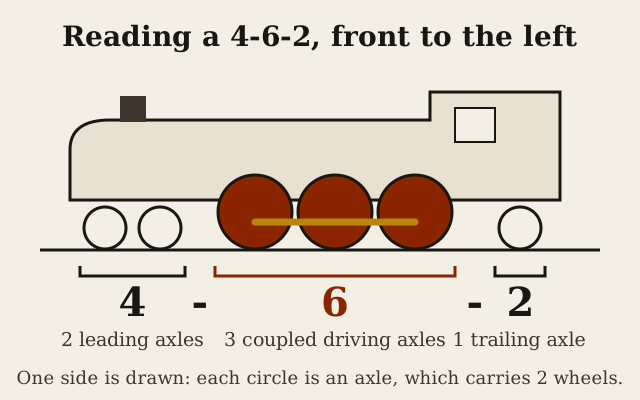
One wrinkle trips people up the first time they read a chart: if the driving wheels on a locomotive are not coupled to each other, each pair has to be written out separately rather than added together into one number.
Whyte notation chart
Each diagram is drawn from the notation itself: small circles are leading and trailing wheels, filled circles are driving wheels, and the front of the locomotive is on the left. One side is shown, so each circle stands for a pair of wheels.
Read any notation in 3 steps
- Find the first number. That is how many wheels sit on the leading, unpowered axles at the front of the locomotive.
- Find the middle number or numbers. That is how many wheels sit on the coupled driving axles. If the drivers are not coupled to each other, each pair is listed on its own instead of being combined.
- Find the last number. That is how many wheels sit on the trailing, unpowered axles at the back.
Two extra marks are worth knowing. Collections Trust's own terminology standard goes further still, noting that tank locomotives are also broken out into narrower sub-types such as ST, PT and WT, alongside the simple T suffix most readers meet first. And on simpler articulated designs such as Mallet types, the frame is jointed under one shared boiler, and there are no unpowered wheels sitting between the two sets of driving wheels, which is why their notation strings two driving groups together.

Who came up with it, and why
The system is named after Frederick Methvan Whyte, who developed it in 1900 while connected to the New York Central Railroad. Collections Trust's railway terminology standard gives the same date, describing Whyte as the American engineer who first proposed the notation in 1900.

Where Whyte notation is still used
Whyte notation came into use after a December 1900 editorial in American Engineer and Railroad Journal. Railways in North America and the United Kingdom took it up as their way of describing how a steam locomotive's wheels are laid out. For steam engines, it is the usual system across the United States, Canada, the United Kingdom and Ireland.
Most modern locomotives, multiple units and trams have moved on: in Europe the UIC system took over from Whyte notation, and in North America the AAR system did. France took its own route. There, the UIC classification is used for diesels and electrics, while steam locomotives use a scheme similar to Whyte notation but counting axles instead of wheels. Switzerland had its own separate notation system until 1989, and that Swiss classification is now only retained for its narrow-gauge railways. British practice today mostly uses a simplified form of the European UIC scheme, with one exception: small diesel shunters in Britain are still classified using Whyte notation. Once railroads moved to diesel and electric power entirely, Whyte notation stopped being the natural fit for the newer fleet: modern diesel and electric locomotives are instead described with letters for the driven axles and numerals for the carrying axles.
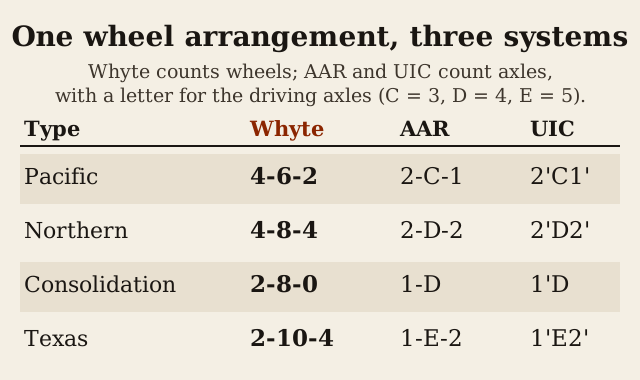
A chart of common wheel arrangements
Here are some of the arrangements you are most likely to meet in print, along with a locomotive built to each one.
| Notation | Common name | Example locomotive |
|---|---|---|
| 4-4-0 | American | The General, built 1855, and Jupiter / Union Pacific No. 119 at the Golden Spike ceremony |
| 2-6-0 | Mogul | Named after the locomotive Mogul, built 1866 |
| 2-8-0 | Consolidation | More than 23,000 built in the United States |
| 4-4-2 | Atlantic | 1894 Baldwin class for the Atlantic Coast Line |
| 2-8-2 | Mikado | Named after Japanese locomotives built by Baldwin in 1897 |
| 4-6-4 | Hudson (Baltic in France) | New York Central J-1a No. 5200, built 1927 |
| 2-10-4 | Texas (Colorado on the Burlington, Selkirk in Canada) | South African Railways Class 21, only one built, 1937 |
| 4-8-4 | Northern | Union Pacific 844 |
The 4-4-0 'American' earned its name in April 1872, when Railroad Gazette used the term for the type, and by that same year 60 percent of Baldwin's own locomotive construction was of this type, with an estimated 85 percent of all locomotives running in the United States being 4-4-0s. Rogers, Ketchum and Grosvenor built The General in Paterson, New Jersey, in 1855, and in the Great Locomotive Chase it was the engine being pursued. Jupiter and Union Pacific No. 119 used the same wheel arrangement at the Golden Spike ceremony. Both original locomotives were eventually scrapped for a fee of $1000 each, though working replicas were built by O'Connor Engineering Laboratories and entered service on the ceremony's 110th anniversary, May 10, 1979.

The 2-6-0 'Mogul' probably got its name from an 1866 engine named Mogul, which the Taunton Locomotive Manufacturing Company built for the Central Railroad of New Jersey. American builders turned out large numbers of the type from the early 1860s until the 1920s.
The 2-8-0 'Consolidation' took its name from the locomotive that originated the type, and after 1875 it became the most popular freight wheel arrangement in the United States. Total American production passed 23,000 locomotives, with 12,000 of those built for export.
The 4-4-2 'Atlantic' takes its name from a class built by the Baldwin Locomotive Works in 1894 for the Atlantic Coast Line, but a tank-engine version of the same wheel arrangement actually came first: William Adams designed the 1 Class 4-4-2T in the United Kingdom in 1880.
The 2-8-2 'Mikado' has an unusual naming history. It was named after Japanese type 9700 locomotives built by Baldwin for the Nippon Railway of Japan in 1897. During the Second World War, American railroads renamed the type MacArthur, after General Douglas MacArthur, and Mikado only became the common name again after the war ended. In Japan itself, the Class D51 2-8-2 reached 1,115 units, the most of any single locomotive class built in that country.
The 4-6-4 is known as the Hudson in the United States, named after the Hudson River, while the same type originated in France, where it is called the Baltic. The first American Hudson, New York Central's J-1a No. 5200, was built in 1927 by the American Locomotive Company.
The 2-10-4 goes by different names depending on where it ran: Texas type across most of the United States, Colorado type on the Burlington Route, and Selkirk type in Canada. South African Railways built only one example of its Class 21 version, completed in 1937.
The 4-8-4 'Northern' was first used by, and initially named after, the Northern Pacific Railway. Canadian National purchased its 4-8-4s in 1927, the 60th anniversary of Canada's confederation, and named them Confederation for that reason. One 4-8-4, Union Pacific 844, holds a distinction of its own: among North American Class I railroads, it is the only steam locomotive that has never been retired.

Tank engines and articulated giants
Not every locomotive fits neatly into a three-number string.
Articulated locomotives push the notation further still. Herbert William Garratt, a British locomotive engineer, invented the articulated design that carries his name and was granted patent no. 12079 for it. Garratt locomotives were used in Africa, Asia, Australia, Europe and South America, but no Garratts were ever used on North American railroads. The most powerful of them all was East African Railways' 59 class. It produced 83,350 pounds of tractive effort, double the figure for a British Railways Class 9F 2-10-0. The world speed record for an articulated locomotive belongs to a French-built Garratt of Algerian Railways, which reached 132 kilometres per hour, about 82 mph.

What happened as steam gave way
Once railroads moved to diesel and electric power, Whyte notation stopped being the natural fit, part of the broader shift to the UIC and AAR systems covered earlier.
Steam locomotives, though, are still remembered by their Whyte notation, and one of the most famous is a 4-6-2. The LNER Class A4 Pacific Mallard was designed by Sir Nigel Gresley and built at Doncaster in 1938. On 3 July 1938, during a series of brake tests, Mallard reached 126 mph at Stoke Bank, a speed record for steam traction that still stands.

Rails & Rivals, our game on Steam, is a turn-based railroad strategy board game for 2 to 6 players: each player runs a rail company, lays track across a hex map and carries goods between cities, and the wealthiest company wins. The how to play page has the rules.
Keep reading
Sources
- Whyte notation (Wikipedia)
- Railway Object Name Thesaurus - Wheel Arrangement (Collections Trust (MDA))
- Frederick Methvan Whyte (Wikipedia)
- Wheel arrangement (Wikipedia)
- 4-4-0 (Wikipedia)
- Everlasting Steam: The Story of Jupiter and No. 119 (National Park Service - Golden Spike National Historical Park)
- 2-6-0 (Wikipedia)
- 2-8-0 (Wikipedia)
- 4-4-2 (locomotive) (Wikipedia)
- 2-8-2 (Wikipedia)
- 4-6-4 (Wikipedia)
- 2-10-4 (Wikipedia)
- 4-8-4 (Wikipedia)
- Garratt (Wikipedia)
- London & North Eastern Railway steam locomotive 'Mallard' (Science Museum Group)