Why Is Standard Gauge 4 ft 8.5 in? Myth vs Record

Standard gauge is 4 feet 8.5 inches because that is the gauge George Stephenson used on the Stockton and Darlington Railway in 1825, a width inherited from the Killingworth Wagonway where he worked, not from Roman war chariots. The Roman chariot story is a popular internet legend with no supporting evidence. Stephenson's gauge was later widened and formally adopted as "standard gauge" on Britain's major lines, and more than half of the world's railway track still runs on it today.
The Roman chariot myth
Online, the explanation repeated most often is that the 4 feet 8.5 inch standard gauge of United States railroads traces back to the original specification for an Imperial Roman war chariot. As the tale is usually told, Roman war chariots were built just wide enough for the rear ends of two war horses. Those chariots wore the first ruts into roads across the empire, and anyone building wheeled vehicles later had to match that spacing or risk wrecking their wagon wheels. The same width was supposedly passed on to British tramways and then to railways. Versions of this claim have circulated for decades and even appear preserved on a university course page as an example of a persistent, uncited internet legend.

The problem is that none of it holds up. Skeptoid researcher Brian Dunning rejects the whole idea that 4 feet 8.5 inches came from Roman war chariots, calling it a complete, utter and total non starter. Roman chariots served in races and parades rather than in war or everyday travel, so they never existed as standard issue equipment with one fixed wheel spacing throughout the empire. Surviving Roman road ruts do not show one consistent gauge either. Their track width was, in Dunning's words, all over the place. Separate studies of historic English wagons found substantial regional variations within extremes of about 130 and 190 centimeters, with no standard width at all. At Pompeii and Herculaneum, one measured rutway is roughly four foot nine from center to center, with a gauge of perhaps four foot six. That puts it in the same general range as a rail gauge, but nothing documents it as the ancestor of one.
Where a kernel of truth actually sits
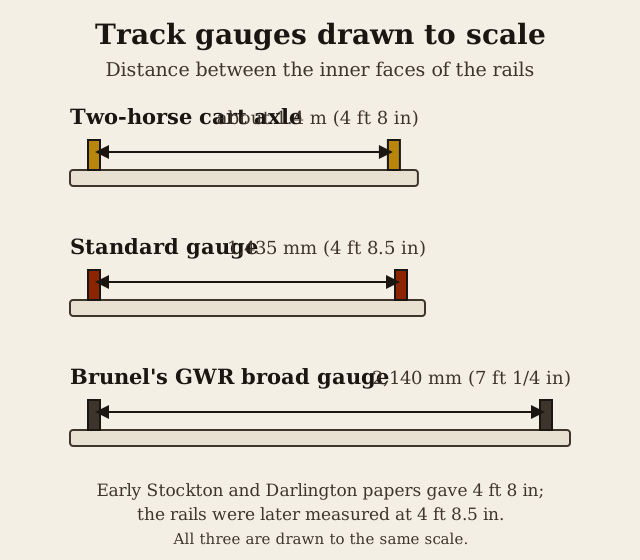
There is a genuine, much more mundane ancestor behind the rough 4 foot 8 inch family of measurements, and it has nothing to do with chariots. One traditional derivation used by wagon and cart builders started from a total wagon width and subtracted four inches for the rails themselves, so that five feet minus four inches equals four foot eight. The more practical ancestor is simpler still: a cart axle pulled by two horses in harness comes out to about 1.4 meters, or 4 feet 8 inches. That is a working dimension shaped by horse anatomy and cart building practice, not a borrowed Roman military standard, and it is the kind of ordinary cart and wagon gauge that was already common in parts of Britain before railways existed.
George Stephenson and the Killingworth Wagonway
The person actually responsible for carrying a roughly 4 foot 8 inch gauge into railway history is George Stephenson, an engineer born in 1781 in Wylam, Northumberland, who died in 1848 and is remembered today as the father of the railways. Stephenson first proved himself as an engineer in 1811 when he fixed the pumping engine at High Pit, Killingworth, and he went on to develop a working steam locomotive on the Killingworth Wagonway, where he was employed. His locomotive Blucher was the first to use flanged wheels running on smooth iron rails, and he is credited with building 16 locomotives at Killingworth before taking on his best known project. The Killingworth Railway itself is identified as one of the first lines built to the roughly 4 foot 8 inch gauge that preceded standard gauge, which meant Stephenson arrived at his next job already committed to a specific track width through direct hands on experience, not through any inherited Roman specification.

The Stockton and Darlington Railway
A parliamentary bill authorizing the Stockton and Darlington Railway passed in 1821, and the project's first iron rail was laid on 23 May 1823. The completed 26 mile line opened on 27 September 1825, built to the gauge Stephenson had used at Killingworth. The line was originally planned for horse-drawn carriages, and that plan for horse-drawn vehicles directly shaped the track dimensions Stephenson chose. Early S&DR documents recorded the gauge as 4 feet 8 inches, but the distance between the rails was later measured as 4 feet 8.5 inches, and the half inch difference between the two figures is, in the words of one source, a mystery that has never been fully explained. Whatever the reason for that small discrepancy, Stephenson's chosen gauge for the Stockton and Darlington Railway is the gauge that subsequently came to be adopted as the standard gauge for railways around the world, and Network Rail draws a direct line from the original horse cart based design to the 4 foot 8.5 inch standard still used today.

A rival gauge: Brunel's broad gauge
Standard gauge did not win out everywhere immediately. Isambard Kingdom Brunel, born on 9 April 1806 in Portsea, Portsmouth, the third child and first son of Sir Marc Isambard Brunel, was appointed Engineer to the Great Western Railway in 1833. Brunel's 1838 design for the GWR used a gauge of 7 ft 1/4 in (2,140 mm), deliberately broader than the conventional 4 foot 8.5 inch narrow gauge used elsewhere in Britain, and the GWR kept that broad gauge until 1892. For years the two systems ran side by side, until 1845, when a Gauge Commission rejected the broad gauge for new lines, effectively settling the national argument in favor of Stephenson's narrower track. Britain's broad gauge lines were then progressively converted to dual gauge or standard gauge from 1864, and the very last stretch of Brunel's broad gauge was converted over a single weekend in 1892. Brunel did not live to see that final conversion. He died on 15 September 1859 at the age of fifty three.

From Liverpool and Manchester to the rest of the world
The gauge's spread beyond the Stockton and Darlington line came quickly. The Liverpool and Manchester Railway, the first intercity line, opened in 1830 using the same basic gauge, and it was on routes like this one that the gauge was widened to 4 feet 8.5 inches and formally named "standard gauge," well on its way to becoming the established norm. British railway technology, and with it standard gauge, was then exported to European countries and to parts of North America as railway building spread internationally.
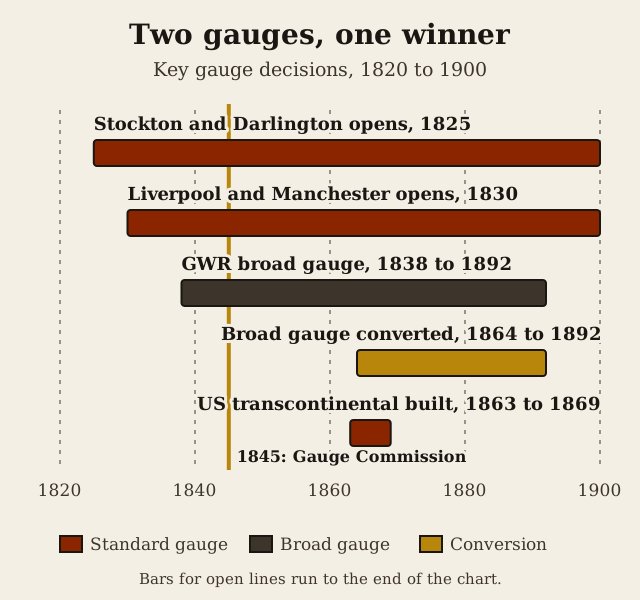
In the United States, Abraham Lincoln signed the Pacific Railroad Act in 1862, and it authorized a railroad and telegraph line running from the Missouri River to the Pacific Ocean. Construction of that line began with the Central Pacific's groundbreaking in Sacramento, California, on 8 January 1863, and the first transcontinental railroad, built to the 4 foot 8.5 inch standard gauge, was completed between 1863 and 1869, creating a transcontinental transportation network. The choice to build that enormous, continent spanning project on Stephenson's gauge rather than any rival width helped cement standard gauge's dominance in North America. Today, more than half of the world's railway lines are built to the 1,435 millimeter, or 4 foot 8.5 inch, standard gauge.
Timeline: myth vs record
- 1811: Stephenson fixes the pumping engine at High Pit, Killingworth, establishing his reputation as an engineer.
- 1821: Parliament passes the bill authorizing the Stockton and Darlington Railway.
- 1823: The S&DR's first iron rail is laid, on 23 May.
- 1825: The Stockton and Darlington Railway opens on 27 September, built to Stephenson's roughly 4 foot 8 inch gauge.
- 1830: The Liverpool and Manchester Railway opens, and the gauge is widened and named "standard gauge" at 4 feet 8.5 inches.
- 1833 to 1838: Brunel is appointed engineer to the Great Western Railway and designs it to a rival 7 ft 1/4 in (2,140 mm) broad gauge.
- 1845: A Gauge Commission rejects the broad gauge for new British lines.
- 1862 to 1869: The Pacific Railroad Act is signed and the first US transcontinental railroad is built to standard gauge.
- 1892: The last of Brunel's broad gauge track in Britain is converted to standard gauge over a single weekend.

None of these dated, documented steps involve a Roman chariot. They involve a pumping engine repair, a parliamentary bill, an iron rail laid by hand, and decades of competing engineering decisions that eventually settled on one width. Stephenson's own path shows how ordinary that process was: he went from fixing a single pumping engine in 1811 to building 16 locomotives at Killingworth, using that hands on experience to fix the gauge for an entirely new kind of railway rather than inheriting it from antiquity. Brunel's broad gauge shows the same thing from the losing side, a carefully engineered 7 ft 1/4 in alternative that coexisted with standard gauge for decades before a parliamentary commission, not an ancient road rut, decided the outcome.

Rails & Rivals, our game on Steam, is a turn-based railroad strategy board game for 2 to 6 players: each player runs a rail company, lays track across a hex map and carries goods between cities, and the wealthiest company wins. The how to play page has the rules.
Keep reading
Sources
- Railroads, Romans and the Space Shuttle (Nevada Northern Railway)
- George Stephenson: The Father of Railways (Stockton-on-Tees Borough Council Heritage)
- George Stephenson (1781-1848) (Network Rail)
- Episode 818: Chariots, Horse's Asses, and Space Shuttles (Skeptoid (Brian Dunning))
- Was standard railroad gauge (4'8½") determined by Roman chariot ruts? (The Straight Dope)
- How Specs Live Forever (University of North Carolina at Chapel Hill, Dept. of Computer Science)
- Track gauge (Wikipedia)
- Pacific Railroad Acts (Wikipedia)
- Isambard Kingdom Brunel 1806-1859 (Science Museum Group)
- Broad-gauge railway (Wikipedia)
- 4 ft 8 in gauge railways (Wikipedia)
- Utah: Golden Spike National Historic Site (U.S. National Park Service)