Brunel's Broad Gauge and the Great Western Railway

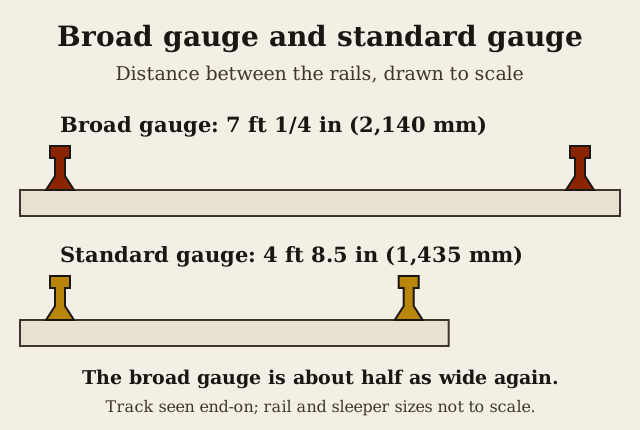
Isambard Kingdom Brunel's broad gauge was a 7 ft, later 7 ft 1/4 in (2,140 mm), track gauge that Brunel chose for the Great Western Railway, the line he was appointed to engineer in 1833 between Paddington station in London and Temple Meads in Bristol. Brunel believed a wider track than the conventional narrow gauge of 4 ft 8.5 in used by earlier railways would allow large wheels outside the bodies of the rolling stock and give smoother running. Broad gauge trains ran on the Great Western Railway from 1838 until the last broad gauge lines were converted to standard gauge over one weekend in May 1892.
Brunel's appointment and the Great Western Railway Act, 1833 to 1835
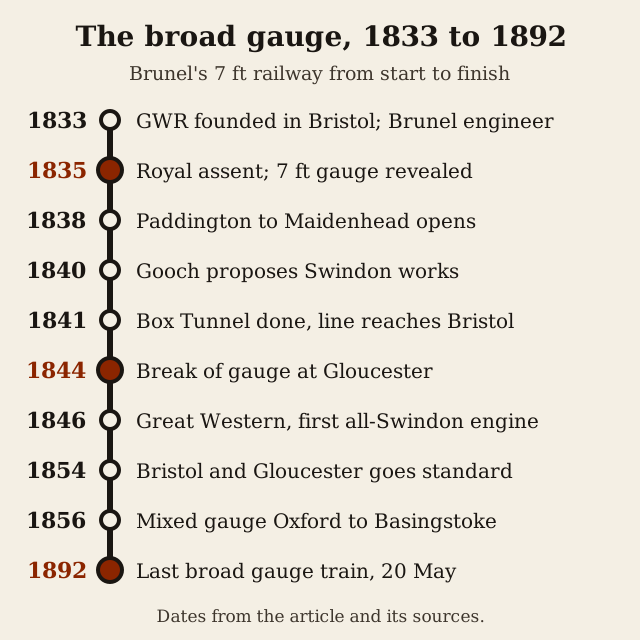
The Great Western Railway was founded at a meeting in Bristol on 21 January 1833. Brunel, then aged 27, was appointed engineer on 7 March 1833. William Townsend, whose only earlier experience was on Bristol tramways, initially shared the role with him at the company's direction. The company tasked Brunel, on 7 September 1833, with carrying out a second, more thorough survey and completing the purchase of the land. The company's bill was submitted to Parliament in November 1833. Of the forty-two days of discussion, Brunel was called to testify on eleven. The House of Lords struck the bill down on 25 July 1834 after opposition from landowners, settlements and rival railway companies. The bill finally passed and received royal assent on 31 August 1835, and this Act of Parliament created the Great Western Railway. In December 1835 the company abandoned a plan to share the London and Birmingham Railway's London terminus and chose to build its own station at Paddington, then merely a village on the outskirts of London.
Why Brunel chose the 7 ft broad gauge
Brunel chose to adopt a broader gauge than earlier railways, so the Great Western Railway was built on a gauge of 7 ft instead of the conventional narrow gauge of 4 ft 8.5 in. Brunel thought the broad gauge would give extra speed and comfort. While revising the company's bill, Brunel had any stipulation of gauge removed from it without telling the directors. Brunel revealed the change of gauge to the directors in September 1835, after the bill had received royal assent. The directors gave their approval in October 1835. The gauge was later widened slightly to 7 ft 1/4 in (2,140 mm). In laying the rails, an extra quarter of an inch was allowed on the straight, but the gauge was always referred to as 7 feet. Brunel also selected a route north of the Marlborough Downs, which allowed for gentler gradients and therefore higher speeds. From London the route ran west to Reading, then swept north before returning to an east-west alignment at Bath.
Building the line from Paddington to Bristol, 1838 to 1841
The company had made public in August 1837 its plan to open the line by November, a target that was not met. A private ceremony for the GWR's directors and others was held on 31 May 1838, when the first train, North Star, ran on the line between Paddington and Maidenhead. The first stretch of line, from Paddington station to Maidenhead Bridge station, opened on 4 June 1838. The board rejected Brunel's design for Reading railway station in April 1839 because of its scale. Bristol Temple Meads was also scaled back later in 1839. The full line to Bristol Temple Meads opened in 1841 on completion of Box Tunnel. Once the complete route was open, trains ran 152 miles (245 km) from Paddington through to Bridgwater, using the Bristol and Exeter Railway beyond Bristol.

Swindon, Daniel Gooch and the broad gauge locomotives
Daniel Gooch became the first locomotive superintendent of the Great Western Railway in 1837, working under Brunel. Gooch suggested in a letter to Brunel on 13 September 1840 that they should build a locomotive works at Swindon, since the company was running out of space at Paddington. Gooch went on to establish the GWR's locomotive works at Swindon. In 1840, Gooch designed the original Fire Fly locomotive so it could operate on the Bristol to London route of Brunel's broad gauge Great Western Railway. When new, the Firefly class engines handled the principal trains from London to Bristol. Firefly class engines could haul trains weighing 80 tons at speeds up to 60 mph. One Firefly class locomotive hauled the first royal train, carrying Queen Victoria from Slough to London, in 1842. The Premier class 0-6-0 goods engines, introduced from February 1846, were the first locomotives built at Swindon, although their boilers were supplied to the company. The Iron Duke class, also designed by Gooch, handled all the fastest trains on the GWR until 1892. Its prototype, Great Western, built in 1846, was the first locomotive entirely constructed at the company's Swindon Works. Iron Duke class locomotives were used to haul the Flying Dutchman express train. GWR locomotives, many of them built in the company's own Swindon workshops, were painted a middle chrome green colour. In 1864 Gooch was succeeded by Joseph Armstrong, some of whose designs were built as either broad or standard gauge just by fitting different wheels.

Break of gauge and mixed gauge track, 1844 to 1856
In 1844 the broad gauge Bristol and Gloucester Railway opened, but Gloucester was already served by the standard gauge lines of the Birmingham and Gloucester Railway. The resulting break of gauge forced all passengers and goods travelling between the south-west and the North to change trains. This was the beginning of the gauge war, covered in our piece on why standard gauge won. The broad gauge spread into Wales, carried by Brunel's influence through the South Wales Railway, where he took up the post of Chief Engineer in 1844. As the Great Western's network expanded, the company had increasing problems transshipping goods onto what it called the narrow gauge of the other railways. In 1846 the Bristol and Gloucester line was bought by the Midland Railway, which converted it to standard gauge in 1854. That conversion brought mixed gauge track, with three rails, to Temple Meads station so that trains could run on either gauge. The GWR's own line north of Oxford had been built with mixed gauge. At the end of 1856, this mixed gauge extended south from Oxford to Basingstoke, which meant goods could travel through from northern England down to the south coast without being transshipped.

The end of broad gauge in 1892 and after
The Cornishman, the last broad gauge train running through to Penzance, departed from Paddington station on 20 May 1892. Over the following weekend, 171 miles of route, 42 miles of it double track, were converted from broad to standard gauge. Over that weekend, the 4,200 platelayers, labourers and others brought in for the job slept in tents, goods sheds and waiting rooms. The conversion cost around £800,000, equivalent to around £108,000,000 at 2021 values. Standard gauge locomotives were running trains out of Penzance by the Monday that followed. Great Western Railway Chairman Frederick Saunders had announced in August 1891 that all remains of the broad gauge system would come to an end. The Times newspaper commented on that announcement:
in the abstract the broad gauge was a magnificent conception worthy of the brilliant genius and uncompromising originality of Brunel; but, practically and commercially it was a failure as has long been acknowledged.
After 1892, with the burden of running trains on two gauges removed, the Great Western Railway turned its attention to building new lines and shortening its previously circuitous routes. What happened next is told in Great Western Railway history, 1892 to 1948.


Rails & Rivals, our game on Steam, is a turn-based railroad strategy board game for 2 to 6 players: each player runs a rail company, lays track across a hex map and carries goods between cities, and the wealthiest company wins. The how to play page has the rules.
Keep reading
Sources
- Isambard Kingdom Brunel 1806-1859 (Science Museum Group)
- Brunel's Broad Gauge Railway (Great Western Society / Didcot Railway Centre)
- Great Western Railway (Wikipedia)
- Great Western Railway 1835-1948 (Science Museum Group)
- Broad Gauge Railway (Great Western Society / Didcot Railway Centre)
- Daniel Gooch 1816-1889 (Science Museum Group)
- The End of the Great Western Railway's Broad Gauge (Friends of the National Railway Museum)
- Isambard Kingdom Brunel (Wikipedia)
- GWR Iron Duke class (Wikipedia)
- GWR Premier Class (Wikipedia)