Railway Mania: Britain's 1840s Railway Bubble Explained

During the 1840s, Britain went through a railway share bubble now known as Railway Mania, in which rising railway share prices drew in more and more speculators until the market collapsed. The mania peaked in 1846: 263 Acts authorising new railway companies were passed that year, though about a third of the schemes authorised during the mania were never actually built.
The National Railway Museum's own review of the parliamentary paperwork agrees, dating the mania's peak to 1846 as well, when more than 200 new railway schemes won Acts of Parliament.
What caused the railway boom of the 1830s and 1840s
By the mid-1840s the economy was improving and manufacturing industries were growing again. The Bank of England cut interest rates during this recovery, making government bonds less attractive, while shares in existing railway companies began to boom as those companies moved ever-increasing amounts of cargo and people, making investors willing to back new lines.

The Bubble Act, which had once sharply curbed how new companies and joint-stock ventures could be formed, was repealed by the government in 1825, and by the 1840s railway shares could be bought for a 10% deposit. Officials favoured a light-touch, laissez-faire approach to the railways: a company first needed Parliament's approval, via a bill, before it could purchase land and have its planned route signed off, yet nothing capped how many such companies could come forward, nor was there any real scrutiny of whether a line made financial sense. Anyone could form a company, gain investment and submit a bill, and many Members of Parliament were themselves heavy investors in such schemes: contemporary accounts counted no fewer than 157 MPs among the subscribers to new railway companies, for sums ranging from £291,000 downwards. Observers at the time summed up the fervour with the cry 'Shares! shares!', noting that whether the underlying projects could ever succeed seemed to matter very little to buyers caught up in the rush.
William Gladstone, then President of the Board of Trade, tried to bring the boom under some control with the Railway Act of 1844, which among other things required every company to run one cheap "Parliamentary" passenger train a day along its line at a penny a mile.
How many miles of railway Parliament authorised
Parliament's output of railway Acts can be tracked year by year. In the 1844 session, 805 miles of new line were sanctioned, rising to 2,700 miles in 1845 as the mania accelerated. It reached its peak in 1846, when 263 Acts of Parliament for new railway companies were passed. Official figures for miles of railway actually opened show a separate pattern: 196 miles opened in 1844, 293 miles in 1845, 595 miles in 1846 and 780 miles in 1847, added to the 1,952 miles that had already opened before 1843.
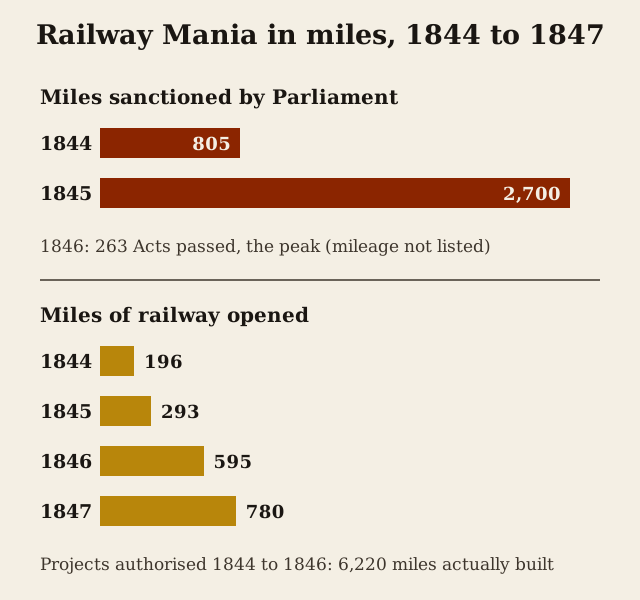
| Year | Miles sanctioned by Parliament | Miles of railway opened |
|---|---|---|
| 1836-37 | Over 1,500 miles (59 new railways) | not listed |
| 1844 | 805 miles | 196 miles |
| 1845 | 2,700 miles | 293 miles |
| 1846 | 263 Acts passed (mileage not listed) | 595 miles |
| 1847 | not listed | 780 miles |
Not every authorised mile became track. Of the projects authorised between 1844 and 1846, 6,220 miles of railway line were actually built, while about a third of the schemes Parliament approved during the mania were never built at all: some companies collapsed through poor financial planning, some were bought out by larger rivals before they could lay track, and some turned out to be fraudulent enterprises set up to channel investors' money elsewhere. The scale of public participation was recorded in parliamentary paperwork: a single surviving volume of subscriber lists names over 27,000 individual shareholders who had subscribed for shares in the different railway companies.
A wider measure, covering the boom years of 1836 and 1845-1847 together, puts Parliament's authorisations even higher: 8,000 miles of line at a projected cost of £200 million, a sum that was about the same size as the country's entire annual output (GDP) at the time.
Famous investors in the railway shares boom
Charles Darwin was among the private investors buying into railway shares. In 1847 he wrote to a relative about buying shares in the Leeds and Bradford Railway, working out that around £400 would be enough to buy two shares at a price of about £50 each.
William Makepeace Thackeray invested in the railway mania as well, and lost over £500 in the process.
The Brontë sisters put money into the boom too. The sisters let Emily manage their joint railway funds, and she chose to put the money into George Hudson's fast-growing railway companies.

Charlotte Brontë grew wary of the boom well before it collapsed. In 1846 she wrote that she wished to be wise in time, saying she doubted that even the strongest railway lines would go on paying such high premiums for many more years.
By 1849 her caution proved justified: the shares had fallen to 20, and it was doubtful whether any dividend would be declared that half-year. Charlotte lost much of her savings in the crash, including an initial £500 payment she had received for Jane Eyre.
George Hudson, the Railway King
George Hudson was born in the village of Howsham, near York, on 10 March 1800.
Hudson's railway interests grew quickly through the 1830s and 1840s. In the summer of 1834 he met George Stephenson by chance in Whitby, and the two became friends and business associates. Hudson's influence across so many railway companies led him to play a leading part in setting up the Railway Clearing House in 1842, which standardised paperwork and apportioned fares between lines.
Engineering choices from the railways' earliest days still shaped Hudson's business a decade later. Builders in the 1830s avoided steep gradients, which would have required more powerful locomotives, while sharper curves were considered less of a concern since the speeds planned at the time were under about 30 mph. George Stephenson's insistence that the North Midland Railway's ruling gradient be no steeper than 1 in 300 pushed its construction costs so high that by 1842 the company was in severe financial difficulty. In August 1843 Hudson convinced shareholders that merging the North Midland, Midland Counties and Birmingham and Derby Junction railways would save £325,000 a year in operating costs and still pay a 5% dividend; the merger was agreed that September and received royal assent on 10 May 1844, creating the Midland Railway with Hudson as its first chairman.

Hudson built his network in the North and Midlands by amalgamating smaller railway companies. After the line from York to Newcastle opened in 1844, his companies controlled 1,016 miles of railway, and Sydney Smith gave him the title "Railway King" that same year. By 1845 Hudson personally controlled a third of the entire British railway system. By 1849, Hudson's empire was at its largest: he held sway over close to 30% of all the rail track running in Britain, spread across four railway groups, the Eastern Counties Railway, the Midland Railway, the York, Newcastle and Berwick Railway, and the York and North Midland Railway. Altogether his companies accounted for more than a quarter of England's completed railway network, running lines from Bristol up to Newcastle and branch routes reaching Scarborough, Hull, Leeds, Nottingham and Rugby.
Hudson used his railway standing to enter politics as well. He was elected Member of Parliament for Sunderland on 14 August 1845 and held the seat until 1859.
Hudson's fall and the 1849 fraud inquiries
Railway shares began to lose value at the end of 1847, and Hudson was forced to resign as chairman of every railway company he controlled. In 1848 a pamphlet titled "The bubble of the age" accused Hudson's companies of paying dividends out of capital rather than revenue, an early public sign that his finances were not what they seemed.
The accusations were confirmed in 1849, when a series of inquiries launched by Hudson's own railway companies exposed his methods. The April 1849 Prance report on the York and North Midland Railway revealed that Hudson's shares had been wrongly valued, and further investigation found that dividends had been paid out of capital, and that figures for traffic, revenue and expenditure had been manipulated. Hudson routinely paid shareholders out of capital rather than money the company had actually earned.

The inquiries forced Hudson out. He was compelled to resign his remaining company directorships and to repay large sums of money he was deemed to have misappropriated. Despite the scandal he kept his parliamentary seat, sitting as MP for Sunderland until 1859.
Hudson spent his later years in financial trouble, staying on the Continent for long stretches so that creditors in Britain could not arrest him for debt.
The Glenmutchkin Railway satire
William Edmondstoune Aytoun wrote "How we got up the Glenmutchkin Railway, and how we got out of it," a satire published in Blackwood's Magazine, where he was a lifelong contributor. The story appeared as the railway mania was in full progress across Great Britain, and Aytoun intended it as a sketch of the mania's more striking features.

One of the promoters, a character called M'Corkindale, argues that everything a man owns, his coat, his hat, even the tumblers he drinks from, counts as marketable capital for floating a new railway company, a joke aimed at the loose financial promises being made during the real mania.
How Railway Mania compares with later bubbles, 1990s to 2025
Railway Mania followed a boom-and-bust pattern that would recur in later financial history: rising railway share prices drew in wave after wave of new speculators, and their buying pushed prices even higher, until the whole market finally gave way. Its peak came in 1846, when 263 Acts of Parliament authorised new companies, and the unwinding exposed frauds like George Hudson's practice of paying dividends out of capital, which came to light in the 1849 inquiries.
Commentators have since compared Railway Mania with later booms. It has been likened to the telecom boom of the 1990s, which saw a vast buildout of fibre-optic telecommunications infrastructure, partly because old railway rights-of-way turned out to make affordable routes for fibre-optic cable. A further boom in internet companies between 1995 and 2000 was followed by the dot-com bubble's collapse in 2000 and a much larger telecoms bubble collapse in 2002, which brought down Enron, WorldCom, Global Crossing and Qwest, even as companies such as Google and Amazon grew and diversified into backbone fibre networks and cloud computing. In 2025, commentators drew comparisons between Railway Mania and investment in artificial intelligence data centres, though the level of economic concentration in the 1840s mania was described as greater than in the AI boom, reflecting the less developed financial market of the time.

Rails & Rivals, our game on Steam, is a turn-based railroad strategy board game for 2 to 6 players: each player runs a rail company, lays track across a hex map and carries goods between cities, and the wealthiest company wins. The how to play page has the rules.
Keep reading
Sources
- Railway Mania (Wikipedia)
- Parliamentary papers and Railway Mania (National Railway Museum (York Museums Trust))
- The Railway Commission, HC Deb 04 July 1848 (UK Parliament (Historic Hansard))
- The Growth and Impact of Railways (The Peel Web (historyhome.co.uk))
- History of rail transport in Great Britain 1830-1922 (Wikipedia)
- George Hudson (Wikipedia)
- George Hudson (Spartacus Educational)
- Hudson, George 1800-1871 (Science Museum Group)
- The Brontës and their railway investments (Anne Brontë (annebronte.org))
- Thackeray and the railway mania (The Victorian Web)
- Railway Mania (contemporary reading, Samuel Smiles) (The Peel Web (historyhome.co.uk))
- 1844 Railway Act (Spartacus Educational)
- Tales from Blackwood, Volume 1 (includes 'The Glenmutchkin Railway') (Project Gutenberg)
- Letter DCP-LETT-1042 (Darwin Correspondence Project, University of Cambridge)
- William Edmondstoune Aytoun (Wikipedia)