The Beeching Cuts: Britain's Railway Closures Explained

The Beeching cuts were a series of railway route and station closures carried out in Great Britain during the 1960s, following the 1963 report The Reshaping of British Railways by British Railways chairman Dr Richard Beeching, and are also known as the Beeching Axe. Around a third of the UK rail network lost its passenger services, more than 2,300 stations closed, and up to 5,000 miles of track went with them.
Richard Beeching and his appointment to British Railways
Richard Beeching was a physicist turned industrialist: he held a PhD in physics and had joined the main board of the chemicals giant ICI at the age of 43. In April 1960, at the request of Prime Minister Harold Macmillan, the industrialist Sir Ivan Stedeford set up an advisory group, the Stedeford Committee, to report on the state of the British Transport Commission, and Beeching was one of its members.
The Minister of Transport, Ernest Marples, then appointed Beeching Chairman of the British Transport Commission in March 1961. The government wanted outside talent to sort out the railway's huge problems, and Beeching was confident he could make the railways pay for themselves.
Marples himself drew scrutiny. When he opened the M1 motorway he called it a new era in road travel, and his links to the road construction firm Marples Ridgway worried both the public and politicians; it was reported that he had moved his shares into an overseas trust.

A railway in crisis before 1963
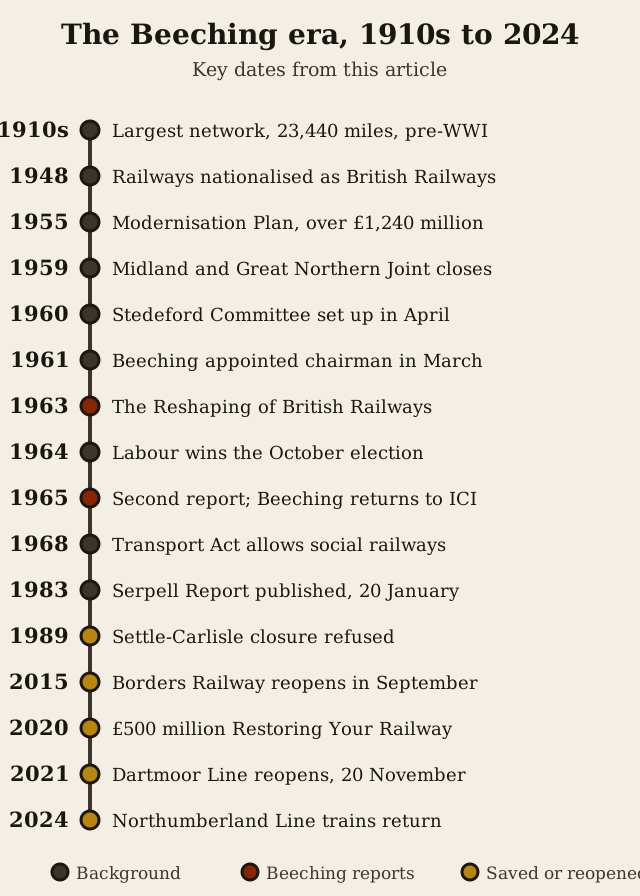
Britain's railway network was at its largest just before the First World War, when the rapid growth of the 19th century Railway Mania had left it covering 23,440 miles. The network was busy through the Second World War but ended it in poor repair, and was nationalised as British Railways in 1948.

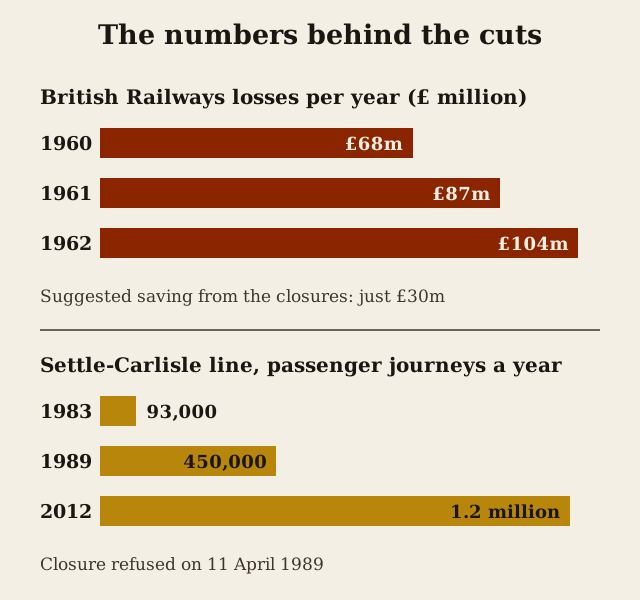
The 1955 Modernisation Plan promised spending of more than £1,240 million, aiming to replace steam locomotives with diesel and electric traction, grow traffic, and return the system to profit by 1962. The losses grew instead: £68 million in 1960, then £87 million in 1961, then £104 million in 1962. The British Transport Commission could no longer pay the interest on its loans. From 1948 to 1964, the miles driven by road vehicles rose steadily by 10% each year. By 1955 the railways held just 5% of the transport market, down from 16%. Road hauliers could easily undercut railway freight rates by the 1950s, and rising car ownership drove down passenger numbers. These compounding pressures came to a head in 1963, setting the stage for the report that would carry Beeching's name.
The Reshaping of British Railways, 1963
The Reshaping of British Railways came out in 1963 and begins with a 1960 brief from Prime Minister Harold Macmillan, which said the industry's size and pattern had to fit modern conditions and prospects. The report proposed closing 6,000 miles of mostly rural and industrial lines entirely, covering 55% of stations and 30% of route miles. It named 2,363 stations for closure, 435 of which were already under threat. These sat on lines due to shut as well as on lines meant to stay open. The report also recommended concentrating long-distance traffic onto nine main lines, a policy that in Scotland favoured only the Central Belt routes and the line via Fife and Perth to Aberdeen, and in Wales selected no routes beyond the Great Western Main Line as far as Swansea.

Whole regions were affected. Along the coasts of north Devon, Cornwall and East Anglia, the report proposed shutting nearly every service, sparing only the Norwich to Great Yarmouth line. Among its most significant closures was the Great Central Main Line, which ran from London Marylebone to Leicester and Sheffield. One casualty sat at an awkward junction of routes: trains from Hull to York via Beverley ran partly on the Yorkshire Coast Line, which stayed open, and partly on the York to Beverley Line, which closed. A separate recommendation to concentrate freight onto fewer railheads, moving goods onto road at either end, would prove prescient with the later rise of intermodal freight transport. Critics said the plan's effect would make the post-1966 railway map resemble that of 1855, and one professor at the time called its conclusions rough and unrealistic and its implementation ruthless to the point of suicidal, according to the Heritage Portal.
Beeching's second report and a change of government
Beeching's second report, The Development of the Major Railway Trunk Routes, followed in 1965. Where the first report was about what to close, this one picked out a small number of major routes for significant investment, the kind of trunk network that later carried Britain's fast InterCity services. Beeching left British Railways in 1965 and returned to ICI.

Labour won the general election of October 1964, ending 13 years of Conservative rule, and Harold Wilson became Prime Minister. Tom Fraser took the post of Minister of Transport, and Barbara Castle succeeded him in December 1965. Most of Beeching's recommendations were taken forward by this Labour government, even though many of the proposed closures sparked protests from communities, especially rural ones, that had no other public transport once their trains were gone.
Protests, politics and whether the cuts actually saved money
Campaigns saved a few stations and lines, though most closed as planned. The Central Wales Line was said to have survived because it ran through so many marginal parliamentary constituencies that no one dared close it, while the Marshlink line between Ashford and Hastings stayed open because of problems running a replacement bus service alongside the existing network.
The replacement bus policy, often called bustitution, largely failed. The buses often linked the old station sites, and some of those sites lay well away from the towns they were meant to serve, so the bus kept none of the advantage of the train it replaced. In practice, people who had already set off by car simply drove the whole way. The freight equivalent assumed lorries would carry goods to the nearest railhead for a long rail haul before a final lorry leg, but many closed lines had run at only a small deficit, so closing them made little difference to the overall loss. Operating costs on many of these lines could instead have been reduced by cutting staff and removing redundant services while keeping the stations themselves open.
It has been suggested that closing almost a third of the network achieved a saving of just £30 million, while overall losses were running in excess of £100 million per year. The Ministry of Transport later estimated that operating costs had indeed been cut by more than £100 million following the report, but much of that saving was swallowed up by increased wages, and by the end of the 1960s it was increasingly clear that closures alone were not going to bring the railway out of deficit. Beeching himself stayed unrepentant, saying "I suppose I'll always be looked upon as the axe man, but it was surgery, not mad chopping." In 1982, under Margaret Thatcher's government, civil servant Sir David Serpell, who had worked with Beeching, produced the Serpell Report arguing that a profitable railway could only be achieved by closing much of what remained; it was published on 20 January 1983 and met an immediate backlash from the media.
Lines that survived: the Settle-Carlisle fight
The best known line that escaped is the Settle-Carlisle line, a 72 mile main line across the Pennines that the Reshaping report had listed for the withdrawal of passenger services. By 1970 all of its stations except Settle and Appleby had closed and service was down to two trains a day each way. When British Rail moved to close it in the 1980s, a campaign by users, councils and enthusiasts fought back, and annual passenger journeys rose from 93,000 in 1983 to 450,000 in 1989. On 11 April 1989 the government refused consent for closure, and Michael Portillo, then the minister for railways, later said he felt emotional about saving a line so important to Britain's heritage. Passenger numbers reached 1.2 million by 2012, and eight of the line's closed stations have reopened.

Closures before and after the Reshaping report
The Beeching cuts were not the first closures to hit the network. Before Beeching, the most significant closure came in 1959, when the former Midland and Great Northern Joint Railway shut. The opposition it stirred up became a significant force against the proposals that followed. The Reshaping report was intended only as the first stage in the network's contraction, and many of the lines that survived its first round were still rationalised afterwards, with reductions to single track and the consolidation of signalling. King's Lynn, for example, was meant to remain at the centre of routes towards Norwich, Hunstanton and Wisbech, yet all three of those routes ultimately closed.
The closure process itself changed over time: later measures made closures simpler to handle, since the case for and against each one no longer had to be heard in detail. The Transport Act 1968 then saved a number of branch lines and local services by allowing them to be supported as social railways.
What has reopened since the Beeching cuts
Some of the lines Beeching marked for closure were never shut at all, and a few that did close have since reopened, while others have been built over, returned to farmland or lie derelict. The reports made no recommendations about what should happen to the land, and many bridges, cuttings and embankments were removed and sold for development. Unlike the United States, where rail banking holds former railway land for possible future use, Britain did not protect its closed trackbeds. As demand for rail has grown since the 1990s, the loss of routes such as Bedford to Cambridge, closed even though Beeching had recommended keeping it, has drawn criticism.
| Line or scheme | What happened |
|---|---|
| Waverley Route (Borders Railway) | A 35 mile section's reopening was approved in 2006, with passenger services resuming in September 2015. |
| Heritage railways | Several former Beeching-era lines run as heritage railways, among them the West Somerset Railway, the North Norfolk Railway, the North Yorkshire Moors Railway, the Mid Hants Railway, the Great Central Railway and the East Lancashire Railway. |
| Golden Valley and Cotswold lines | Traffic on the single-track Kemble to Swindon and Oxford to Worcester lines has grown significantly, and double track has been reinstated on the Golden Valley Line. |
| Dartmoor Line | Reopened for year-round services between Okehampton and Exeter on 20 November 2021 for the first time in nearly 50 years, backed by over £40 million of Restoring Your Railway investment. |
| Northumberland Line | Funding of £34 million was announced in January 2021, and passenger trains between Newcastle and Ashington returned in December 2024. |

In January 2020, more than 50 years after the Beeching cuts, the UK government pledged £500 million for the Restoring Your Railway Fund, explicitly citing the thousands of miles of track and stations closed in the 1960s. Road traffic levels have grown significantly since the cuts, yet a few of the railway closures have since been reversed: a number of closed stations have opened again, and passenger trains have returned to a few lines that had lost them.

The Beeching story is about which lines a network can afford to keep, the same question every rail company faces. Rails & Rivals, our game on Steam, is a turn-based railroad strategy board game for 2 to 6 players: each player runs a rail company, lays track across a hex map and carries goods between cities, and the wealthiest company wins. The how to play page has the rules.
Keep reading
Sources
- Government pledges £500 million to bring back historic rail lines (UK Government (GOV.UK))
- Beeching cuts (Wikipedia)
- Dr Beeching, Hero or Villain? (The Heritage Portal)
- Settle-Carlisle line (Wikipedia)
- Article on the 1989 Settle-Carlisle reprieve (RailStaff)
- Re-opening Beeching-era lines and stations (UK Government (GOV.UK, Department for Transport))