Pullman Company History: George Pullman's Sleeping Car

The Pullman Company, founded by George Pullman, built railroad cars and also operated its sleeping cars on most of the railroads in the United States. Its sleeping car operations ended on December 31, 1968.
George Pullman: Life and Career
George Mortimer Pullman (March 3, 1831 to October 19, 1897) was an American engineer and industrialist. His parents were James Lewis Pullman, a carpenter, and Emily Caroline Minton, and he was born in Brocton, New York. In 1845 the family relocated to Albion, New York, on the Erie Canal, where his father was to help with widening the canal; the father already held a patent on a jackscrew machine able to shift buildings onto new foundations. George Pullman attended local schools and helped his father, and took over his father's business in 1853, at age 22, after his father died. He also worked as a clerk for a country merchant. In 1856 the State of New York gave him a contract to relocate 20 buildings that stood in the path of the canal widening.

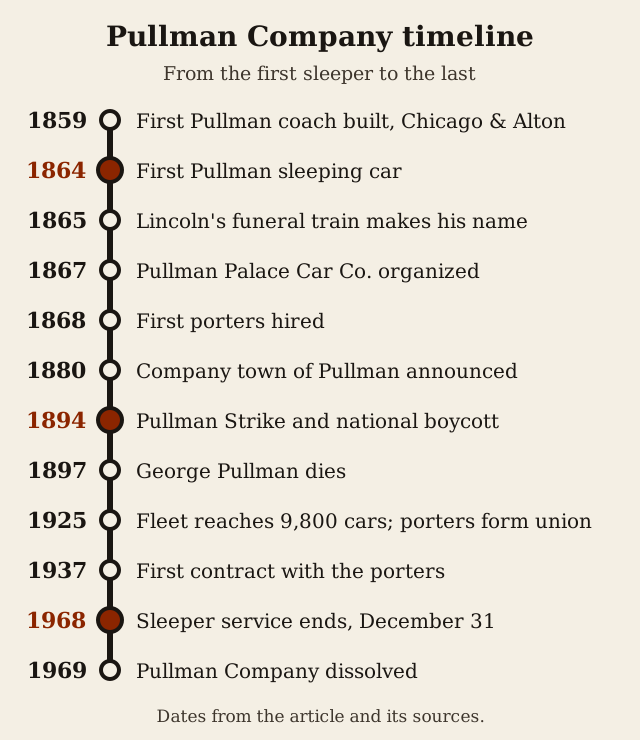
In 1859 Pullman and his business partner Charles Moore moved to Chicago, where the streets often resembled a swamp because the city had been built too low on the shore of Lake Michigan. A city project to re-engineer the sewers required raising street levels by an average of over a metre, so buildings along the way had to be demolished or physically lifted onto the new grade. Pullman and Moore raised the Matteson House, a large brick hotel, and went on to raise several more Chicago buildings, including a consortium project that lifted a whole ninety-eight-metre block of brick and stone buildings on Lake Street, in the stretch from Clark to La Salle Streets. Edward Mendel recorded that feat in a large lithograph.
Much later, on October 19, 1897, a heart attack killed Pullman in Chicago, and he was laid to rest at Graceland Cemetery. Fearing that former employees or labor supporters might try to dig up his body, his family had his lead-lined mahogany coffin sealed inside a block of concrete. A layer of steel rails bolted together at right angles was laid over it between further layers of concrete.
Designing the Pullman Sleeping Car
In 1864 Pullman developed his first sleeping car for the railroads, which became known as the Pullman sleeper or "palace car." A night spent sleeping in his seat on a train trip had inspired him to design a passenger car with sleeper berths for all its passengers. The cars were designed after the packet boats that traveled the Erie Canal of his youth. The first Pullman coach had actually been built earlier: in the spring of 1859, Chicago & Alton President Joel A. Matteson allowed it to be put together in the railroad's shops at Bloomington, Illinois. In the finished design, the upper berth folded up overhead during the day, much like an airliner's overhead luggage compartment, then folded down at night while the two facing seats below it folded over to form the lower berth; curtains gave privacy, and washrooms sat at each end of the car for men and women.

Pullman gained national attention when he arranged for the body of the assassinated President Abraham Lincoln to be carried from Washington, D.C., to Springfield on a sleeper, with Pullman's own cars attached for the president's surviving family; hundreds of thousands of people lined the route. Orders for his cars poured in after that, even though each sleeper cost more than five times the price of an ordinary railway car. Pullman and his partner Benjamin Field had already secured a contract from the Chicago, Alton and St. Louis Railroad to develop a more comfortable sleeping car. The Pioneer, an early Pullman sleeper, measured 54 feet in length and 10 feet across, and it had room for 50 passengers. The Pullman Palace Car Company was incorporated in 1867.
The company kept adding new car types: in 1867 it introduced the President, a "hotel on wheels" sleeper with its own kitchen and dining car, followed in 1868 by the Delmonico, the world's first sleeping car devoted to fine cuisine. The first parlor car followed in 1875. From 1867 to 1915, patented paper car wheels offered a smoother and quieter ride than ordinary cast iron ones.
How the Pullman Company Operated: Leasing Cars to Railroads
Pullman leased his sleeping cars to railroads rather than selling them outright, a system meant to put the cars to work on the greatest possible number of lines instead of only the few that could afford his more costly cars.

The Pioneer's two-dollar fares soon drew passengers away from rival sleepers. Within a year Pullman owned 48 sleepers. Within 10 years he held a virtual monopoly on luxury train travel in the United States. By 1883 Pullman had shops in St. Louis, Detroit, Elmira and Wilmington, as well as several factories in Europe and England. The company's best years were the mid-1920s, and in 1925 its fleet grew to 9,800 cars. In that period the Pullman Co. employed twenty-eight thousand conductors and twelve thousand porters.
The company also diversified: in 1889 Pullman partnered with William H. Patton, who had developed a locomotive powered by a gasoline engine. Together they developed the world's first gasoline-electric locomotive, and they sold these machines as Patton Motors products until World War One began. The original Pullman Palace Car Co. had been organized on February 22, 1867. Having bought up many related and rival firms, the company was reorganized around 1900 as The Pullman Co., whose trademark phrase was "Travel and Sleep in Safety and Comfort."
The corporate structure kept evolving. In 1924, to bring The Pullman Co.'s car-building interests together, the Pullman manufacturing department was combined with the newly purchased Haskell & Barker Car Company to form the Pullman Car & Manufacturing Corporation. On June 21, 1927, Pullman, Inc., was formed as a holding company, and The Pullman Co. was established as its own company. Pullman purchased a controlling interest in the Standard Steel Car Company in 1929. On December 26, 1934, Pullman Car & Manufacturing and several other Pullman, Inc. subsidiaries merged with Standard Steel Car Co. to form the Pullman-Standard Car Manufacturing Company. In 1940 the United States Department of Justice filed an anti-trust complaint against Pullman Incorporated, seeking to separate its sleeping car operations from its manufacturing. In 1944 the court ordered Pullman Incorporated to divest itself of either the Pullman Company, which operated the cars, or Pullman-Standard, which manufactured them. After negotiations, the Pullman Company was sold to a consortium of railroads.
Beyond Sleeping Cars: Streetcars and Trolleybuses
Pullman's manufacturing reach extended well past sleeping cars. The PCC streetcar was a standardized design that many North American transit systems bought between 1936 and 1952, and nearly 5,000 were built in total. Only three companies ever built it, just two of them in the United States, and Pullman was one of those two. In 1934 Pullman made the body for the very first all-new PCC car, a prototype known as "model B." Pullman's own first production-series PCC cars did not follow until 1938, and they were delivered in early 1939. The St. Louis Car Company captured about 75% of the U.S. market for PCC cars, with the remaining balance of around 25% supplied by Pullman.

From 1931 until late 1952, Pullman-Standard also made trolley buses, which were more often called trolley coaches in that era, and it turned out 2,007 of them. They were built in Worcester, Massachusetts, at a plant that had once belonged to the Osgood Bradley Car Company. Pullman gained control of that plant in 1929/30, when it bought a controlling interest in the Standard Steel Car Company. Nearly all of these trolleybuses went to U.S. cities; Canadian cities received only 24, and South American cities got 136 in all.
Pullman Porters
The Pullman Company was also noted for its porters, who served first-class passengers traveling in its luxurious sleeping cars. When George Pullman began hiring porters in 1868, he sought people trained to be the perfect servants, which led the company to hire Black men, many of them newly freed former slaves, almost exclusively for the job. The decision was driven primarily by economics rather than altruism. Pullman paid the porters very little, which forced them to rely on tips from white passengers for most of their earnings. Keeping pay low for one of its largest and most important groups of workers allowed the company to raise its profits.

Porters were required to work 400 hours a month and often worked 20-hour shifts. They had to pay for their own food, do unpaid preparation work and supply their own uniforms. Porters were often addressed as "George," a practice based in the social standards of slavery itself. Former slaves working in the role were frequently subject to verbal and physical abuse. Even so, Pullman porter work was seen as safe, steady employment, and it gave tens of thousands of African Americans access to middle-class life. This had less to do with the wages than with the reliable income. Porters would bring African-American newspapers such as the Chicago Defender or the Pittsburgh Courier back to their communities.
Starting in 1909, porters tried unsuccessfully to organize a labor union. In 1925 A. Philip Randolph helped form the Brotherhood of Sleeping Car Porters. In 1937 the Pullman Company signed a contract with the Brotherhood, leading to higher salaries, better job security and increased protection for workers' rights through grievance procedures. It was the first major labor agreement between an African-American union and a corporation. Porters accounted for 44 percent of the workers in Pullman's rail car operations, and no company in the nation employed more African Americans than Pullman.
The Company Town of Pullman
George Pullman built a company town in the hope of drawing a better class of worker, and he meant to improve those workers further by keeping harmful influences out. He expected that fresh country air and good facilities, free of agitators, saloons and the city's vice districts, would give him contented and loyal employees.
In late April 1880 Pullman announced his plan to build a company town and factory, having already secretly bought 4,000 acres of land near Lake Calumet, 14 miles south of Chicago, earlier that year. He hired architect Solon Spencer Beman to design the plant and the town's 1,300 original structures. Pullman located the town in Hyde Park, the town next door, rather than inside Chicago's city limits. The town featured housing, shops, churches, theaters, parks, a hotel and a library. At the heart of the complex stood the Administration Building, along with a man-made lake. The Hotel Florence, named for Pullman's daughter, was built nearby.

Throughout construction Pullman sought to minimize costs and maximize efficiency by adopting techniques of mass production wherever possible, and some of the earliest departments and shops built on site, including painting, iron and woodworking shops, could then be employed to contribute to the continuing construction of the town.
The first permanent residents moved into Pullman on January 1, 1881. By May of that year more than 350 people lived there. The original town of Pullman was completed in 1884. The whole town site, Pullman shops included, covered no more than 300 acres. The residential portion of the town had 531 houses. Each house came with running water and indoor toilets, comforts that were unheard of in Chicago's other working-class neighborhoods. Pullman's plan expected rent from the houses to produce a 6 percent return on investment, but the actual return always fell short of that.
The Pullman Strike
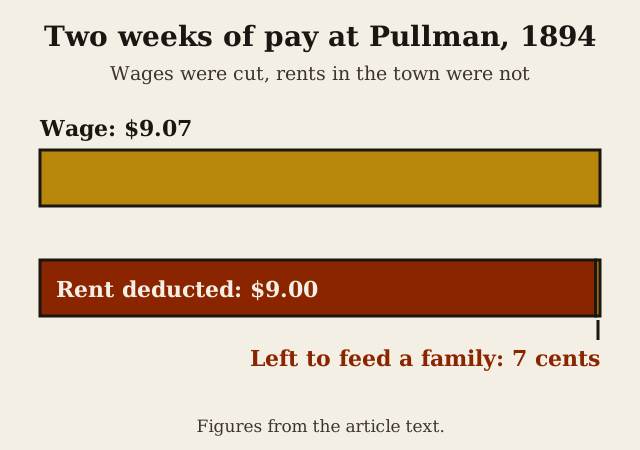
In the winter of 1893 to 1894, at the start of a depression, Pullman cut wages but did not reduce rents in the town. A workman could earn $9.07 over two weeks and have his $9 rent deducted straight from his wages, which left him only 7 cents to feed his family. One worker later testified:
"I have seen men with families of eight or nine children crying because they got only three or four cents after paying their rent."
On May 11, 1894, workers at the Pullman factories went on strike. The American Railway Union then began a boycott of the handling of Pullman cars by its workers. Since so many railroads used Pullman cars, the boycott badly disrupted rail traffic across the country. Disruption of the United States mail gave the federal government an opening to intervene. Pullman gained the support of President Grover Cleveland for the use of federal troops. Thousands of U.S. marshals and U.S. Army troops were deployed, over the objections of Illinois Governor John Altgeld. The troops harshly suppressed the strike, and fighting in the Chicago area left many people dead and wounded.

The boycott dissolved in mid-July 1894, and the American Railway Union was defeated. The Illinois Supreme Court ruled in October 1898 that the Pullman Company had to sell off all of its land holdings not used for industry. Much later, on February 19, 2015, President Barack Obama designated the former company town as Pullman National Monument, the first National Park Service unit in Chicago. The site was later redesignated Pullman National Historical Park.
George Pullman's Wider Legacy
Pullman's will left $1.2 million to found the Pullman Free School of Manual Training. Its pupils were to be the children of Pullman Palace Car Company employees and of residents of the neighboring Roseland community. The school, also known as Pullman Tech, closed its doors in 1949. In 1950 the George M. Pullman Educational Foundation succeeded it. The city of Pullman, Washington, is named in his honor. As head of the Oregon Improvement Company, which owned 60% of the Northern Pacific Railroad, he was expected by the town to use his influence to get rail lines built to Pullman.

The End of the Pullman Company
Pullman built its last standard heavyweight sleeping car in February 1931, several years after what had been its best period in the mid-1920s.
On December 31, 1968, the Pullman Company stopped running its sleeper cars and ended all of its leases. On January 1, 1969, the Pullman Company was dissolved and all its assets were liquidated. The Pullman name was removed from the letterboards of Pullman-owned cars on many railroads, including Union Pacific, and the remaining assets were auctioned at the Pullman plant in Chicago in early 1970.
Pullman, Inc., carried on as the parent company after the 1944 breakup. Its Pullman-Standard subsidiary remained in the rail car manufacturing business until 1982. In late 1980 Pullman, Inc., which had stayed independent until then, merged with Wheelabrator, whose CEO at the time was Michael D. Dingman. As a result of the merger, the Pullman interests were split off in early and mid-1981. Working out of a Denver office, Pullman, Inc., stayed in existence until 1981 or 1982 to settle its outstanding liabilities and claims.

Rails & Rivals, our game on Steam, is a turn-based railroad strategy board game for 2 to 6 players: each player runs a rail company, lays track across a hex map and carries goods between cities, and the wealthiest company wins. The how to play page has the rules.
Keep reading
Sources
- Pullman Company (Wikipedia)
- George M. Pullman (National Park Service)
- The Pullman Company (Pullman State Historic Site / Historic Pullman Foundation)
- Pullman Palace Car Company (Encyclopedia.com (Gale))
- Five Things to Know About Pullman Porters (Smithsonian Magazine)
- Pullman Porters: From Service to Civil Rights (National Railroad Museum)
- The Pullman Story, Part 2 (National Park Service / Pullman National Historical Park)
- The Town of Pullman (Pullman State Historic Site / Historic Pullman Foundation)
- The Strike of 1894 (National Park Service / Pullman National Historical Park)
- History & Culture (National Park Service / Pullman National Historical Park)
- George Pullman (Wikipedia)