Ffestiniog Railway History: Wales's Narrow Gauge Pioneer

The Ffestiniog Railway is a narrow gauge heritage railway in Gwynedd, Wales, laid to a gauge of 1 ft 11½ in (597 mm). It runs for about 13½ miles through wooded mountain country, linking Porthmadog harbour with Blaenau Ffestiniog, a slate mining town. It was built to carry slate from the quarries around Blaenau Ffestiniog to Porthmadog, where the slate was loaded onto ships. The line was built by the Festiniog Railway Company, founded in 1832, which is the oldest surviving railway company in the world. Most of the route lies inside Snowdonia National Park, and the line is a major draw for tourists.
Built to carry slate to Porthmadog
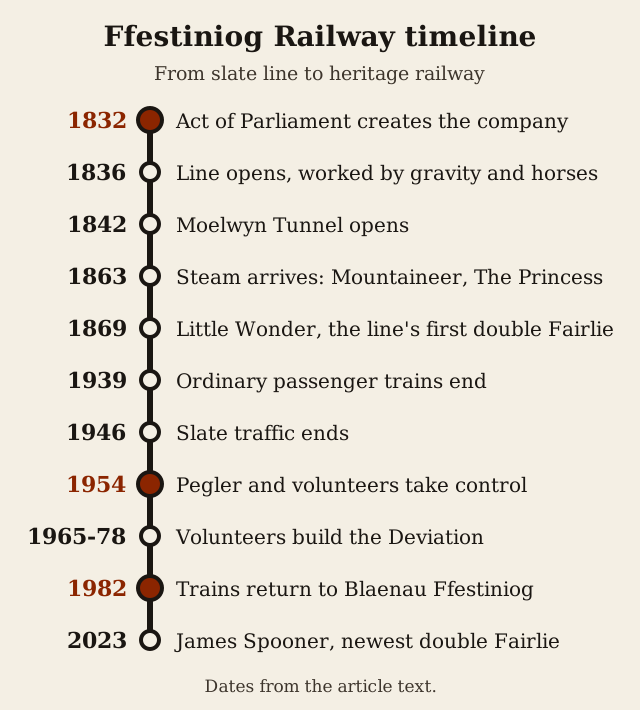
The main purpose of the railway was to link the mountain slate quarries around the area that became Blaenau Ffestiniog with the harbour at Porthmadog. No fewer than 23 quarries had a link to the line, some direct and some indirect, and many of these links were inclines. The quarries sent their finished slate down the railway in slate wagons, and it was moved onto ships and, in later years, onto the standard gauge railway at Minffordd. An Act of Parliament of 23 May 1832 created the Festiniog Railway Company, which built the line. Most of its money was raised in Dublin by Henry Archer, who served as the company's first secretary and managing director. Leaving Porthmadog, trains spend their first mile on the Cob, an embankment that serves as the dyke of the Traeth Mawr polder.

The railway company is properly known as the Festiniog Railway Company. The single F spelling is in the company's official title in the Festiniog Railway Act 1832 (2 & 3 Will. 4. c. xlviii), the local Act of Parliament that created the railway. Important developments in the line's early history were celebrated by firing rock cannon at points along the route. Cannon marked the laying of the first stone at Creuau in 1833, the railway's opening in 1836 and the opening of the Moelwyn Tunnel in 1842. Cannon were also fired when the Festiniog Railway Act 1869 was passed, and on that occasion a fitter at Boston Lodge who was helping to fire them lost the fingers of one hand in an accident.
Gravity and horse working on the original line
Gravity did the work of moving loaded slate wagons downhill on the original Ffestiniog Railway. Its gradient let full wagons roll under gravity the whole way from Blaenau Ffestiniog down to the port. Horses pulled the empty wagons back uphill, and on the way down the horses rode in special "dandy" wagons. Keeping that steady fall, roughly 1 in 80 over much of the route, meant tracing the natural contours of the hillside, with cuttings and with embankments made from stone and slate blocks set without mortar. Before a long tunnel through a spur of the Moelwyn Mountain was completed in 1842, slate trains were worked over the top of the spur on inclines designed by the engineer Robert Stephenson. Up to six trains ran daily in each direction, and Charles Easton Spooner published a printed timetable on 16 September 1856. Spooner, following his father, served as the line's Manager and Clerk for 30 years.

The switch to steam in the 1860s
Steam locomotives came to the Ffestiniog Railway because gravity and horse power could no longer keep up with demand. By the late 1850s the quarries at Blaenau Ffestiniog were producing ever more slate, and the line was plainly getting close to the most it could handle. In 1860 the company's board began investigating steam locomotives to increase the railway's carrying capacity. Narrow gauge steam locomotives had been tried before this, but very few had been built to so narrow a gauge. In 1862 the company advertised for manufacturers to tender for the line's first locomotives, and in February 1863 the bid of George England and Co. was accepted. Mountaineer, the first of the George England engines, reached Porthmadog on 18 July 1863, and The Princess arrived a few days after it. The first official train ran on 23 October 1863. These locomotives allowed much longer slate trains and also enabled the official introduction of passenger trains in 1865. No narrow gauge railway in Britain had carried passengers before the Ffestiniog did. Rails increased in weight and strength as traffic changed. The original 16 lb per yard rails were laid for horse-drawn operation, and the 30 lb per yard rails used for early steam operation were found to be too light.

The Fairlie locomotives and their worldwide influence
A Fairlie locomotive is a type of articulated steam locomotive with its driving wheels mounted on swivelling bogies, built either double-ended (a double Fairlie) or single-ended (a single Fairlie). The Scottish engineer Robert Francis Fairlie published a pamphlet in 1864 setting out his plans for this new type of articulated locomotive, and he received a patent for the design in May 1864. In Fairlie's layout the boiler was double-ended: a single central firebox, with a smokebox at either end. As a result, the size of the fireboxes and ashpans was limited only by the overall loading gauge, not by the width of the frames or the track.
The Ffestiniog Railway's first double Fairlie, Little Wonder, was introduced in 1869. Its two fireboxes were separate, divided by a water jacket. That arrangement worked far better than the first Fairlie, The Progress of 1865, where the draught from both halves of the boiler passed through a single firebox. In February 1870, Fairlie staged a series of demonstrations of Little Wonder on the Ffestiniog line for high-powered delegations from many parts of the world. Those trials won buyers across the world for Fairlie's invention and for the idea of the narrow gauge railway it relied on. Engines of his type went to many British colonies and to the Russian Empire, and some were even built for the United States. The majority of the world's diesel and electric locomotives follow the basic form of the Fairlie design, with two power trucks and every axle driven. Little Wonder did so well that Fairlie granted the Festiniog Railway Company an unrestricted licence to his locomotive patent, with no end date. In exchange, he could feature the line and the achievements of its Fairlie engines in his publicity.

Boston Lodge, the railway's own works, built the double Fairlie Merddin Emrys in 1879, the first double Fairlie built there. In 2011, Merddin Emrys was still in daily use. Long after, the works built Earl of Merioneth in 1979, the first double Fairlie built by the restored Ffestiniog Railway, with cuboid side tanks that deviated from the classic design. Earl of Merioneth's last day in service was in 2018. David Lloyd George followed in 1992. James Spooner, completed in 2023 to replace Earl of Merioneth, became the most recent double Fairlie locomotive in the world. Livingston Thompson, an older double Fairlie dating from 1885, left service in 1971; it was restored in 1988 and put on static display at York's National Railway Museum. In 1999, Boston Lodge built a replica of the single Fairlie Taliesin. The original Taliesin dated from 1876. Since James Spooner was completed in 2023, the Ffestiniog Railway has had three double Fairlies in running condition. On each swivelling power bogie, the flexible pipes carrying steam to and from the cylinders tended to leak, which wasted power. Rolt recorded that in 1909 the designers at Beyer, Peacock & Company examined the spherical steam joints of a Fairlie engine built for the Ffestiniog Railway, and that this let them solve the problem of steam-tight flexible connections on the Garratt locomotive.
| Locomotive | Built | Note |
|---|---|---|
| Little Wonder | 1869 | First double Fairlie built for the Ffestiniog Railway |
| Merddin Emrys | 1879 | First double Fairlie built at Boston Lodge Works, still in daily use in 2011 |
| Livingston Thompson | 1885 | Withdrawn 1971, restored 1988 as a static display at the National Railway Museum, York |
| Earl of Merioneth | 1979 | First double Fairlie built by the restored railway, with cuboid side tanks, last in service 2018 |
| David Lloyd George | 1992 | Returned to service in 2014 with new power bogies, converted to coal firing |
| James Spooner | 2023 | Most recent double Fairlie locomotive in the world on completion |
Decline and closure
Slate traffic on the Ffestiniog Railway went into decline from the 1920s onward. By the 1920s, demand for slate as a roofing material dropped owing to newer materials and the loss of the overseas slate trade during the First World War, and the railway suffered a gradual decline in traffic. The Aluminium Corporation, based at Dolgarrog in the Conwy Valley, paid £40,000 in 1921 for a controlling interest in the company. Henry Jack became chairman, and the company's financial administration moved to Dolgarrog. Jack was also chairman of the new Welsh Highland Railway. In 1923, the Ffestiniog line was joined to the Welsh Highland line at a station called Portmadoc New. The Welsh Highland line was almost totally dependent on tourism, which proved slow to develop.

Ordinary passenger services on the Ffestiniog Railway ceased on 15 September 1939, shortly after the outbreak of the Second World War. Slate traffic ended on 1 August 1946. The one exception was the stretch through the centre of Blaenau Ffestiniog, leased to the quarry owners on 7 October 1946. The Festiniog Railway Company stayed independent, even though most other British lines were grouped into four big companies in 1921 and later absorbed by British Railways in 1948. In 1947 it was excluded from British Railways because it was closed to traffic, although there was strong local lobbying for it to be included.
The volunteer revival
From 1949, various groups of rail enthusiasts attempted to revive the closed railway. In 1951, friends asked the railway enthusiast Alan Pegler to pay off the outstanding debt on the derelict Ffestiniog Railway so that it could be bought. That same year, Allan Garraway was one of the "Bristol group" of volunteers who proposed rescuing the railway. With £3,000 lent to him by his father, Pegler gained control of the company together with the volunteers on 24 June 1954. Garraway was appointed engineer of the Festiniog Railway in November 1954. In June 1955, he left British Railways and became the railway's full-time Manager and Engineer. In 1958, Garraway became the first general manager of the revived company. Long after the revival, Pegler remained fully involved with the railway until his death in 2012.

The Deviation and the return to Blaenau Ffestiniog
Built between 1965 and 1978, the Ffestiniog Railway Deviation was a 2.5 mile diversion between Dduallt and Tanygrisiau. It took the line around the Ffestiniog hydro-electric power station and its reservoir, Llyn Ystradau. The Deviation was built mostly by volunteers. Three Cornish tin mining engineers and a small team of employees built its new 310 yard tunnel between 1975 and 1977, blasting it through a granite spur of the Moelwyn mountain. The southern end of the Deviation has the Dduallt spiral, a formation found on no other public railway in the United Kingdom. Volunteers built the spiral, including its bridge, entirely themselves, and it gains an initial height rise of 35 feet. The Deviation rejoined the old route at Tanygrisiau station, which reopened in 1978.

The last 1½ miles from Tanygrisiau to Blaenau Ffestiniog took a further four years, in a programme of work called Project Blaenau. As with the Deviation, volunteers did most of this work. It was split into separate projects, each led by a volunteer project leader, and in many cases the volunteers took full charge of both designing and carrying out their project. Four decrepit footbridges were rebuilt to the new loading gauge. The decrepit steel bridge across the Afon Barlwyd was replaced, using timber beams on the original abutments and piers and a new deck formed of old rails. Ffestiniog trains returned to Blaenau Ffestiniog in 1982.
Operation, tourism and the Welsh Highland link
As of 2011, Boston Lodge, the Ffestiniog Railway's works, was the oldest operational railway works in the world, and it had produced new steam locomotives in the 19th, 20th and 21st centuries. Worried about how a competing heritage railway close by might affect its business, the Festiniog Railway Company took part in 1988 in a controversial plan to prevent the rebuilding of the neighbouring Welsh Highland Railway. Under the initial plan, the company would have bought the old Welsh Highland Railway's track bed from its receiver and given it to Gwynedd County Council, provided no railway-related development was allowed on the land. This action may have delayed the start of the Welsh Highland Railway's rebuilding. From 1988, however, the company put its full weight behind reopening the Welsh Highland Railway, which reopened fully in 2011. The two railways share the same track gauge and meet at Porthmadog station.
The railway's passing loops have shifted over time. As the line was extended, passing loops were brought into use at Minffordd, Penrhyn and Tan-y-Bwlch. Because of limits on the length of trains that could pass at Penrhyn, Rhiw Goch opened on 14 May 1975. The Penrhyn loop stayed in service for several more years before it closed. Minffordd, Rhiw Goch, Tan-y-Bwlch and Dduallt had the passing loops by the end of the 1970s. In the busiest summer timetable from the early 1980s, three train sets ran, and they usually crossed at Rhiw Goch and Dduallt. The line is single track throughout with four intermediate passing places. The railway operates on the electric token system, under the overall control of a duty controller based at Porthmadog. Its intermediate token instruments are at Boston Lodge, Rhiw Goch, Dduallt and Glan-y-Pwll.
Between Porthmadog Harbour station and Boston Lodge, the railway runs along the Cob, which William Madocks built between 1807 and 1811 as the dyke of the Traeth Mawr polder. Tolls were charged at a tollgate at Boston Lodge until 2003, when the rights were bought by the National Assembly for Wales. The higher, original section of the Cob carries a public footpath alongside the railway for virtually its entire length.

Tourism, though always valued, came to acquire a major importance for the railway in the inter-war years from 1919 to 1939. Since restoration began in 1954, tourism has been the railway's only significant source of income. In 1964, the Wales Tourist Board gave the railway a certificate for conspicuous service to Welsh tourism. In 1972 the board ranked it fifth among Welsh tourist sites, behind Caernarfon Castle, the Swallow Falls, Cardiff's National Museum of Wales and Conwy Castle. After the railway fully reopened in 1982, it was carrying 200,000 passengers annually and became the second largest Welsh tourist attraction after Caernarfon Castle.
The railway and its infrastructure are included in the "Slate landscape of North Wales", a UNESCO World Heritage Site. The operator describes the Ffestiniog as the oldest narrow gauge railway in the world, with a history going back almost 200 years. On the 13½ mile journey from Porthmadog to Blaenau Ffestiniog, trains climb over 700 feet from sea level, rounding tight bends and a complete spiral.

Rails & Rivals, our game on Steam, is a turn-based railroad strategy board game for 2 to 6 players: each player runs a rail company, lays track across a hex map and carries goods between cities, and the wealthiest company wins. The how to play page has the rules.
Keep reading
Sources
- Ffestiniog Railway (Wikipedia)
- Fairlie locomotive (Wikipedia)
- List of Ffestiniog Railway rolling stock (Wikipedia)
- Alan Pegler (Wikipedia)
- Allan Garraway (Wikipedia)
- Dduallt railway station (Wikipedia)
- Heritage steaming ahead in North Wales (National Lottery Heritage Fund)
- About the Ffestiniog Railway (Ffestiniog & Welsh Highland Railways (operator))