Canadian Pacific Railway: History and Route Explained

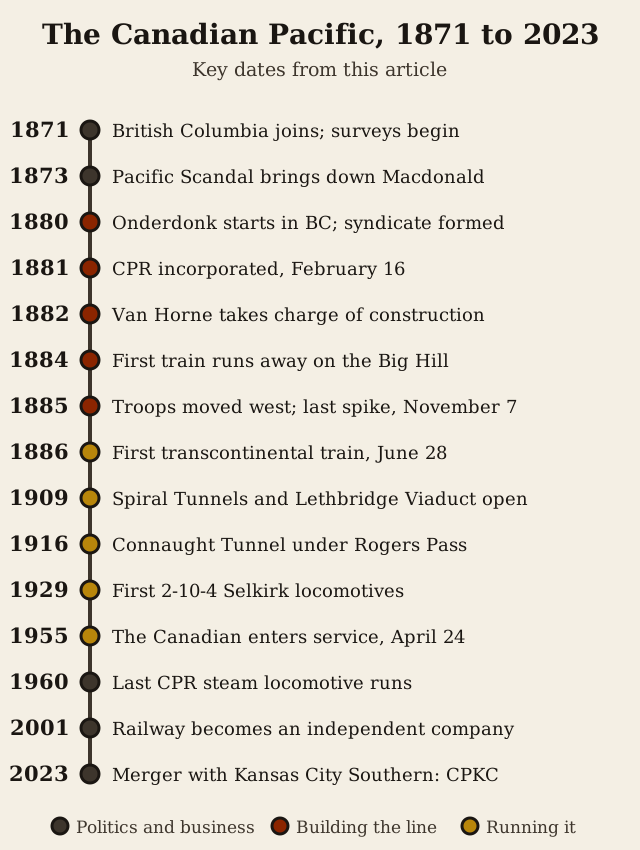
The Canadian Pacific Railway (CPR) is the railway that first linked eastern Canada to the Pacific coast. The Canadian Pacific Railway Company was incorporated on February 16, 1881, with George Stephen as its first president, to keep a promise that had brought British Columbia into Confederation in 1871. CPR director Donald A. Smith drove the last spike at Craigellachie, British Columbia, on November 7, 1885, finishing the line years ahead of the deadline in its contract.
Why Canada built a transcontinental railway
British Columbia joined Canada in 1871 on one condition: a transport link to the rest of the country in the east. Prime Minister Sir John A. Macdonald promised to build what would be the longest railway in the world within ten years. The pledge became an engineering challenge without precedent and took about 15 years to fulfil.
The railway was a key part of Macdonald's National Policy, a plan to build up the young country. It was meant to do two jobs at once: act as a firewall against American expansion into the empty West, and drive economic development by opening the prairies to farming and settlement.

The companies and people who built the CPR
Sandford Fleming was the project's first chief engineer, and survey and construction work started in 1871. The first attempt then collapsed in the Pacific Scandal of 1873, when it emerged that the shipping magnate Hugh Allan, whose company sought the railway contract, had paid large sums to Macdonald's Conservatives. Macdonald's government fell, and Alexander Mackenzie's Liberals built the line slowly, as a public work, in sections.
After Macdonald returned to power, a syndicate of Montreal businessmen, many of them Scottish Canadians, formed on October 21, 1880, to take on the job. In exchange for $25 million in credit and 25 million acres (100,000 km2) of land, the new Canadian Pacific Railway Company agreed to finish the line.
The 1881 season fell far short, with only 211 km of track built, and the company's chief engineer and general superintendent were fired at the end of it. The CPR then hired the American railroader William Van Horne as general manager with a large salary. He arrived in Winnipeg on December 31, 1881, started work on January 2, 1882, and promised to lay 500 miles of track on the prairies that year, more than any company had built in a single year. Van Horne ran construction from western Manitoba to the mountains and along the hard line north of Lakes Huron and Superior, and became president of the CPR in 1888.

In British Columbia the contractor was the American Andrew Onderdonk, whose crews started work on May 15, 1880, on the government's section up the Fraser Canyon. About 17,000 workers came from China, and about three quarters of the men who built the line between the Pacific and Craigellachie were Chinese. They were given the most dangerous work, such as blasting tunnels through rock, for a dollar a day, half a white worker's pay, and hundreds died from accidents and illness. Their contribution was designated a national historic event in Canada in 1977.
Through the Canadian Shield and across the prairies
The CPR's main line in the east starts near Callander and Bonfield in northern Ontario, where its own construction began in 1881. From there it had to cross the Canadian Shield north of Lake Superior, where crews fought what one local history called the hardest rock on earth and bottomless pits of muskeg. Running the line through this empty, rocky country rather than through the United States was a political choice: the government wanted the railway entirely on Canadian soil.

The prairies were much faster going, and the route choice made towns. Winnipeg grew from a few hundred people to 14,000 once the CPR decided to run its main line through the city. New towns such as Regina grew up around the stations the railway set out across the plains.
In 1885 the unfinished line proved its worth. During the North-West Rebellion that spring the government used it to move troops west. Some sections of track were incomplete or had never been used, but the trip to Winnipeg took nine days and the rebellion was quickly put down. The company was close to running out of money at the time, and the episode helped persuade Parliament to back it with further loans.
Over the Rockies: Kicking Horse Pass, the Spiral Tunnels and Rogers Pass
The CPR chose a southern route through the Rockies, via Kicking Horse Pass, because it stayed close to the US border, which helped keep American railways out of the Canadian West, and gave a shorter run to the Pacific. West of the Rockies the line crossed the Selkirk Mountains at Rogers Pass.
To save time, the CPR laid a temporary line down the western side of Kicking Horse Pass with grades as steep as 4.5 percent, known as the Big Hill. The first train to attempt it, in 1884, ran away and derailed, killing three workers. The Big Hill stayed in use for 25 years, until the Spiral Tunnels opened in 1909. The Lower Spiral Tunnel curls 891 metres into the mountain and comes out 15 metres higher, and the Upper Spiral Tunnel, inside Cathedral Mountain, runs 991 metres. Around 25 to 30 trains still pass through them every day.

Rogers Pass brought a different danger: avalanches. In 1916 the CPR opened the Connaught Tunnel, 8 km long under Mount Macdonald, to take trains away from the worst of the snow. It was then the longest railway tunnel in the Western Hemisphere.
The Last Spike at Craigellachie, 1885
The line from the east met the line from the Pacific at Craigellachie, in Eagle Pass between Sicamous and Revelstoke, British Columbia. On November 7, 1885, CPR director Donald A. Smith drove the last spike, a plain iron one, and the famous photograph of the moment shows him surrounded by railway officials and workers. Craigellachie was named after a village in Moray, Scotland, the ancestral home of George Stephen. The site sits beside the Trans-Canada Highway today.
The line was finished well inside the ten years the company's 1881 contract allowed, and about a decade after the first sod had been turned at Fort William on Lake Superior in 1875. In eastern Canada the CPR had also built or bought a network of lines from Quebec City to Sault Ste. Marie, where it connected with American railways and its own Great Lakes steamships.
The route from Montreal to Vancouver
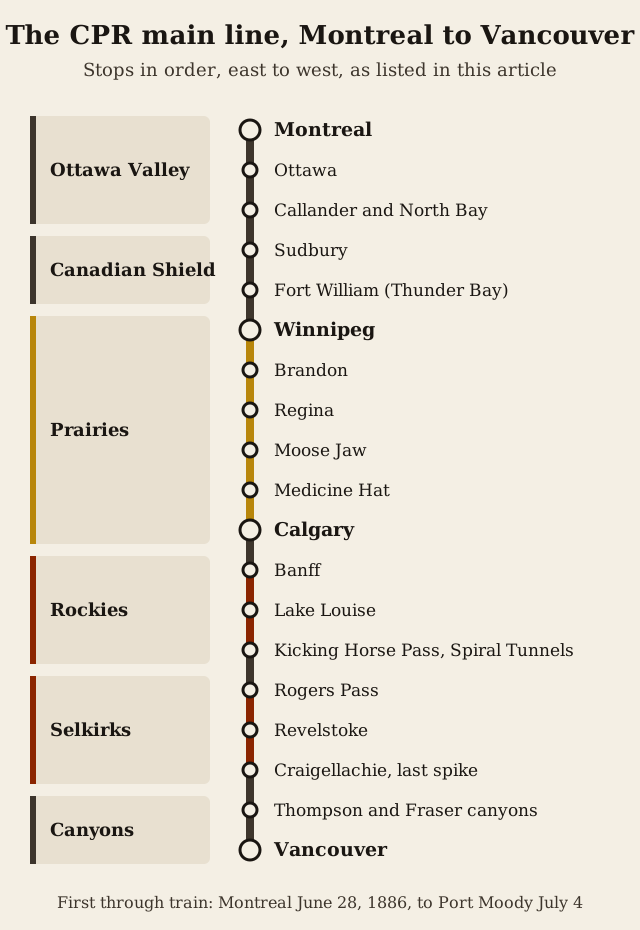
The first transcontinental passenger train left Dalhousie Station in Montreal at 8 pm on June 28, 1886, and reached Port Moody on the Pacific coast by noon on July 4. The line was soon extended a few miles further to Vancouver, which became the CPR's Pacific terminus. The classic route runs:
- Montreal to Ottawa and up the Ottawa Valley to Callander and North Bay.
- Across the Canadian Shield, north of Lakes Huron and Superior, through Sudbury to Fort William (now Thunder Bay).
- Winnipeg, then west across the prairies through Brandon, Regina, Moose Jaw and Medicine Hat to Calgary.
- The Rockies via Banff, Lake Louise and Kicking Horse Pass with its Spiral Tunnels.
- The Selkirks via Rogers Pass, then Revelstoke and Craigellachie.
- Down the Thompson and Fraser canyons to Vancouver.
Hotels, steamships and an empire beyond the rails
With the main line finished, the CPR needed people and traffic. It ran an intense campaign to bring immigrants to Canada, with agents abroad selling one combined package: the sea crossing on a CP ship, the onward journey on a CP train, and land bought from the CP railway. It also built hotels, starting with Glacier House in Glacier National Park and Mount Stephen House at Field, then grand buildings like the Banff Springs Hotel and the Château Frontenac in Quebec City. They became landmarks in their own right, known together as Canada's grand railway hotels.

Ships were part of the business from the start. Once the railway reached British Columbia, the CPR chartered and then bought its own ocean liners across the Pacific, so a traveller could go from Britain to Hong Kong using only CPR ships, trains and hotels. The original 1881 charter also let the company run a telegraph and later telephone service, which was faster than the mail and became an important business of its own.
The CPR in the 20th century
The early 20th century brought big engineering on the prairies too: the Lethbridge Viaduct over the Oldman River valley in Alberta opened on November 3, 1909. The first 2-10-4 Selkirk locomotives reached the CPR in 1929; no larger steam locomotives ever ran in Canada or anywhere in the British Empire. The CPR's 4-6-4 Hudsons also became some of its best known engines. Our biggest steam locomotives guide puts the Selkirks beside other giants.

The last CPR steam locomotive ran on 6 November 1960, by which time the fleet had gone over to diesel. The CPR introduced Budd Rail Diesel Cars from November 9, 1953, and a new luxury transcontinental train, The Canadian, on April 24, 1955. But cars, trucks and aircraft were taking traffic away. The CPR's other transcontinental train, The Dominion, was dropped in January 1966, and passenger services ended on many routes, including the line through southern British Columbia and Crowsnest Pass in January 1964.
The CPR as of 2023
Canadian Pacific grew into a freight railway in both Canada and the United States. The Soo Line and the Milwaukee Road gave it a route to Chicago, and the Delaware and Hudson Railway took it to New York. In 2001 its parent company, Canadian Pacific Limited, split its five businesses, including the railway, into independent companies, and in 2009 the railway bought the Dakota, Minnesota and Eastern and the Iowa, Chicago and Eastern railroads.
In April 2023 Canadian Pacific merged with the US railroad Kansas City Southern to form CPKC, a network of about 20,000 miles running from Canada through the United States to Mexico, linking the ports of Montreal and Vancouver to cities such as Chicago and Kansas City.

The CPR's choices, a longer route on home soil, a steep temporary grade to open sooner, land and hotels to create traffic, are the kind of calls a rail company has to make. Rails & Rivals, our game on Steam, is a turn-based railroad strategy board game for 2 to 6 players: each player runs a rail company, lays track across a hex map and carries goods between cities, and the wealthiest company wins. The how to play page has the rules.
Keep reading
Sources
- Our History (Canadian Pacific / CPKC corporate heritage site)
- The Canadian Pacific Railway (Dictionary of Canadian Biography (Library and Archives Canada / University of Toronto))
- Rogers Pass National Historic Site - A Promise to British Columbia (Parks Canada / Government of Canada)
- Canadian Pacific Railway (Canadian Society for Civil Engineering)
- Van Horne, Sir William Cornelius (Dictionary of Canadian Biography)
- Chinese Construction Workers on the Canadian Pacific Railway National Historic Event (Parks Canada / Government of Canada)
- Canadian Pacific Railway (Thunder Bay Museum)
- MHS Centennial Business: Canadian Pacific Railway Company / CPKC (Manitoba Historical Society)
- Spiral Tunnels, Yoho National Park (Parks Canada / Government of Canada)
- The Last Spike (Canadian Museum of History)
- Last Spike at Craigellachie (Destination British Columbia)
- Canadian Pacific Railway (Wikipedia)
- CPKC Railway (CPKC) Profile (Iowa Department of Transportation)