Orient Express History, Route and the Trains Today

Set up in 1883 by the Belgian firm Compagnie Internationale des Wagons-Lits (CIWL), the Orient Express was a luxury long-distance passenger train that crossed continental Europe from Paris to Constantinople (later Istanbul), with branch lines serving Athens, Brussels and London. Regular service under the name continued, in shrinking form, until it ceased entirely on 14 December 2009. Today the name survives only on dated, operator-run luxury trains rather than on a single continuous service.
Georges Nagelmackers and the Compagnie Internationale des Wagons-Lits
Georges Nagelmackers (born 25 June 1845, died 10 August 1905) was a Belgian businessman who founded the company that became the Compagnie Internationale des Wagons-Lits in 1872, after ten months of travelling in the United States exposed him to sleeping car travel on Pullman carriages and convinced him there was a market for Pullman-type carriages in Europe. CIWL went on to run luxury trains, travel agencies and hotels across Europe, Asia and North Africa, and its most famous train remained the Orient Express. In 1893 the company adopted the fuller name Compagnie Internationale des Wagons-Lits et des Grands Express Europeens, a name it kept until 1967.

The First Journeys and the Route to Constantinople, 1882 to 1889
Before paying passengers came aboard, Nagelmackers organised a test run. The train pulled out of the Gare de l'Est in Paris on the evening of Tuesday, 10 October 1882 and got to Vienna late the following day. For the trip back it set off from Vienna on Friday, 13 October 1882, and it pulled into the Gare de Strasbourg on schedule on Saturday, 14 October 1882. The first onboard menu, served on 10 October 1882, included oysters, soup with Italian pasta, turbot with green sauce, chicken a la chasseur, fillet of beef with chateau potatoes, chaud froid of game, lettuce, chocolate pudding and a buffet of desserts. Commercial service began on 5 June 1883, when the first Express d'Orient left Paris for Vienna via Munich. Vienna remained the terminus until 4 October 1883, the date the Nagelmackers biography gives for the Orient Express launch, when the route was extended to Giurgiu in Romania. The train was then called the Train Express d'Orient; it was not officially renamed the Orient Express until 1891, after the period covered here.
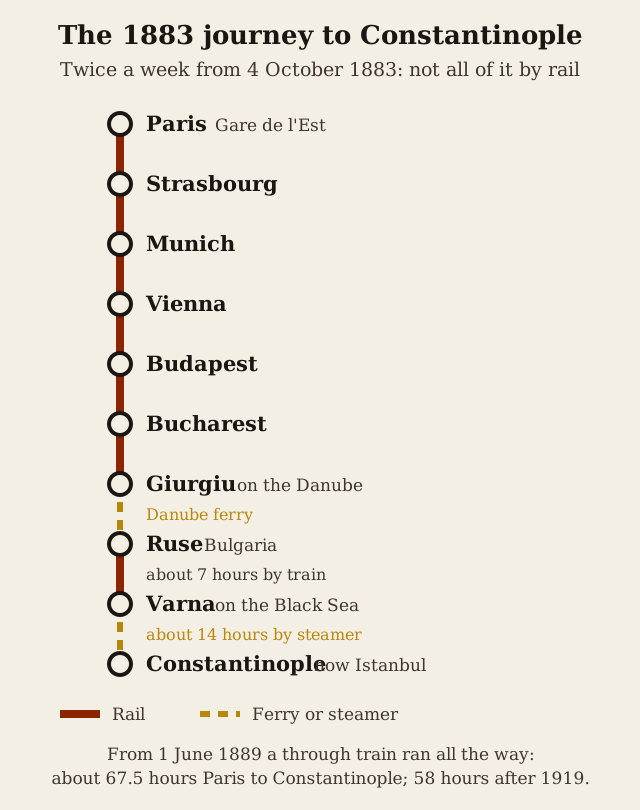
From 4 October 1883 the train ran twice a week, and beyond Giurgiu the journey relied on more than rail. The route ran as follows:
- Paris (Gare de l'Est)
- Strasbourg
- Munich
- Vienna
- Budapest
- Bucharest
- Giurgiu (Danube ferry crossing to Ruse, Bulgaria)
- Varna, on the Black Sea (a 7 hour train journey from Ruse)
- Constantinople (a 14 hour sea voyage by steamer from Varna)
In 1885 a second route began operating, reaching Constantinople by rail from Vienna through Belgrade and Nis, by carriage to Plovdiv, then by rail again into the city. The first through train from Paris to Constantinople departed the Gare de l'Est on 1 June 1889. It did away with the ferry, steamer and carriage transfers, and the whole trip took about 67.5 hours. The eastern terminus was the Sirkeci Terminal by the Golden Horn, with a ferry from piers next to the station carrying passengers across the Bosphorus to Haydarpasa Terminal, the terminus of the Asian lines of the Ottoman Railways.
Orient Express Routes by Era
| Era | Main route | End points |
|---|---|---|
| From 4 October 1883 | Paris, Strasbourg, Munich, Vienna, Budapest, Bucharest, Giurgiu, then Danube ferry to Ruse, rail to Varna and steamer onward | Paris and Constantinople |
| From 1885 (second route) | Rail from Vienna to Belgrade and Nis, carriage to Plovdiv, rail to Constantinople | Vienna and Constantinople |
| From 1 June 1889 | Direct train from Paris (Gare de l'Est), no ferry or carriage transfers | Paris and Constantinople |
| From 1920 (Simplon Orient Express) | Paris (Gare de Lyon), Lausanne, Milan, Venice, Trieste, Belgrade, Istanbul | Paris and Istanbul |
| 1931 to 1962 (Arlberg Orient Express) | Paris, Zurich, Innsbruck, Vienna, Budapest, then Bucharest, or Belgrade and Athens | Paris and Bucharest or Athens |
| From 1962 (Direct Orient Express) | Daily cars from Paris to Belgrade, twice-weekly cars from Paris to Istanbul and Athens | Paris and Belgrade, Istanbul or Athens |
| 1977 to 1991 (Orient Express) | Paris, Strasbourg, Munich, Vienna, Budapest, Bucharest | Paris and Bucharest |
| 1991 to 2001 (Orient Express) | Paris to Budapest, after the Budapest to Bucharest leg was discontinued | Paris and Budapest |
| 2001 to 8 June 2007 (EuroNight Orient Express) | Paris to Vienna, coaches attached to a Paris to Strasbourg express for that leg | Paris and Vienna |
| 10 June 2007 to December 2009 (Orient Express) | Strasbourg to Vienna, departing nightly from Strasbourg at 22:20 | Strasbourg and Vienna |

The Simplon Orient Express and the 1930s Golden Age
World War I suspended Orient Express services from 1914, and they resumed at the end of the war in 1918. In 1919 a more southerly route opened via the Simplon Tunnel, Milan, Venice and Trieste, known as the Simplon Orient Express, which ran in addition to continuing services on the old route. Before the war, Austria, whose territory then included Trieste, let international trains cross it only when they were routed via Vienna. The new line got around this because it lay wholly south of the borders Austria had after the war. The Simplon Orient Express launched on 11 April 1919 from Paris's Gare de Lyon to Belgrade and was extended to Istanbul from 1920. Within a short time it was the leading rail link between Paris and Istanbul, and after 1919 the trip was cut to 58 hours. Around 1920, CIWL commissioned the glass designer Rene Lalique to decorate its cars.

The 1930s saw the service at its most popular, with three parallel named trains running at once: the Orient Express, the Simplon Orient Express and the Arlberg Orient Express, the last running via the Arlberg railway between Zurich and Innsbruck to Budapest, with sleeper cars continuing to Bucharest and Athens. In these years the Orient Express made its name for luxury and comfort. Staff were on duty in its sleeping cars at all hours, its restaurant cars were praised for their food, and its passengers included royalty, nobles, diplomats and business people. All three trains also took on sleeping cars that had come from Calais to Paris, so the service stretched across continental Europe from end to end.

Decline and the End of Regular Service, 1939 to 2009
World War II interrupted the service again from 1939 until 1945. During the war the German Mitropa company ran some services through the Balkans, but Yugoslav Partisans frequently sabotaged the track, forcing that service to stop. After the war, normal services resumed except on the Athens leg, where a closed Yugoslavia-Greece border prevented running until it reopened in 1951, and the closure of the Bulgarian-Turkish border from 1951 to 1952 separately stopped services to Istanbul. As the Iron Curtain fell across Europe, Communist nations increasingly replaced the Wagon-Lits cars on the route with carriages run by their own railway services.
By 1962 the original Orient Express and the Arlberg Orient Express had both stopped running, leaving the Simplon Orient Express on its own. That same year it too gave way to the Direct Orient Express, a slower service with cars every day between Paris and Belgrade and cars twice a week between Paris and Istanbul and Athens. In 1971 the Wagon-Lits company stopped operating carriages itself, selling or leasing them to national railway companies while still supplying staff. The Paris to Athens direct service was withdrawn in 1976, and the Direct Orient Express was withdrawn completely in 1977, with the last Paris to Istanbul service running on 19 May 1977.
The withdrawal of the Direct Orient Express did not end the Orient Express name: a service continued from Paris to Bucharest via Strasbourg, Munich, Vienna and Budapest, though a through sleeping car on that run only lasted until 1982 and ran seasonally, so passengers often had to change carriages despite the unchanged name and numbering. In 1991 the Budapest to Bucharest leg was discontinued, leaving Budapest as the final station. A summer sleeping car from Bucharest to Paris reappeared twice weekly in 1999 and 2000, operated by CFR, before the route was cut back in 2001 to a Paris to Vienna EuroNight train whose coaches were attached to a regular Paris to Strasbourg express. This pared-down service ran daily under the Orient Express name until 8 June 2007. When the LGV Est high-speed line between Paris and Strasbourg opened on 10 June 2007, the Orient Express service was cut back again, to Strasbourg to Vienna, departing nightly from Strasbourg at 22:20 and losing the train numbers 262 and 263 it had carried for decades. In its final years, through coaches ran between Vienna and Karlsruhe, continuing to Dortmund, then Amsterdam, then finally Frankfurt. The last train with the name, now written Orient-Express with a hyphen, left Vienna on 10 December 2009 and Strasbourg one day later.
a "victim of high-speed trains and cut-rate airlines"
As that quote describes, the Orient Express stopped running altogether on 14 December 2009 and vanished from European railway timetables. SNCF Voyageurs owns one surviving original train of 7 coaches, and 4 of those coaches are listed as historical monuments. One of the last known CIWL teak sleeping cars from before World War I can still be seen at the former Amfikleia station site in Greece. Long after that, between December 2021 and December 2025, an OBB Nightjet train ran three times a week on the Paris to Vienna route, though it was not branded as Orient Express, and it was cancelled again when the French government withdrew financial support.
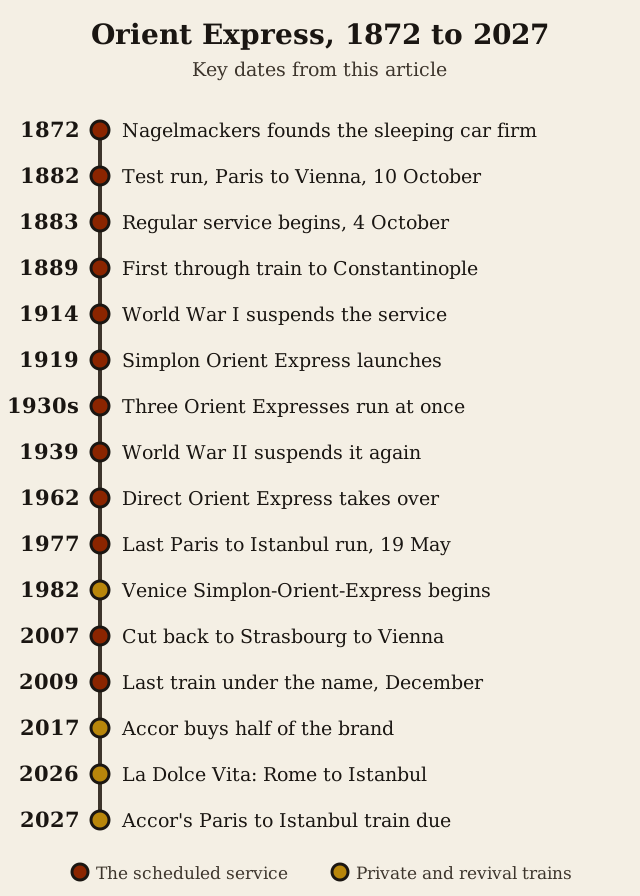
The Trains That Have Used the Name Since 1976
The Venice Simplon-Orient-Express was established in 1982 by the businessman James Sherwood as a private venture, making its first London to Venice run on 25 May 1982, and it is now owned by Belmond. It uses restored carriages mostly dating from the 1920s and 1930s. Its classic London, Paris, Milan and Venice route originally ran via the Simplon Tunnel, but in 1984 it was altered to serve Zurich, Innsbruck and Verona through the Brenner Pass. It has operated as a seasonal train for leisure travellers, and it has traditionally made one trip a year to Istanbul via Budapest, Sinaia and Bucharest. Sherwood also ran a chain of Orient Express branded luxury hotels under license from SNCF, the owner of the branding, until that license ended and the chain was renamed Belmond in 2014. In April 2023 Belmond announced that Brexit complications would end its connecting British Pullman service from London to Folkestone, so travellers from London now take Eurostar to Paris to join the train. Belmond also runs a similarly themed luxury train called the Eastern & Oriental Express in Singapore, Malaysia and Thailand.

In 1976 Intraflug AG, a Swiss travel company, began renting several CIWL carriages and later bought them. Society Expeditions, a company based in Seattle, ran them as the Nostalgic Istanbul Orient Express, at first between Zurich and Istanbul along the line of the old Arlberg Orient Express. To mark the Orient Express's 100th anniversary in 1983, the route was lengthened so that it ran from Paris to Istanbul. The train ceased operations in 2007.
In 2017 Accor, a hospitality group, bought a 50 percent share of the Orient Express brand from SNCF, which gave it the right to use the name. In 2018, Accor began restoring 17 CIWL carriages from the defunct Nostalgie Istanbul Orient Express, dating from the 1920s and 1930s, with plans for two routes: a Central Europe route and an original route reaching Turkey. Accor had first announced in late 2022 that it planned to launch its own Orient Express in late 2026 running between Paris and Istanbul, with the first service now due to begin in 2027. In early 2026 the carriages were put on display at the Musee des Arts Decoratifs within the Louvre in Paris. Separately in Italy, La Dolce Vita Orient Express, run by the company Arsenale with Accor's Orient Express brand under a long-term concession from the Italian state railway Trenitalia, uses six trains, each built for 62 guests, constructed in Brindisi, Italy. In 2026 it launched a Rome to Istanbul service via Venice, Budapest, Brasov and Sinaia.

If charting a route like this across a map sounds appealing, there is a game for it. Rails & Rivals, our game on Steam, is a turn-based railroad strategy board game for 2 to 6 players: each player runs a rail company, lays track across a hex map and carries goods between cities, and the wealthiest company wins. The how to play page has the rules.
Keep reading
Sources
- Orient Express (Wikipedia)
- Georges Nagelmackers (Wikipedia)
- Compagnie Internationale des Wagons-Lits (Wikipedia)
- Venice Simplon-Orient-Express (Wikipedia)
- Orient Express (Accor) (Wikipedia)
- History of the Orient Express (Seat61 (independent rail travel reference))
- Routes Of Orient Express From 1883 To Present (Pera Palace Hotel, Istanbul (historic Orient Express hotel))
- Venice Simplon-Orient-Express (Belmond (official operator site))
- Compagnie Internationale des Wagons-Lits (Science Museum Group (UK, includes National Railway Museum))