Shinkansen: Japan's Bullet Train Lines and History

The Shinkansen is Japan's network of high-speed railway lines, known in English as the bullet train, running mainly across the islands of Honshu and Kyushu with a branch into Hokkaido. The network began with the Tokaido Shinkansen, which opened between Tokyo and Shin-Osaka in 1964 as the world's first high-speed rail line. Today the network covers 2,951.3 km of lines with top speeds of 260 to 320 km/h, and it ranks among the world's famous railway lines for that engineering first.
Why Japan Built the Tokaido Shinkansen
Before the Shinkansen, conventional limited express trains needed about 6 hours and 40 minutes to travel between Tokyo and Osaka. When plans for a dedicated high-speed line began to take shape in 1957, many people opposed the idea, pointing to railways' declining stature in the United States at the time. That same year, Odakyu Electric Railway introduced its 3000 series SE Romancecar, and when Japanese National Railways (JNR) leased a trainset to run high-speed tests it reached 145 km/h, a world speed record for a narrow-gauge train that gave designers confidence they could safely build an even faster standard-gauge train.
As president of Japanese National Railways (JNR), Shinji Sogō argued hard that high-speed rail could work, and his influence was key to winning political backing for the project. Hideo Shima, JNR's chief engineer, led the technical side. JNR chose to build the Tokaido Shinkansen as a new 1,435 mm standard-gauge line parallel to the existing narrow-gauge route. Government approval followed in December 1958, and construction of the first segment between Tokyo and Osaka started in April 1959.
Tokyo was chosen in May 1959 to host the 1964 Olympic Games, and the line's opening was timed to coincide with them. The Tokaido Shinkansen opened commercial service on October 1, 1964, between Tokyo and Osaka, just over a week before the Games got under way on October 10, 1964. The line was designed for 210 km/h, a speed reached in 1964, although JNR at first held regular running to 160 km/h while the new track settled and allowed 210 km/h under normal conditions from November 1965. That top speed beat the 126 mph (about 203 km/h) record of Mallard, covered in our article on the fastest steam locomotives. In 2000 the line was designated a joint Historic Mechanical Engineering Landmark and IEEE Milestone, and our railroad history timeline marks its opening as the start of the high-speed era. On July 13, 1967, the line carried its 100 millionth passenger. Trains of sixteen cars entered service in 1970, ready for Expo '70 in Osaka.

Standard Gauge on a Narrow-Gauge Network
The Shinkansen runs on 1,435 mm standard gauge, while most other railway lines in Japan use 1,067 mm narrow gauge. Japan's narrow-gauge network could not be readily adapted for sustained high-speed running because of technical limitations, including lower permissible speeds through curves compared with wider gauges, which is why planners built the Shinkansen as a physically separate standard-gauge system rather than upgrading existing track. For more on how this kind of trade-off plays out around the world, see our explainer on track gauge.
Shinkansen trains are also built to a larger loading gauge than conventional Japanese rolling stock, with one exception: on so-called mini-Shinkansen routes, former narrow-gauge lines such as the Yamagata Shinkansen and Akita Shinkansen were regauged to standard gauge so through trains could reach smaller cities without the cost of building all-new dedicated track. Because these lines keep the original conventional loading gauge, they need narrower trains, and on them speeds are limited to 130 km/h. Mini-Shinkansen trains are coupled to a Tohoku Shinkansen train between Tokyo and their start station, where they couple and decouple on the platform before continuing their journey. Between Omagari and Akita, a single standard-gauge track was laid alongside the narrow-gauge Ou Main Line, and on a 13 km section between Jingūji and Mineyoshikawa a third rail was added to a parallel narrow-gauge track so mini-Shinkansen trains can pass each other at speed.

The Main Shinkansen Lines
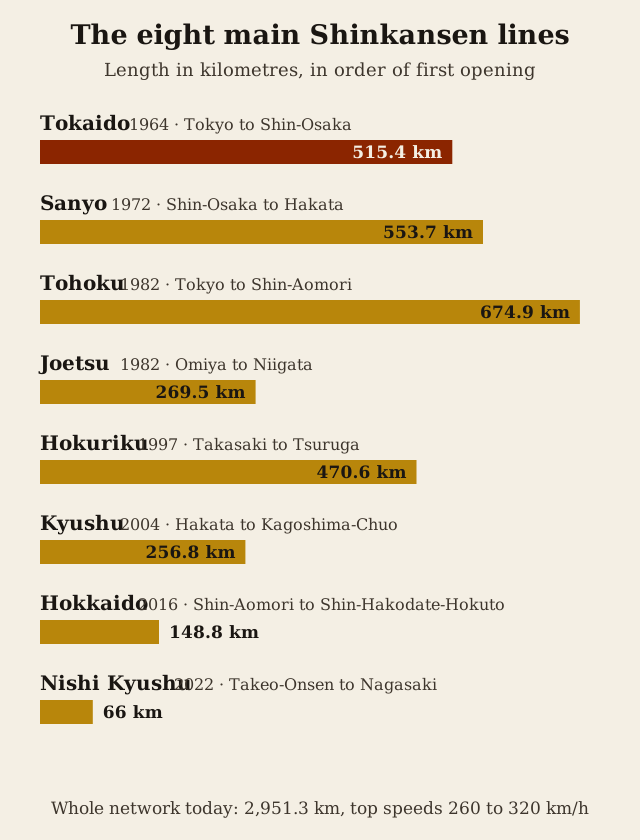
Eight Shinkansen lines make up the core network, built up over six decades outward from the original Tokaido corridor to Kyushu and Hokkaido. Next to high-speed railways abroad, Shinkansen lines usually place the tracks for the two directions closer together, allow tighter minimum curves and have tunnels with a smaller cross section, and each of these limits how much faster the trains can go.
| Line | Opened | Endpoints | Length |
|---|---|---|---|
| Tokaido Shinkansen | 1964 | Tokyo to Shin-Osaka | 515.4 km (320.3 mi) |
| Sanyo Shinkansen | 1972 (Shin-Osaka to Okayama); full line 1975 | Shin-Osaka to Hakata | 553.7 km |
| Tohoku Shinkansen | 1982 (first section, Omiya to Morioka) | Tokyo to Shin-Aomori | 674.9 km |
| Joetsu Shinkansen | 1982 | Omiya to Niigata (through trains to Tokyo) | 269.5 km |
| Hokuriku Shinkansen | 1997 (Takasaki to Nagano); extended 2015 and 2024 | Takasaki to Tsuruga | 470.6 km |
| Kyushu Shinkansen | 2004 (southern section); full line 2011 | Hakata to Kagoshima-Chuo | 256.8 km |
| Nishi Kyushu Shinkansen | 2022 | Takeo-Onsen to Nagasaki | 66 km |
| Hokkaido Shinkansen | 2016 | Shin-Aomori to Shin-Hakodate-Hokuto | 148.8 km |
Each line's construction followed its own timeline. The Tohoku Shinkansen's first section opened between Omiya and Morioka on June 23, 1982, before later growth made it Japan's longest Shinkansen line, linking Tokyo and Aomori. The Sanyo Shinkansen's Shin-Osaka to Okayama segment opened on March 15, 1972, and the rest of the line followed on March 10, 1975, connecting Shin-Osaka with Hakata Station in Fukuoka. The Joetsu Shinkansen began regular service on November 15, 1982. The Hokuriku Shinkansen opened in stages: its first 117.4 km section between Takasaki and Nagano opened on October 1, 1997, it was extended 228.1 km from Nagano to Kanazawa on March 14, 2015, and a further 125 km extension from Kanazawa to Tsuruga opened on March 16, 2024. The Kyushu Shinkansen's southern section opened on March 13, 2004, and its northern section followed on March 12, 2011, connecting Hakata Station in Fukuoka with Kagoshima-Chuo Station in Kagoshima. The Nishi Kyushu Shinkansen, the shortest line in the network, opened its 66 km section between Takeo-Onsen and Nagasaki on September 23, 2022. The Hokkaido Shinkansen's initial section between Shin-Aomori and Shin-Hakodate-Hokuto opened on March 26, 2016.
The Tokaido Shinkansen is the busiest line in the network, carrying about 171 million passengers in fiscal 2024, and it carried roughly 5.3 billion passengers in total between 1964 and 2012. In JFY2019, the line ran an average of 378 trains a day with an average delay of just 12 seconds. Through services also link separately operated lines: trains run between the Tokaido and Sanyo lines and between the Sanyo and Kyushu lines even though different companies operate each one. Prime Minister Kakuei Tanaka backed the Shinkansen strongly. His government put forward a large network that would run alongside most of Japan's existing trunk lines. The Tohoku and Joetsu Shinkansen were built under that plan, but JNR's mounting debt delayed or cancelled many of the other lines it proposed.
Notable Shinkansen Train Series
The 0 Series was introduced by Japanese National Railways in October 1964 for the newly opened Tokaido Shinkansen, built by manufacturers including Hitachi, Kawasaki Sharyo, Kinki Sharyo, Kisha Seizo, Nippon Sharyo and Tokyu Car Corporation. A retired 0 Series front car was donated by JR West to the National Railway Museum in York, England, in 2001. The 100 series followed in 1985, adding bilevel cars with a restaurant car and compartments. Central Japan Railway Company (JR Central) was established in April 1987, and the company introduced the first Nozomi service, running 300 series trains, on the Tokaido Shinkansen in March 1992, followed by the 700 series in 1999 with a maximum operating speed of 285 km/h.
JR Central introduced the N700 series for Nozomi services in July 2007; the type has a maximum operating speed of 300 km/h and is operated by JR Central, JR West and JR Kyushu across the Tokaido, Sanyo, Kyushu and Hakataminami lines. A Kyushu-specific variant, the N700-7000/8000 series, began running as 8-car trainsets on the Kyushu Shinkansen in March 2011 with the same 300 km/h top speed. JR Central followed with the N700A in February 2013 and the N700S, which began commercial operation in July 2020. On the Hokuriku line, JR East introduced the 12-car E7 series in March 2014, joined by JR West's matching W7 series in March 2015, and the E7 later reached the Joetsu Shinkansen in 2019. The privatized regional JR companies have kept developing new Shinkansen rolling stock, and each new model usually gets a look of its own; JR West's 500 series is one example. On the Kyushu Shinkansen, the fastest service category, Mizuho, makes the fewest stops, mainly Hakata, Kumamoto and Kagoshima-Chuo, while the slowest category, Tsubame, stops at every station along the line.

Shinkansen Safety Record
Since the Shinkansen's first train left Tokyo in 1964, the network has recorded no passenger fatalities from train accidents such as derailments or collisions in more than 60 years of operation. In that time, two trains have derailed in passenger service: a Joetsu Shinkansen train during the Chūetsu earthquake on October 23, 2004, with no casualties among its 154 passengers, and an Akita Shinkansen train in a blizzard on March 2, 2013, with no passengers injured. The network has separately recorded suicides by passengers jumping from or in front of moving trains, tracked apart from operational accidents.

Engineering safeguards include the Urgent Earthquake Detection and Alarm System, introduced in 1992 to brake trains automatically during large earthquakes, given Japan's earthquake risk. During inspections prompted by the Kobe Steel data falsification scandal, involving a supplier of high-strength steel for Shinkansen trainsets, cracks were found in a single bogie, which was removed from service on December 11, 2017. On August 15, 2025, crew members aboard a Kodama service on the Tokaido Shinkansen noticed a burning smell, and firefighters found a fire on the underside of the train; there were no reported injuries, and the 250 passengers moved to a later Nozomi service. On the reliability side, JR Central reported an average delay of 24 seconds per Shinkansen train in 2016.
Lines Still Under Construction
The Hokkaido Shinkansen's current line, between Shin-Aomori and Shin-Hakodate-Hokuto, opened on March 26, 2016, running 148.8 km. It continues from the Tohoku Shinkansen at Shin-Aomori and reaches Hokkaido through the undersea Seikan Tunnel, and it is operated by Hokkaido Railway Company (JR Hokkaido). An extension toward Sapporo, adding roughly 211.3 km of new line that is about 76% tunnel, is under construction; in December 2024 its opening was put back to the end of fiscal year 2038. In April 2026, Japan's Ministry of Finance estimated that higher construction costs had cut the extension's cost-benefit ratio to 0.6. New Shinkansen construction needs a ratio of at least 1.0, so the project fell into the range that the government classifies as one that should, in principle, be discontinued.
As of 2025, a second major project, the maglev Chuo Shinkansen, was under construction by JR Central between Shinagawa Station in Tokyo and Nagoya, with a later extension to Osaka planned. Maglev trains began running on the Yamanashi test track in 1997, routinely at over 500 km/h, and JR Central announced in July 2008 that the line would start at Shinagawa rather than Tokyo Station because of difficulty securing land there. JR Central's original target for starting commercial service between Tokyo and Nagoya was 2027. Construction delays made that date impossible, and in 2025 the opening was pushed back to 2035 at the earliest. The Nagoya to Osaka section is targeted for 2037 at the earliest, and the full line is planned to link Tokyo and Osaka in 67 minutes.
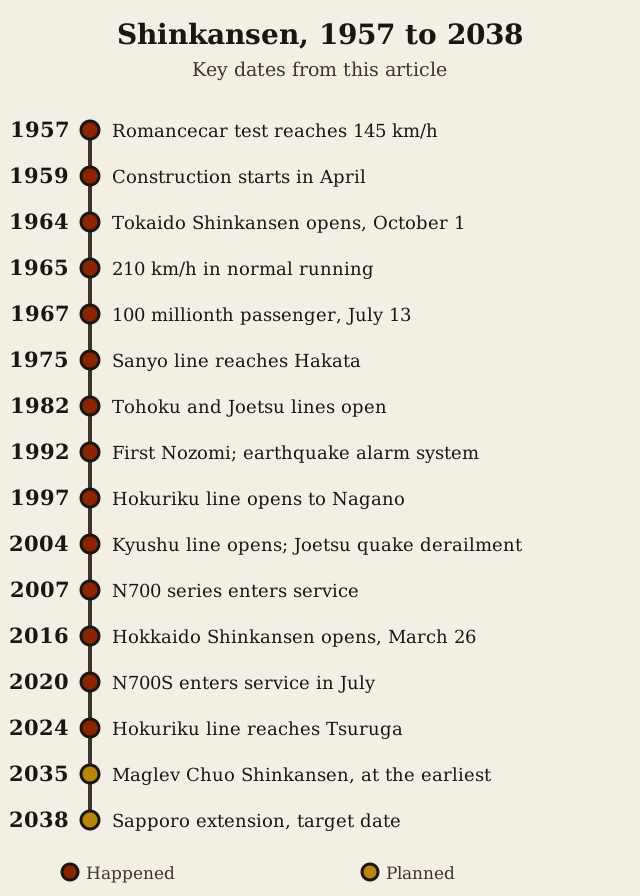

Japan has kept extending the Shinkansen network for six decades, from the 1964 Tokaido line to the 2024 extension to Tsuruga. Rails & Rivals, our game on Steam, is a turn-based railroad strategy board game for 2 to 6 players: each player runs a rail company, lays track across a hex map and carries goods between cities, and the wealthiest company wins. The how to play page has the rules.
Keep reading
Sources
- The Shinkansen Turns 50: The History and Future of Japan's High-Speed Train (Nippon.com)
- Shinkansen (Wikipedia)
- Tokaido Shinkansen (Wikipedia)
- Tōhoku Shinkansen (Wikipedia)
- San'yō Shinkansen (Wikipedia)
- Jōetsu Shinkansen (Wikipedia)
- Hokuriku Shinkansen (Wikipedia)
- Kyushu Shinkansen (Wikipedia)
- Nishi Kyushu Shinkansen (Wikipedia)
- Chūō Shinkansen (Wikipedia)
- Mini-Shinkansen (Wikipedia)
- Hokkaido Shinkansen (Wikipedia)
- Central Japan Railway: Company History (Central Japan Railway Company (JR Central))
- 0 Series Shinkansen (Wikipedia)
- N700 Series Shinkansen (Wikipedia)
- Kyushu Shinkansen (Japan Guide)