Settle-Carlisle Railway: History and Route Explained

The Settle-Carlisle line is a 73 mile (117 km) main railway line in northern England, running from Settle Junction in North Yorkshire across the Yorkshire Dales and the North Pennines to Carlisle. The Midland Railway built it in the 1870s with 14 tunnels and 22 viaducts, the best known being Ribblehead Viaduct. It opened to passengers on 1 May 1876, was nearly closed in the 1980s and was saved in 1989.
Few lines in Britain have a stronger following. It was built as an express route to Scotland through some of the bleakest country in England, it was run down for decades as a duplicate of the West Coast Main Line, and a public campaign rescued it from closure. As of 2026 it carries local trains, freight and regular steam charters. This guide covers why it was built, how, the route station by station, the closure fight and its steam.
Why the Midland Railway Built the Settle-Carlisle Line
The line began as a quarrel between two companies. In the 1860s the expanding Midland Railway wanted its own trains to Scotland, but its route north ran via Ingleton, where it met the Lancaster and Carlisle line controlled by its rival, the London and North Western Railway (LNWR). The two companies could not even agree on sharing a station at Ingleton. For a time Midland passengers had to walk about a mile between two separate stations to change trains.
An agreement later let Midland carriages run through on LNWR trains, but the LNWR handled them with deliberate obstruction, for example attaching them to slow goods trains instead of fast passenger services. The Midland board decided the only answer was a line of its own. Surveying began in 1865, and the Midland Railway (Settle to Carlisle) Act became law in 1866.
A financial crisis soon gave the Midland second thoughts, and it tried to drop the scheme. Parliament refused to let it abandon the line, partly because other railways were counting on it, so the Midland had to build what it had asked for.

Building Ribblehead Viaduct
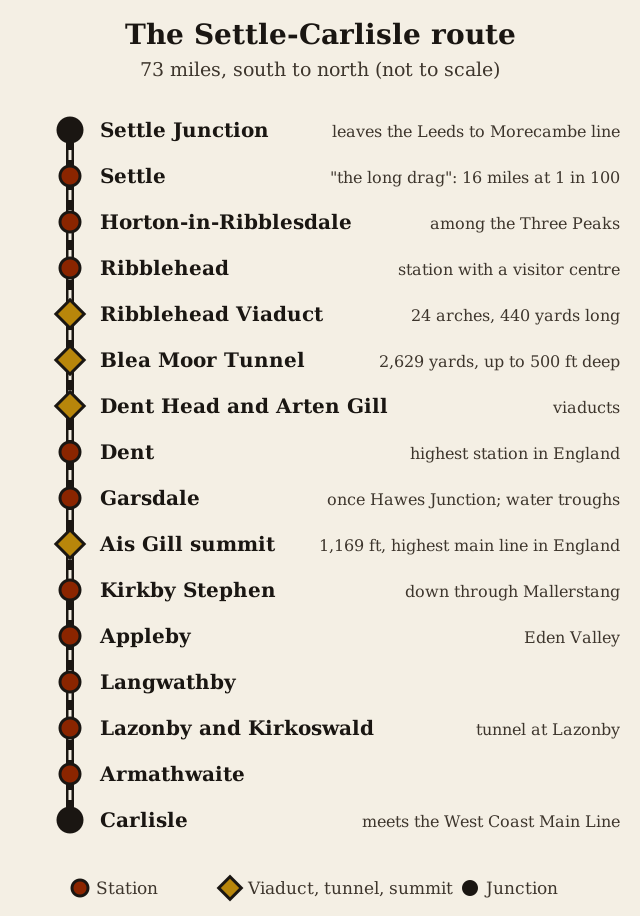
The line was engineered to express standards. To keep gradients no steeper than 1 in 100, the limit for fast running with steam, it needed huge works through the hills. Even so, trains heading north face a 16 mile (26 km) climb from Settle to Blea Moor, almost all of it at 1 in 100, a stretch enginemen called "the long drag".
The most famous structure is Ribblehead Viaduct, also called Batty Moss Viaduct. It is 440 yards (400 m) long and up to 104 feet (32 m) high, with 24 arches of 45 ft span, and it is the longest structure on the line. The first stone was laid on 12 October 1870. In December 1872 the design was changed from 18 arches to 24, and because the ground was swampy, the piers had to be sunk 25 ft below the peat and set in concrete. The last stone went in by the end of 1874. The designer was John Sydney Crossley from Leicestershire, the Midland's chief engineer, who was responsible for all the major works on the line.
Up to 2,300 men worked on the viaduct, living with their families in temporary camps on the moor. The Batty Green camp alone housed over 2,000 navvies, and over 100 men died during the viaduct's construction, from accidents and disease. Eighty people died at Batty Green alone in a smallpox epidemic. A plaque in St Leonard's Church at Chapel-le-Dale remembers the workers who died building the railway.

Blea Moor Tunnel and the Rest of the Engineering
Right after Ribblehead the line enters Blea Moor Tunnel, 2,629 yards (2,404 m) long and up to 500 ft below the moor, dug largely by hand. It comes out onto Dent Head Viaduct, followed soon after by Arten Gill Viaduct. The summit at Ais Gill, 1,169 ft (356 m) above sea level, is the highest point reached by main-line trains in England.
The whole line took over 6,000 navvies, most of them Irish, and the work was stopped for months at a time by frozen ground, snowdrifts and floods. Dent Head gets almost four times the rainfall of London, and one contractor gave up after underestimating the terrain and the weather. Some camps became small townships with schools and post offices, with names such as Sebastopol and Jericho. The line opened to goods in August 1875 and to passengers on 1 May 1876, at a cost of £3.6 million, 50 per cent over the estimate.
The Route from Settle Junction to Carlisle
The line leaves the Leeds to Morecambe line at Settle Junction and runs north through these stations:
- Settle, the market town that gives the line its name.
- Horton-in-Ribblesdale, among the Three Peaks and their quarries.
- Ribblehead, beside the viaduct, with a visitor centre in the station.
- Dent, the highest railway station in England, 4.5 miles from the village it is named after.
- Garsdale, once Hawes Junction, near Dandry Mire Viaduct. It had the highest water troughs in the United Kingdom, where steam locomotives took water on the move.
- Kirkby Stephen, past the summit at Ais Gill and down through Mallerstang.
- Appleby, the old county town of Westmorland, in the Eden Valley.
- Langwathby, Lazonby and Kirkoswald, and Armathwaite, villages on the Eden Valley run. The tunnel at Lazonby was built because the local vicar did not want trains passing his vicarage.
- Carlisle, the border city where the line meets the West Coast Main Line.
Many stations were miles from the villages they served, because the route was built for through expresses first and local traffic second. Today Northern runs the passenger trains, mostly Class 158 diesel units, at up to 60 mph. Most of the line is double track, but Ribblehead Viaduct was reduced to a single track during the 1980s repairs.

The Closure Fight and the 1989 Reprieve
The Midland and the LNWR were merged into the London, Midland and Scottish Railway in 1923, and from then on the Settle-Carlisle was a slower duplicate of the west coast route. In 1962 the Thames-Clyde Express over the line took almost nine hours from London to Glasgow, against 7 hours 20 minutes on the West Coast Main Line. The 1963 Beeching Report recommended withdrawing all passenger services, the last through expresses ended in the 1970s, and by the early 1980s only a handful of trains ran each day.
By 1980 Ribblehead Viaduct was in disrepair, with water weakening many of its piers. British Rail argued that renewing the viaducts and tunnels would cost far too much for so little traffic, and in 1984 closure notices went up at the stations. The Friends of the Settle-Carlisle Line (FoSCL) had already held its first meeting at Settle Town Hall in June 1981 and campaigned with local councils, residents and enthusiasts. The campaign found that British Rail had exaggerated repair costs, putting Ribblehead alone at £6 million, and had diverted traffic away from the line to justify closing it.
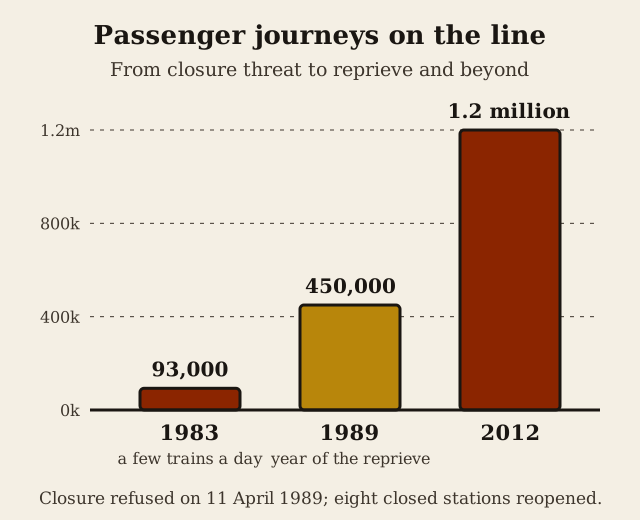
The publicity brought the passengers back: journeys rose from 93,000 in 1983 to 450,000 in 1989. On 11 April 1989 the government refused consent for closure, citing trial repairs on Ribblehead that showed the viaduct could be fixed for less than expected, and the growth in passengers. Michael Portillo, then the minister responsible for railways, made the announcement. By 2012 the line carried 1.2 million passenger journeys, and eight closed stations had reopened. On Garsdale's platform a bronze statue of Ruswarp, the Border Collie who signed the campaign petition with a paw print, remembers the fight.
Steam Specials on the Settle-Carlisle Line
Steam has a special place in the line's story. On 11 August 1968 British Rail ran its last scheduled steam-hauled train, the Fifteen Guinea Special, from Liverpool via Manchester to Carlisle, with the return over the Settle-Carlisle. Main line steam then disappeared from British Rail for years, but once it returned, the line's long climbs and big viaducts made it one of the most popular routes in the country for steam and diesel charters.

FoSCL does not run steam trains itself, but charters cross the line often, and watching a steam engine work hard over Ribblehead Viaduct is a classic sight. When the line fully reopened in March 2017 after a landslip at Eden Brows near Armathwaite, No. 60103 Flying Scotsman ran a special to Carlisle to celebrate, and the hero photo above shows the new-build A1 No. 60163 Tornado on its first run over the line in 2009.
Where the Settle-Carlisle Line Fits in Railway History
The Settle-Carlisle is a late Victorian main line built out of company rivalry rather than local need. It shows how much a railway's route depends on who controls the tracks next door. It is also one of the clearest cases of a line saved by its users: after the 1989 reprieve, the structures that were meant to justify closing it helped make it one of the most popular routes in the country for steam and diesel charters. Our famous railway lines guide sets it beside other record and scenic lines around the world.

The Midland's choice between paying a rival for access and building its own line through the hills is the kind of decision rail strategy games are made of. Rails & Rivals, our game on Steam, is a turn-based railroad strategy board game for 2 to 6 players: each player runs a rail company, lays track across a hex map and carries goods between cities, and the wealthiest company wins. The how to play page has the rules.
Keep reading
Sources
- Settle-Carlisle line (Wikipedia)
- Ribblehead Viaduct (Wikipedia)
- Film: Ribblehead Viaduct (Network Rail)
- FoSCL homepage (Friends of the Settle-Carlisle Line)
- Fifteen Guinea Specials (Friends of the Settle-Carlisle Line)
- About FoSCL (Friends of the Settle-Carlisle Line)
- Portillo visits the S&C (Friends of the Settle-Carlisle Line)
- Settle to Carlisle Railway (Historic UK)