Flying Scotsman: History of the LNER A3 4472 Locomotive

Flying Scotsman is London and North Eastern Railway (LNER) Class A3 Pacific steam locomotive No. 4472, built in 1923 at Doncaster Works to a design by Sir Nigel Gresley. It hauled the first non-stop London to Edinburgh train in 1928 and in 1934 became the first steam locomotive officially recorded at 100 mph. Saved from scrap in 1963, it is now owned by the National Railway Museum in York.
Nigel Gresley's A1 to A3 Pacific Design
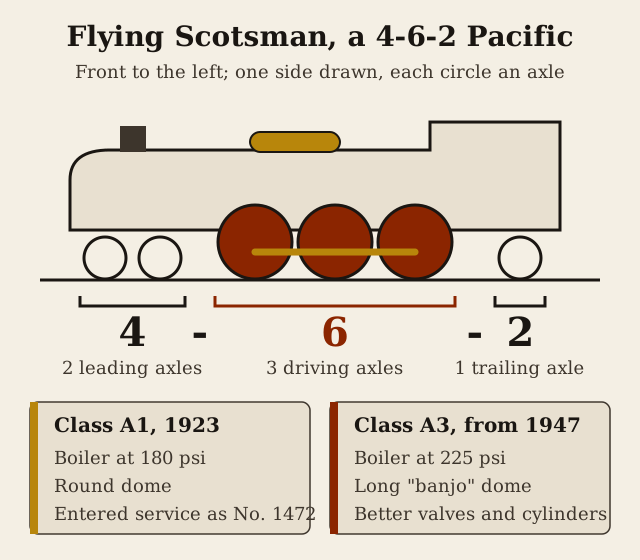
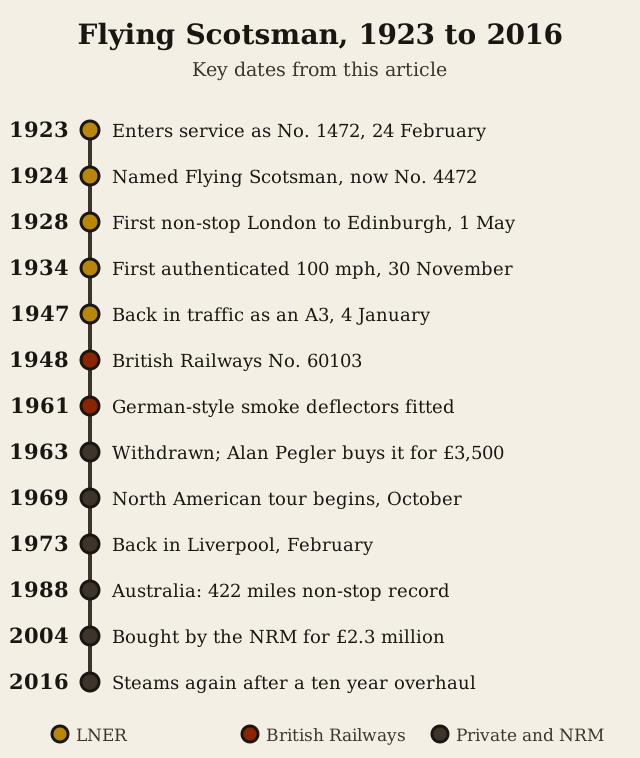
Flying Scotsman began as a Great Northern Railway order. In July 1922 the GNR approved ten Class A1 locomotives of the 4-6-2 "Pacific" type, designed by its chief mechanical engineer Nigel Gresley to haul heavy express passenger trains on the East Coast Main Line. By the time the first of the batch was finished, the GNR had been absorbed into the new LNER in the 1923 grouping, and the A1 became the company's standard express design. The locomotive cost £7,944 to build, was the first engine delivered to the LNER, and entered service on 24 February 1923 as No. 1472.
From 1928 Gresley gradually rebuilt his A1s into an improved version, the A3. Flying Scotsman was one of the last: it was rebuilt in late 1946 and returned to traffic on 4 January 1947. Its old round-dome boiler working at 180 psi was replaced with a 225 psi boiler carrying the long "banjo" dome it still has, and it got more efficient valves and cylinders. In the Whyte notation used for steam engines, it stayed a 4-6-2 throughout; our Whyte notation guide explains what that means.
The Name and the Train It Honors
The locomotive is named after a train. The Flying Scotsman service began in 1862 as the Special Scotch Express, with simultaneous 10:00 departures from King's Cross in London and Edinburgh Waverley. The LNER officially named the daily express Flying Scotsman in 1924, and it still runs the 393 miles between the two cities today, operated by London North Eastern Railway, one of the oldest named train services in the world.

No. 1472 got the name in February 1924, when the LNER chose it to appear at the British Empire Exhibition at Wembley, and it was renumbered 4472 at the same time. From then on the locomotive was the company's flagship, and it went back to the exhibition in 1925.
The 1928 Non-Stop Run Between London and Edinburgh
On 1 May 1928 No. 4472 hauled the first non-stop Flying Scotsman from London to Edinburgh, a run of 392 miles completed in 8 hours and 3 minutes. No locomotive could carry enough coal for that distance with one crew, so the LNER built special corridor tenders for the service. The tender held an extra long ton of coal and had a narrow corridor down one side, so a fresh driver and fireman could walk through from the train and take over while it kept moving.

The non-stop run made the locomotive famous. In 1929 it appeared in The Flying Scotsman, a feature film built around the train and the locomotive.
The 1934 World Record for 100 mph
On 30 November 1934, hauling a light test train between Leeds and London, Flying Scotsman reached 100 mph. It was the first steam locomotive whose 100 mph was officially authenticated, and the LNER made the most of the publicity. The Great Western Railway's City of Truro was reported to have reached the same speed in 1904, but that claim was never officially confirmed.

Gresley's streamlined A4 class arrived the next year, in 1935, and soon took over the fastest trains; an A4, Mallard, went on to set the world steam speed record in 1938, covered in our fastest steam locomotives guide. Flying Scotsman was moved to lesser duties, though it still worked main line passenger trains. In 1943, like all railway stock in the Second World War, it was painted black.
British Railways Rebuilding and the Smoke Deflectors
After Britain's railways were nationalised on 1 January 1948, the locomotive became British Railways No. 60103. It wore BR Express Blue between 1949 and 1952 and then BR Green, and returned to the East Coast Main Line in 1953, first at Grantham and then back at King's Cross.

In December 1958 BR fitted a double Kylchap chimney to improve performance and economy. The softer exhaust from the new chimney let smoke drift down over the boiler and block the driver's view, so at the end of 1961 the locomotive was given German-style smoke deflectors, the wing-like plates beside the smokebox. That is why photographs of Flying Scotsman show it in two quite different looks: the clean LNER outline, and the BR look with double chimney and deflectors. It was withdrawn from BR service on 15 January 1963, after covering about 2.08 million miles.
Private Ownership, Bankruptcy and the Rescue from America
Amid rumours that BR would scrap it, the businessman and railway enthusiast Alan Pegler bought Flying Scotsman in January 1963 for £3,500. He had it restored at Doncaster as closely as possible to its LNER condition: renumbered 4472, painted LNER Apple Green, smoke deflectors removed, single chimney refitted, and a corridor tender coupled up. As water columns for steam engines disappeared, he added a second tender in 1966, converted into an extra water tank. Forty years after its first non-stop run, Flying Scotsman repeated the feat in May 1968, running from King's Cross to Edinburgh without a stop.
In 1969, with the support of Harold Wilson's government, Pegler took the locomotive to North America to haul an exhibition train promoting British exports, fitted with a cowcatcher, bell, American whistle and headlamp. The tour began in October 1969 with a run from Boston to Atlanta via New York and Washington, then continued to Texas. Complaints from businesses along the route ended the trips, the train had to move to a less accessible yard and income fell by 90 percent. Pegler, now £132,000 in debt, declared himself bankrupt, and the locomotive was stored at the US Army's Sharpe Depot in California to keep it from unpaid creditors.

William McAlpine heard of the situation and arranged a rescue, paying off the locomotive's debts and buying it for $72,000, about £25,000. Flying Scotsman arrived back in Liverpool in February 1973 and steamed to Derby with crowds lining the route. From 1986 its base was the Southall Railway Centre in London.
Later Owners and an Australian Record
In October 1988 McAlpine sent Flying Scotsman to Australia for the country's bicentenary. It covered more than 45,000 km there, including Sydney to Perth via Alice Springs, and set a second world record: the longest non-stop run by a steam locomotive, 422 miles between Parkes and Broken Hill in New South Wales. In Perth it met GWR No. 4079 Pendennis Castle, which had stood beside it at the British Empire Exhibition in 1924.

Back in Britain it returned to its BR look as 60103 and ran until its main line certificate expired in 1992. In 1993 the music producer Pete Waterman joined McAlpine as co-owner. In February 1996 the entrepreneur Tony Marchington bought the locomotive, a set of Pullman coaches and the Southall depot for £1.5 million, then spent about £1 million on a three year overhaul back to main line condition. His company ran into debt, and in 2003 Marchington was declared bankrupt, which put the locomotive up for sale again.
Purchase by the National Railway Museum and Restoration
In 2004 the locomotive was offered in a sealed bid auction. Amid fears it could go abroad, the National Railway Museum ran a Save Our Scotsman appeal and won with a bid of £2.3 million, 15 percent above the next bidder. Most of the money came from a £1.8 million National Heritage Memorial Fund grant, with the rest from public donations, matched by Richard Branson, and a newspaper appeal. Flying Scotsman arrived in York in time for the museum's Railfest in June 2004.

Its condition was worse than anyone knew. It failed several times in 2004 and 2005, and in January 2006 it entered the museum's workshops for an overhaul expected to take a year and cost about £750,000. Instead, the work found a misaligned frame, a cracked cylinder and cracks throughout the frame assembly. A 2012 review found the museum had greatly underestimated the job after a rushed early inspection. The work moved to Riley & Son in Bury in 2013, and Flying Scotsman finally steamed again in January 2016, after ten years and a final cost of £4.2 million.
Flying Scotsman in Popular Culture
Few locomotives have been on screen as often. After the 1929 film, it appeared with a British Rail InterCity 125 in a 1985 television advert, and its long restoration became television in its own right, on BBC Four and in an ITV series with Robson Green. It has a full role in the animated film Thomas & Friends: The Great Race (2016), voiced by Rufus Jones. The Royal Mint issued a collectable £2 coin, some struck in colour inspired by its Apple Green livery, the first colour coin the Mint had made in over 20 years.

Where Flying Scotsman Ran From 2016
From 2016 Flying Scotsman hauled special trains across Britain, including a farewell run for Alan Pegler from King's Cross to York in October 2018, organised at the request of his daughter. In April 2022 it was withdrawn for an overhaul ahead of its centenary year in 2023. After that work it is certified to run on the main line until 2029, and then only on heritage railways until 2032. The National Railway Museum looks after it as part of the national collection.

Flying Scotsman's whole career, from flagship express engine to publicity star, shows how much a railway's name depends on the trains it runs. Rails & Rivals, our game on Steam, is a turn-based railroad strategy board game for 2 to 6 players: each player runs a rail company, lays track across a hex map and carries goods between cities, and the wealthiest company wins. The how to play page has the rules.
Keep reading
Sources
- LNER Class A3 4472 Flying Scotsman (Wikipedia)
- London & North Eastern Railway Steam Locomotive, 'Flying Scotsman' (Science Museum Group)
- Flying Scotsman (train) (Wikipedia)
- Flying Scotsman Made Train History When Speedometer Hit 100 (Smithsonian Magazine)