Largest Steam Locomotive Ever Built: Weight, Length, Power

The largest steam locomotive ever built, by total weight, is Union Pacific's Big Boy: the railroad gives each one a length of 133 feet, a weight of 1.2 million pounds and a maximum tractive power of 135,375 lbs. Guinness World Records also lists the Big Boy as the largest steam locomotive. Other locomotives hold the record for length, for horsepower, or for outright pulling force, so which engine counts as biggest depends on the measurement.
Why "biggest" depends on what you measure
Union Pacific says its Big Boy weighs 1.2 million pounds and is 133 feet long, while Wikipedia credits the Pennsylvania Railroad's S1 as the longest reciprocating steam locomotive ever built, at 140 ft 2-1/2 in overall including engine and tender.
A locomotive that wins on one measure can lose on another, so every "biggest" claim below names the specific measure it refers to.

The largest steam locomotives, compared
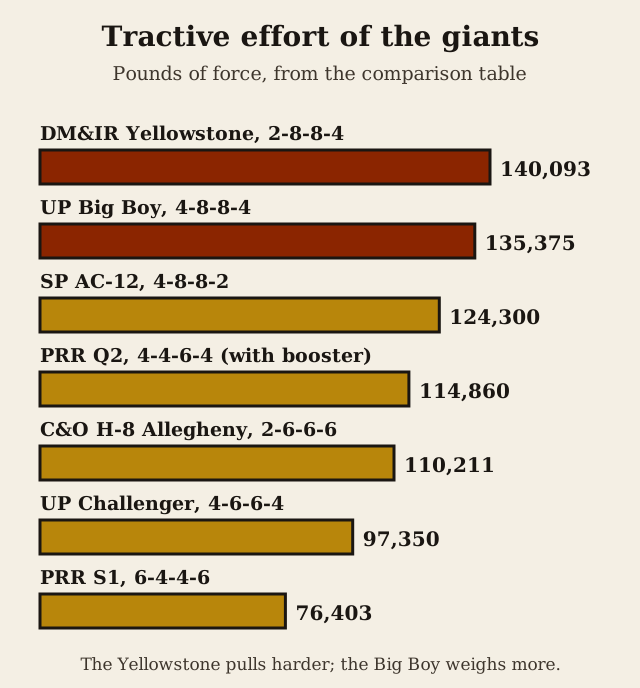
| Locomotive | Wheel arrangement | Length | Weight | Tractive effort | Number built | Survivors |
|---|---|---|---|---|---|---|
| Union Pacific Big Boy | 4-8-8-4 | 133 ft overall | 1.2 million lb | 135,375 lbf | twenty-five | 8 (7 static, 1 operating) |
| Union Pacific Challenger | 4-6-6-4 | nearly 122 ft overall | more than one million lb (UP); 1,073,900 lb total for No. 3985 | 97,350 lbf | 105 | 2 |
| C&O H-8 Allegheny | 2-6-6-6 | 76 ft 8-3/8 in loco, 125 ft 7-7/8 in overall | 771,300 lb in working order (Nos. 1600 to 1644) | 110,211 lbf | not listed | 1 on display at The Henry Ford |
| DM&IR Yellowstone | 2-8-8-4 | not listed | 695,040 lb loco, 1,133,040 lb total | 140,093 lbf | not listed | 3 |
| PRR S1 | 6-4-4-6 (duplex) | 140 ft 2-1/2 in overall | 1,060,010 lb total | 76,403 lbf | 1 | none (scrapped 1949) |
| PRR Q2 | 4-4-6-4 (duplex) | not listed | 1,049,100 lb total | 114,860 lbf (with booster) | 26 | none |
| SP AC-12 | 4-8-8-2 (cab forward) | 123 ft 8 in overall, 78 ft 11 in loco | 657,900 lb loco only | 124,300 lbf | 20 | 1 |
Union Pacific Big Boy: the heaviest, by Union Pacific's own numbers
The Big Boy is an articulated 4-8-8-4 freight locomotive, built for Union Pacific to haul heavy trains over the mountains of Wyoming and Utah. Union Pacific says the locomotives are 133 feet long and weigh 1.2 million pounds, with a maximum tractive power of 135,375 lbs. Union Pacific commissioned twenty-five Big Boys in total, built exclusively for its own railroad.
Our Union Pacific Big Boy guide covers why the class was built for the Wasatch grade, the eight survivors and how No. 4014 was restored to steam.
No. 4014 was retired in December 1961 after traveling 1,031,205 miles. It returned to service in May 2019 to help mark the 150th anniversary of the transcontinental railroad's completion. Guinness World Records recognizes the Big Boy as the largest steam locomotive, citing a figure of 508.02 tonnes, or 1.12 million pounds, with tenders attached. For current running dates, Union Pacific's own heritage page is the place to check.
Among the seven Big Boys on static display is No. 4012, built in November 1941 by the American Locomotive Company at its Schenectady Locomotive Works in Schenectady, New York.

C&O H-8 Allegheny: the horsepower champion
The H-8, known as the Allegheny, is a 2-6-6-6 articulated locomotive that the Chesapeake and Ohio used to haul heavy coal trains over the Allegheny Mountains. Its tractive effort was 110,211 lbf, and it is best known for its power output, given as 6,500 to 7,500 hp at the drawbar.

The locomotive itself measured 76 ft 8-3/8 in, stretching to 125 ft 7-7/8 in with its tender attached. The first batch of Alleghenies, numbered 1600 through 1644, weighed 771,300 lb, or 385.7 short tons, in working order, without the tender.
The example preserved at the Henry Ford Museum, a gift of the Chesapeake and Ohio Railway, could produce 7,500 horsepower, and together with its tender it weighed 1.2 million pounds.
DM&IR Yellowstone: the weight dispute with Big Boy
The Yellowstones were articulated ore haulers on the Duluth, Missabe and Iron Range Railway in northern Minnesota. The railway's 2-8-8-4 engines weighed 695,040 lb for the locomotive alone, or 1,133,040 lb with the tender attached. Tractive effort was 140,093 lbf, higher than the Big Boy's 135,375 lbf.
One account states that the Yellowstones' tractive effort exceeded the Big Boy's, though the Big Boys were slightly heavier overall. Three Yellowstones survive, all on display in Minnesota: No. 225 at Proctor, No. 227 at the Lake Superior Railroad Museum in Duluth, and No. 229 at Two Harbors.

Pennsylvania Railroad S1 and Q2: length, power, and a disputed speed record
The Pennsylvania Railroad's S1 was, at 140 ft 2-1/2 in overall including engine and tender, the longest reciprocating steam locomotive ever built. It weighed 1,060,010 lb in total and produced a tractive effort of 76,403 lbf, said to be the highest of any passenger steam locomotive when it was built. Only one S1 was ever produced, and it was scrapped in 1949.

The S1 also carries a widely repeated speed claim: it was reported to have exceeded 152 mph on the Fort Wayne to Chicago run, and the Pennsylvania Railroad was reportedly fined for the feat. That speed was never independently verified, so it was never confirmed as a record.
The Q2, a later Pennsylvania Railroad duplex design, weighed 1,049,100 lb in total and produced 7,987 indicated horsepower versus 6,645 hp at the drawbar. With its booster engine engaged, tractive effort reached 114,860 lbf, compared with 100,816 lbf without it. The Q2 class comprised one prototype and twenty-five production locomotives, 26 in total, and none survive: all were scrapped.
Southern Pacific AC-12: weight, length, and a sole survivor
The AC-12 is one of Southern Pacific's cab forward locomotives, articulated engines run backwards so the crew sat ahead of the smoke in the long tunnels and snow sheds of the Sierra Nevada. It weighed 657,900 lb for the locomotive alone (576,800 lb with the boiler empty) and stretched 123 ft 8 in overall, with the locomotive itself measuring 78 ft 11 in. Tractive effort was 124,300 lbf.
Twenty AC-12s were built, and only one, No. 4294, survived into preservation. It went on display at the California State Railroad Museum in 1981.

What was preserved
Not all of these giants were kept. The Pennsylvania Railroad's S1 and all of the Q2s were scrapped, leaving nothing of either class today. The Big Boy fared better: of twenty-five built, eight survive, including No. 4014, which still runs in excursion service after returning to steam in 2019.
Union Pacific's related 4-6-6-4 Challenger, built between 1936 and 1943, tells a similar story. Union Pacific once owned 105 of them, nearly 122 feet long and weighing more than one million pounds each, with a tractive effort of 97,350 lbf, but only two survive today. Wikipedia gives a more precise total weight for No. 3985 specifically: 1,073,900 lb, with the same 97,350 lbf tractive effort cited by Union Pacific. No. 3985 is the only Challenger to have operated in excursion service, and in April 2022 Union Pacific announced it would donate the locomotive to the Railroading Heritage of Midwest America, which is restoring it to operating condition.

Rails & Rivals, our game on Steam, is a turn-based railroad strategy board game for 2 to 6 players: each player runs a rail company, lays track across a hex map and carries goods between cities, and the wealthiest company wins. The how to play page has the rules.
Keep reading
Sources
- Big Boy No. 4014 (Union Pacific Railroad)
- Challenger No. 3985 (Union Pacific Railroad)
- Union Pacific Big Boy (Wikipedia)
- Union Pacific 4014 (Wikipedia)
- Union Pacific 3985 (Wikipedia)
- Largest steam locomotive (Guinness World Records)
- Chesapeake and Ohio class H-8 (Wikipedia)
- Allegheny Steam Locomotive, 1941 (The Henry Ford Museum)
- 2-8-8-4 (Wikipedia)
- The DM&IR Yellowstones (American-Rails.com)
- Pennsylvania Railroad class S1 (Wikipedia)
- Pennsylvania Railroad class Q2 (Wikipedia)
- Southern Pacific 4294 (Wikipedia)
- Southern Pacific class AC-12 (Wikipedia)