Model Train Scales Chart: Ratios, Gauges and History

Scale is the ratio between a real locomotive and its model, while gauge is the distance between the rails, and the two do not always match in the way you would expect.
The model train scales chart
The table below lists the main commercial scales from smallest to largest, with their ratio to the real thing, their track gauge, and the detail that makes each one distinct.
| Scale | Ratio | Track gauge | Notable detail |
|---|---|---|---|
| Z | 1:220 | 6.5 mm | One of the smallest commercially available scales, named Z because it is the last letter of the alphabet |
| N | 1:160 (effectively 1:159) | 9 mm | Launched commercially by Arnold of Nuremberg in 1962 |
| TT | 1:120 | 12 mm | Invented in the US by former automotive designer Hal Joyce |
| OO | 1:76.2 (4 mm to the foot) | 16.5 mm | British standard, shares HO's track width |
| HO | 1:87 (3.5 mm to the foot) | 16.5 mm | One of the most popular scales for model railroaders |
| S | 1:64 | 22.4 to 23.0 mm | Made popular by A.C. Gilbert's American Flyer trains from 1946 |
| O | 1:43.5 (UK), 1:45 (Continental), 1:48 (US) | 31.75 mm (American 1:48) | Three different ratios share the same name depending on country |
| G | roughly 1:13 to 1:32 | 45 mm (fixed) | One track gauge covers narrow, metre and standard-gauge prototypes |
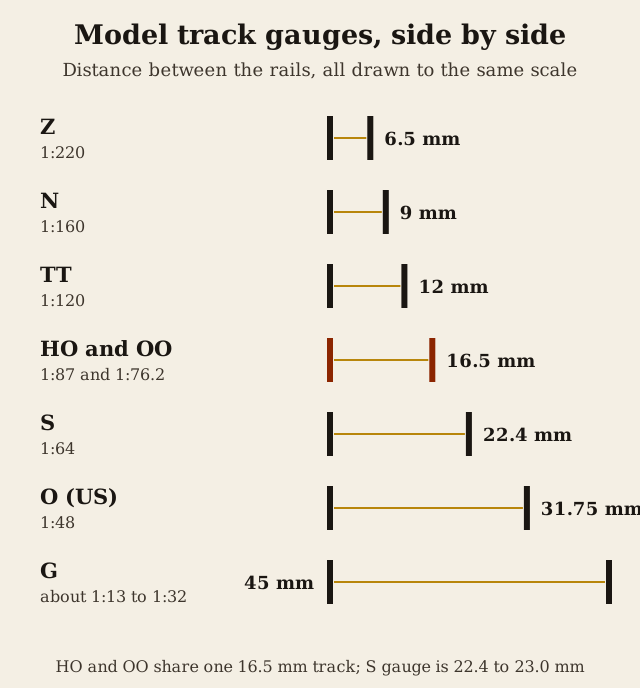
Two things stand out in this chart. First, a single track gauge can represent more than one scale, which is exactly what happens with OO and HO, and again with the several ratios that share G scale's 45 mm track. Second, the ratio numbers themselves were often set by what motors, toy fairs, or existing tooling could support at the time, not by a tidy mathematical plan.

An EBSCO research summary independently lists HO as one of the most popular scales for model railroaders, at approximately 1:87 actual size, puts N scale at approximately 1:160 actual size with a gauge of 9.0 millimeters, and gives O scale trains as approximately 1:48 actual size with a gauge of 31.75 millimeters, matching the ratios and gauges shown in the table above.
Where model train scales came from
Model railroading followed real passenger railroads almost immediately, with toy makers producing wooden and metal replicas starting in the 1820s. The first commercially available toy train set that included track came from the German company Marklin in 1891.
Marklin itself traces back further than that single train set. The company was founded by tinsmith Theodor Friedrich Wilhelm Marklin in 1859 in Goppingen, Germany, and all early model toy trains were originally built to Marklin's Gauge 1, a track measuring 1.75 inches, or 44.45 mm, wide. In 1891, at the Leipzig Toy Fair, Marklin went further and defined gauges 1 through 5 as the first numbered standards for toy trains.

America joined in a few years later. Carlisle and Finch created the first American electric model engine in 1896, and Lionel built its first electric train in 1901. By the 1950s, model railroading had reached its commercial peak in the US, with train sets the best-selling item in the holiday market that decade.
HO scale: how it became the default
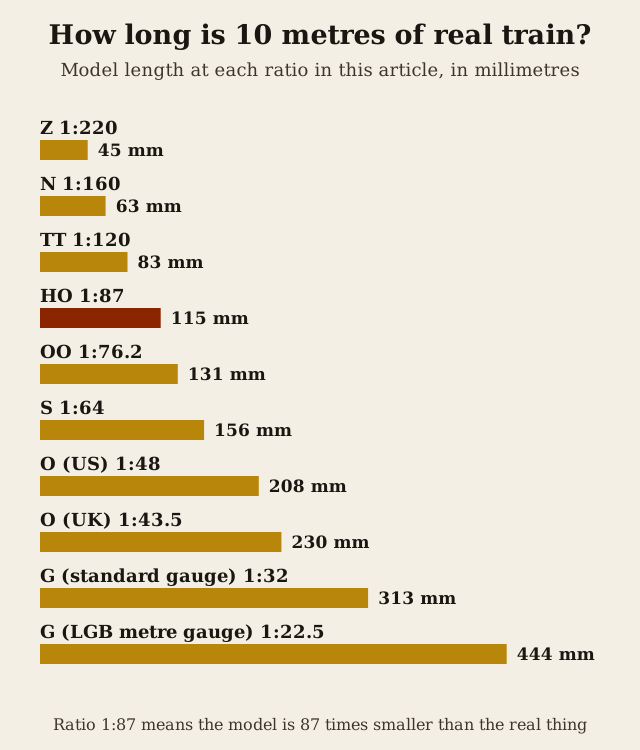
HO scale is defined as a 1:87 ratio, or 3.5 mm to the foot, with track spaced 16.5 mm apart to represent standard-gauge rails of 1,435 mm. The name literally means "Half O", since 1:87 is half the ratio of the older O scale that Marklin had introduced around 1900.
One early compromise grew out of HO: when the scale was first developed, the motors available were too large to fit inside scale-sized locomotive bodies, so manufacturers increased the body size from 3.5 mm to 4 mm to the foot while keeping the gauge unchanged, so other parts could still be shared across ranges. That 4 mm body on 16.5 mm track is the OO scale described below. HO did not dominate the hobby right away, either: it only began to challenge the market dominance of O gauge in the 1950s, and by the 1960s, as it overtook O scale in popularity, even longtime O gauge stalwarts like Marx and the Lionel Corporation started manufacturing their own HO trains.
N scale: small trains, big layouts
N scale's track gauge is precisely 9 mm between the rails, a figure chosen so that it would represent the 1,435 mm width of real standard gauge at a ratio of 1:160 (effectively 1:159). Modern N scale models were first launched commercially by the Arnold company of Nuremberg in 1962. Arnold's own company history credits that 1962 Rapido range, built to 1:160 scale on 9 mm track, as the actual birth of N scale as a commercial product. Arnold itself had been founded in Nuremberg on 4 October 1906 by Karl Arnold, decades before N scale existed.

So the HO vs N question comes down to size and detail versus space: the same room holds a much longer N scale main line, while HO leaves more room for detail on every car and building. Whichever you choose, the track plan matters as much as the scale, and our model railroad layout plans guide covers the loops, point to point lines and switching plans that make the most of the space you have.
OO vs HO: same track, different scale
This is the comparison that causes the most confusion, and it is a genuinely odd piece of history rather than a simple mistake. OO gauge models at 1:76.2, or 4 mm to the foot, but it runs on the same 16.5 mm track that HO uses. That shared track width means OO's rails actually represent a prototype gauge of about 4 ft 1.5 in rather than 4 ft 8.5 in standard gauge, making British OO track 12.5% narrower than its own 1:76.2 scale would strictly call for.

OO itself traces back to 1921, when Bing launched Double-O scale model railways under the name "The Table Railway," running on the same 16.5 mm track and scaled at 4 mm to the foot that OO still uses today. Meccano, the British company founded by inventor Frank Hornby, entered the OO market in 1938 under the Hornby Dublo brand. Hornby himself was born on 15 May 1863 in Liverpool, formed the Meccano company in 1908, launched Hornby Trains in 1920, and introduced the Dinky Toys die-cast line in 1934, not long before his death. The Science Museum Group's national collection even holds a set of Hornby OO gauge brake van models from around 1960, boxed as a six-wagon set.
O, S, TT, Z and G scale, briefly
O scale has no single agreed ratio. The British use 1:43.5, Continental Europe uses 1:43.5 and 1:45, and American manufacturers use 1:48, each calling their product "O scale" regardless. O gauge became the default American standard almost by accident: the Great Depression wiped out demand for larger, more expensive trains, so O gauge was left as the standard, more or less by default, by 1932. Three-rail AC O gauge then remained the most common model railroad scale in the United States until the early 1960s, when HO overtook it. Lionel sold O gauge trains from 1915.
S scale is formally defined as a 1:64 ratio by its own standards body, the National Association of S Gaugers, which maintains official track and wheel standards for the community and stresses that all 1:64 products are the same scale despite naming confusion. Those S scale standards are themselves built around the real North American standard-gauge rail spacing of 4 feet, 8.5 inches, the same prototype width that HO and N scale are also modeling at their own, different ratios. The earliest known 1:64-scale train model was a cardstock construction from 1896, but genuine S scale, S gauge trains did not arrive commercially until A.C. Gilbert's American Flyer brand began producing them in 1946.
TT scale, short for "table top," uses a 1:120 ratio with 12 mm track gauge. Hal Joyce, a former automotive designer, created it in the United States; his company, H.P. Products, was founded in 1945, and the first TT scale advertisement appeared in 1946. In Europe, TT scale production began separately in West Germany, through the Rokal brand, and in East Germany, through Zeuke, toward the end of the 1950s.
Z scale, at 1:220, is one of the smallest commercially available model railway scales, with a track gauge of just 6.5 mm between the rails. Its name was chosen deliberately: Z is the last letter of the alphabet, signaling that no smaller commercial scale was expected to follow.

G scale breaks the usual rule that one scale equals one gauge. It uses a fixed 45 mm track gauge for outdoor garden railways, but that single gauge actually covers several different ratios, from about 1:13 for narrow-gauge prototypes up to 1:32 for standard-gauge ones. The German company LGB introduced G scale in 1968, adopting the 45 mm gauge to model 1,000 mm-gauge European trains at a ratio of 1:22.5, which is why a G scale train can look so different in size depending on which prototype it is based on.
Why scale and gauge keep getting confused
Part of the confusion across every scale in this chart traces back to loose language. Scale and gauge are formally distinct terms in model railroading: gauge refers to the distance between the rails, while scale is the ratio of a real locomotive's size to the model's size, according to the National Association of S Gaugers. Using "gauge" as a casual name for a scale is an old habit, with roots in the early 1900s when the hobby itself was just getting started, and it is the same habit that lets people talk about "OO gauge" and "HO gauge" as if the track width alone settled the matter.

The organization most responsible for sorting out these standards across North America is the National Model Railroad Association, founded in the United States in 1935. Its initial goal was to develop standards for scale model railroad equipment specifically to make equipment from different makers interchangeable and operable between modelers, clubs and others, and its core work today is still publishing formal Standards and advisory Recommended Practices for equipment. The NMRA now counts over 16,000 active members, associates, families and clubs worldwide, all working under the same broader mission of education, advocacy and standards for the global scale model railroading hobby.
For readers who want to see these ratios applied to real pieces of history rather than a chart, the Smithsonian's model train collection, originally conceived by transportation curator John H. White, spans locomotives and rolling stock from the earliest railroads of 1803 to 1846 through 20th-century design, built around a centerpiece scale model of a 1949 General Motors E8 diesel locomotive. The collection is displayed as containing some of the finest scale models ever crafted, which makes it a useful reference point for seeing how a single ratio like 1:48 or 1:87 actually reads on a full-size prototype locomotive rather than just on a spec sheet.
From the model shelf to the game board
None of this stops modelers from mixing scales for effect, and it does not need to. A chart like this is mostly useful for knowing what will actually fit on the same track as what you already own.

Real model railroading sits at one extreme of precision, with its competing ratios and gauge mismatches to sort through. Rails & Rivals sits at the other end of that spectrum: it is a turn-based railroad strategy board game for 2 to 6 players, where each player runs a rail company, lays track across a hex map, and carries colored goods between cities while trying to finish as the wealthiest company on the board. There is no HO, N or OO scale to argue over, just the hex grid itself. If you want the full rundown of turns, track-laying and scoring before your first game, the how to play page covers it.
Keep reading
Sources
- About the NMRA (National Model Railroad Association (NMRA))
- National Model Railroad Association (Wikipedia)
- S-Scale Standards (National Association of S Gaugers (NASG))
- Smithsonian Model Train Collection (B&O Railroad Museum / National Museum of Railroad History & Innovation)
- HO scale (Wikipedia)
- N scale (Wikipedia)
- O scale (Wikipedia)
- Frank Hornby - Scientist of the Day (Linda Hall Library)
- Six model railway wagons, OO gauge, brake vans, boxed (Science Museum Group)
- Rail transport modelling scales (Wikipedia)
- Z scale (Wikipedia)
- G scale (Wikipedia)
- OO gauge (Wikipedia)
- S scale (Wikipedia)
- TT scale (Wikipedia)
- About Arnold (Arnold (Hornby Group))
- Model Railroads (EBSCO Research Starters)
- Marklin History (Train Collectors Association, Western Division)