Hornby Trains: History of the British Model Train Maker

Hornby is a British scale model maker whose name is best known for model railways. The company grew out of the toy business of Frank Hornby, the Liverpool inventor behind Meccano, Hornby Model Railways and Dinky Toys. Hornby produced its first clockwork train in 1920 and launched its first OO gauge trains, the Hornby Dublo range, in 1938. Since 1964 the business has changed owners several times.
Frank Hornby, the Man Behind the Name
Frank Hornby was born on 15 May 1863 at 77 Copperas Hill in Liverpool, Lancashire. His parents were John Oswald Hornby, a provision merchant, and Martha Hornby, née Thomlinson. That birth date is on his birth certificate, but an entry in the family bible in his mother's handwriting gives 2 May instead. On 15 January 1887 Hornby married Clara Walker Godefroy, a schoolteacher and the daughter of a customs officer. The couple had two sons, Roland and Douglas, and a daughter, Patricia. His father died in 1899 and the family firm shut down. Hornby then took a job keeping the books for David Hugh Elliot, a Liverpool meat importer.
Frank Hornby began making toys for his sons in 1899 from pieces he cut out of sheet metal in his home workshop. He built models of bridges, trucks and cranes, but the pieces were not interchangeable. His breakthrough was the idea of separate, interchangeable parts that could be bolted together, so that any model could be built from the same components. The regular perforations in those parts could also act as bearings for axles and shafts, which made complex mechanisms relatively simple to build. Hornby made the first metal strips by hand from copper sheets, half an inch wide with bolt holes at half-inch intervals. By the end of 1900 he had a set of parts he considered worth marketing.

From Patent to Meccano Ltd, 1901 to 1914
Frank Hornby patented his invention in January 1901 as "Improvements in Toy or Educational Devices for Children and Young People". To cover the costs, he first had to borrow £5 from his employer, David Elliot. During 1901 he looked for companies to manufacture the product, but it was poorly finished and attracted little attention. Elliot offered him vacant premises next to the office where he worked, and the two men became partners.

Hornby called the toy Mechanics Made Easy. Professor Henry Selby Hele-Shaw, who led Liverpool University's engineering department at the time, backed the idea. With that support, Hornby signed up outside manufacturers to make the parts. Mechanics Made Easy sets went on sale in 1902, each with only 16 different parts and a leaflet showing 12 models. In 1903 the business sold 1,500 sets without making a profit. In 1906 it made a small profit for the first time. By 1907 the part suppliers could not meet demand, so Hornby quit his job with Elliot and leased a workshop in Duke Street in the Rope Walks area of Liverpool. The partners were making their own parts there by June 1907.
In September 1907 Hornby registered the Meccano trade mark and used the name on all new sets. To raise capital for a larger factory, he formed Meccano Ltd on 30 May 1908, with Elliot declining to join and Hornby as sole proprietor. Meccano Ltd acquired a factory in West Derby Road, Liverpool, and began producing Meccano sets for sale across the UK. Meccano Ltd's turnover for the 1910 financial year was £12,000. Hornby and his son Roland set up Meccano (France) Ltd in Paris in 1912. In Germany, Märklin started producing Meccano under licence. A new factory in Binns Road, Liverpool, was in full production by September 1914 and served as company headquarters for over 60 years.
Frank Hornby's Later Years, 1916 to 2013
Frank Hornby launched the monthly Meccano Magazine in 1916, and it stayed in circulation for over sixty years. In 1930 he formed the Meccano Guild, which brought together Meccano clubs from around the world. By the 1930s his inventions had made him a millionaire. In 1931 he was elected Conservative MP for the Everton constituency in Liverpool, and he stood down at the 1935 general election.

Frank Hornby died in Maghull, near Liverpool, on 21 September 1936, of a chronic heart condition complicated by diabetes. He is buried in the grounds of St Andrew's Church, Maghull. His elder son Roland took over as chairman of Meccano Ltd. Long after his death, on 15 May 2013, the 150th anniversary of his birth was marked by National Museums Liverpool, the Frank Hornby Charitable Trust in Maghull and the Brighton Toy and Model Museum.
Hornby's First Trains: O Gauge, 1909 to 1949
In 1909 an educational Meccano set, the Hornby System of Mechanical Demonstration, became the first product to carry the Hornby name. Meccano's first railway product arrived in 1915 under the name Raylo. Only in 1920 did Meccano sell a loose track model railway system under the Hornby name. That year Meccano Ltd launched the Hornby Clockwork Train, an O gauge model in enameled tinplate. The first Hornby trains were replicas of British trains, with the authentic colours and lettering of the railway companies of the time. By 1922 Meccano was making both Hornby and Zulu clockwork trains.
Shortly after the clockwork model came an electric Hornby train. Its design fell short, and the small number produced went on sale in France. In 1925 a much more successful electric model arrived, running on a high voltage of 110 volts AC. Clockwork nonetheless remained the mainstay of Hornby's O gauge trains until 1937. From 1949 clockwork was the only power available in Liverpool-made O gauge trains. Hornby trains made in Liverpool were exported in large numbers to Australia, New Zealand, Argentina and Scandinavia.

In 1927 Hornby set up a factory in Elizabeth, New Jersey, to make American-style trains. These trains were colourful and attractive, but low-market and clockwork only. Meccano Ltd sold the Elizabeth plant to the A. C. Gilbert Company in late 1929. Hornby trains had vanished from the US market by 1930. In 1931 Meccano Ltd introduced Modelled Miniatures to go with its railway sets. In early 1934 these die-cast models became Dinky Toys.
Hornby Dublo and the Move to OO Gauge, 1938 to 1959
In 1938 Meccano launched OO scale trains, branded Hornby Dublo. Its locomotives were made of diecast metal, while most carriages and wagons used tinplate. The range of electric and clockwork models consolidated 12 volt DC as the standard for OO scale. OO then became a broadly accepted modelling standard in the UK, while much of the rest of the world adopted HO scale, as our model train scales chart explains. Electric Hornby Dublo engines used a third rail for power, as Hornby's O gauge engines did, and their track sat on a pressed tinplate base.
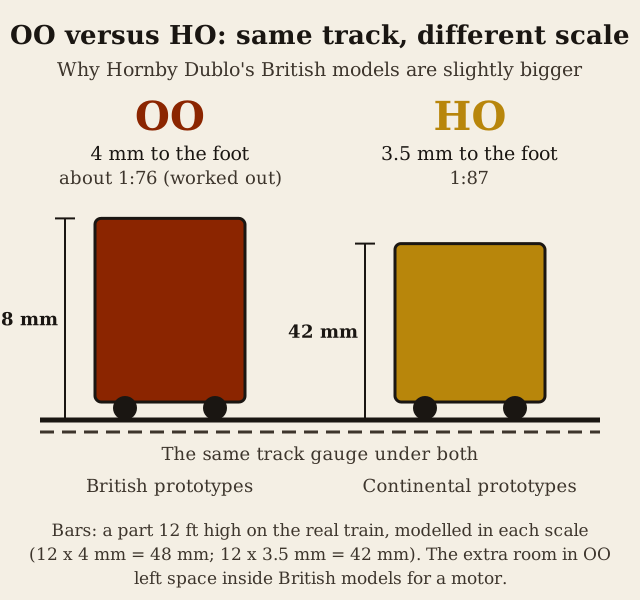
OO and HO share the same track gauge, but their scales differ. HO models of continental prototypes were built at 3.5 mm to the foot, or 1:87. Hornby chose a slightly larger 4 mm to the foot for the smaller British prototypes, to leave more room inside for a motor. The Hornby Dublo range expanded quickly until production was curtailed from 1940 by the Second World War. Production was completely suspended in 1942. Production resumed after the war. Clockwork models were not produced in OO scale after the war.
The early 1950s were good years for Hornby, as they were for British makers Bassett-Lowke and Exley and for American makers Lionel and American Flyer. Hornby struggled in the second half of the decade. The company was slow to see the threat from rival makers, particularly Triang-Rovex, and slow to see the potential of plastic. In 1959 Hornby introduced two-rail track and moulded plastic rolling stock in its Super Detail series. The plastic-wheeled rolling stock worked with either system, but the locomotives and track did not, so practically every locomotive had to be made in both formats.

Tri-ang Hornby and Hornby Railways, 1964 to 1980
In 1964 Lines Bros, the parent company of rival Tri-ang Railways, purchased Meccano Ltd. Lines Bros merged Hornby and Tri-ang into a combined range called Tri-ang Hornby. The old Hornby range was dropped, and Tri-ang's cheaper plastic designs took its place. The Hornby Dublo tooling was sold to G & R Wrenn, which continued to make most of the locomotive range. Leftover O gauge stock was scrapped or went to Hattons Model Railways, a local retailer, which needed about 30 years to clear it. In 1969 the Hornby Railway Collector's Association was founded for collectors of pre-1964 Hornby trains.
Lines Bros went into liquidation in 1971, and the former Tri-ang Hornby business was sold to Dunbee-Combex-Marx. From January 1972 the Tri-ang Hornby system took the name Hornby Railways. By 1976 Palitoy and Airfix were both making detailed, high quality models, and Hornby had to compete with them. In late 1979 Hornby introduced Zero 1, a digital model railway control system. Much later, in 1985, the Zero 1 Master Control unit made its last catalogue appearance.
For the 1980 Rocket 150 celebrations, Hornby released a live steam model of Stephenson's Rocket. It was fuelled by butane gas from cigarette lighter refills. By 1980 the market was extremely tough, and the liquidation of Dunbee-Combex-Marx placed Hornby in receivership.

Hornby Hobbies: Acquisitions and Expansion, 1980 to 2009
In 1980 Hornby became Hornby Hobbies. A management buyout in 1981 put the company back on a sound footing. Hornby Hobbies went public in 1986. In a cost-cutting move, manufacturing moved to Guangdong province in China from 1995, a process completed by 1999. Hornby also bought in some of Dapol's products and some old Airfix moulds, which Dapol had bought as part of the Mainline range from Palitoy in 1985.
Lima was an Italian maker of affordable model railway products that merged with Rivarossi, Arnold and Jouef under market pressure. The merged group did not survive and stopped trading in 2004, after which Hornby Railways bought Lima's assets. The deal included the Rivarossi line of HO scale products and the Arnold brand of N scale products. By 2007 Hornby Hobbies had bought model paint maker Humbrol and its scale model kit subsidiary Airfix, after Humbrol went into administration following cashflow problems. In May 2008 Hornby said it was buying Corgi from Corgi International for £7.5 million. Corgi ranks among the oldest makers of collectable die-cast models in the world. At Christmas 2009 the new Hornby Shop opened at Margate in Kent, with the visitor centre still under construction.
Skaledale is a range of resin buildings and track accessories for OO gauge railways made by Hornby Hobbies. Station buildings and platforms are part of it, along with trackside accessories, shops, houses, churches, monuments and street furniture. Some of the Skaledale station pieces were inspired by Goathland railway station. Lyddle End is a related range of N scale buildings in die cast resin, representing a fictional English village. Lyddle End buildings were generally released about 6 months to a year after their OO gauge Skaledale equivalents.
Financial Crisis, Turnaround and Hornby Today, 2015 to 2026
From 2015, Hornby plc announced a series of declining financial results. The company blamed fewer collecting customers, as older buyers were not replaced by younger ones. It also blamed a general loss of interest in modelling as a hobby as internet games advanced. In the year to 31 March 2017, revenue fell to £47.4 million from £55.8 million. Underlying losses in that year widened to £6.3 million from £5.7 million in 2016.
In July 2017 Phoenix Asset Management, Hornby's largest shareholder, agreed to buy enough shares from the second largest shareholder to take a majority holding. Under stock exchange rules, the purchase triggered a mandatory takeover offer at 32.375p a share, valuing Hornby at £27.4 million. In October 2017 Phoenix Asset Management announced a new management team for the turnaround: Lyndon Davies, Simon Kohler and Tim Mulhall. The annual report for the year to March 2018 showed revenue down to £35.7 million and a pre-tax loss of £7.6 million. Hornby's 2020 accounts showed revenue of £37.8 million and a net loss of £2.8 million.
In August 2021 Hornby acquired the remaining 51% of LCD Enterprises, owner of Oxford Diecast, for £1.3 million. In October 2022 Hornby released a range of TT:120 items. In July 2023 Hornby bought a 25% share in Warlord Games, a maker of historical tabletop wargames. In November 2024 Hornby agreed to sell Oxford Diecast Ltd for £1.38 million to EKD Enterprises Ltd, a business owned by Lyndon Davies and his family. After nearly 40 years as a public company, Hornby left the London Stock Exchange's Alternative Investment Market in April 2025. In February 2026 Hornby sold its Scalextric slot car brand to Purbeck Capital Partners. As of February 2026, Hornby's parent company was Castelnau, and its remaining brands included Airfix and Corgi.

Rails & Rivals, our game on Steam, is a turn-based railroad strategy board game for 2 to 6 players: each player runs a rail company, lays track across a hex map and carries goods between cities, and the wealthiest company wins. The how to play page has the rules.
Keep reading
Sources
- Hornby Railways (Wikipedia)
- Frank Hornby (Wikipedia)
- Meccano Ltd (Wikipedia)
- About Hornby (Hornby Hobbies Ltd)
- Hornby (Grace's Guide to British Industrial History)
- Hornby sells Scalextric in £20m deal (Eastern Eye)