Lionel Trains: History of the Toy Train Maker

Lionel trains are the toy and model trains made under the Lionel name since 1900, first by the Lionel Corporation, an American toy manufacturer founded in New York City. Toy trains and model railroads were the company's main claim to fame. Lionel is known for its O gauge and Standard Gauge trains, its sales peak in the 1950s, and a long string of later owners.
What Lionel Trains Are
Lionel Corporation was an American toy manufacturer that later became a holding company for toy stores. Toy trains and model railroads were its main product for most of its history. In its 1950s heyday, Lionel accounted for two-thirds of all toy trains sold in the United States. The company built its reputation on train sets known for authentic detail, smooth-running three-rail track, and transformers that let a child vary the train's speed. The National Toy Hall of Fame added the Lionel electric train in 2006, and no electric toy had been honored there before it. Lionel trains remain a standard bearer among hobbyists today.

Joshua Lionel Cowen and the Founding of Lionel in 1900
Joshua Lionel Cowen was an American inventor born Joshua Lionel Cohen in Queens, New York City, on August 25, 1877. His parents were Hyman Nathan Cohen and Rebecca (nee Kantrowitz) Cohen, and he had eight siblings. As the story goes, Cowen was seven when he made his first toy train: he carved a locomotive out of wood and fitted it with a small steam engine. He later studied at Columbia University and the City College of New York. He also attended Cooper Union, which counts him among its engineering alumni.

In 1899, Cowen received his first patent, for a device that ignited a photographer's flash. That same year, he won a U.S. Navy contract to produce mine fuses, which earned him $12,000. In 1900, Cowen and his associate Harry C. Grant founded Lionel in New York City. Cowen and his partner set up a production facility in a Manhattan loft and incorporated as the Lionel Manufacturing Company. The company was formed to make what Cowen called "electrical novelties," such as fans and lighting devices. In 1910, after building his business, Cowen legally changed his surname from Cohen to Cowen to avoid antisemitism. Many other Jewish immigrants from Germany and eastern Europe and their families also adopted anglicized names in this period.
The First Trains and Early Track Gauges
Lionel's first train, the Electric Express, was delivered in December 1900. Historians long believed it was intended as a storefront display rather than a toy. It ran on brass track and was powered by a battery and a motor Cowen had originally intended for an electric fan. Cowen built the car from a red-stained wooden box fitted with wheels, with a gold-painted "Electric Express" sign on the side. He sold it with 30 inches of track for $6. A Manhattan shopkeeper bought the train in 1901 to use as a storefront display. When customers asked to buy the display itself, the shopkeeper bought six more trains, and Lionel began making toy trains for the general public.
Accounts differ on exactly how Cowen arrived at the idea for a powered display. One account says he devised a battery-powered fan for his shop and then connected the fan's motor to a small model train. Another traces his design to a department store window, where he saw a model train that did not move. A third frames the spark as a simple question: would a moving element attract more passersby than a static window display?
Cowen published the first Lionel Electric Train catalog, a 16-page black-and-white booklet, in 1902. In 1903, Lionel produced a train whose locomotive was based on a Baltimore and Ohio tunnel engine.

Lionel's earliest trains ran on two-rail track with the rails 2 7/8 inches apart, larger than the gauges commonly sold today. In 1906, Lionel began offering a three-rail track with its outer rails 2 1/8 inches apart. Lionel called this track Standard Gauge, and other American companies that copied it usually called it wide gauge. Whether the odd size came from a misreading of Marklin's 2 gauge specifications or was an intentional incompatibility is unclear. Starting in 1915, Lionel followed most of its U.S. competitors and adopted the smaller O gauge, with rails one and one-quarter inches apart. In 1938, Lionel added OO gauge. By about 1940, Lionel had dropped Standard Gauge to focus on the cheaper, more profitable O and OO gauges.
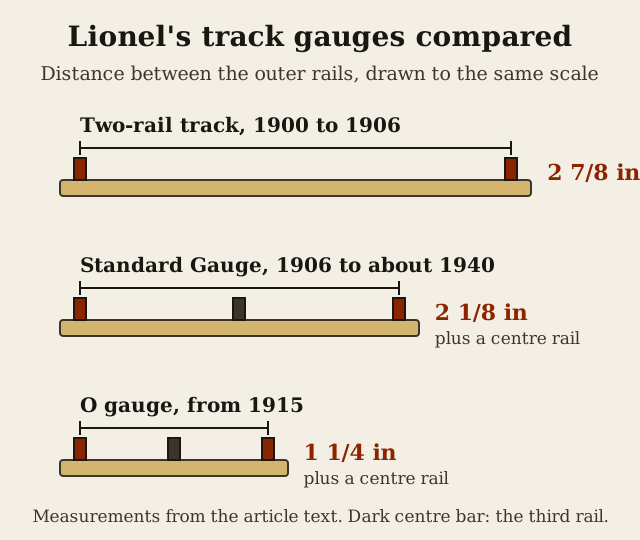
| Gauge | Rail spacing | Years used by Lionel |
|---|---|---|
| Early two-rail track | 2 7/8 inches apart | 1900 to about 1906 |
| Standard Gauge (three-rail) | 2 1/8 inches (53.975 mm) | 1906 to about 1940 |
| O gauge | 1 1/4 inches apart | 1915 onward |
| OO gauge | 19 mm (3/4 inch) | 1938 to 1942 |
Model train gauges and scales beyond O and OO, including how they compare in ratio and track width, are covered in our model train scales chart.
Growth, Competition and the Great Depression
Lionel's rivals before World War I were American Flyer, Dorfan, Louis Marx and Company, Boucher Manufacturing Company, and Ives Manufacturing Company. By the end of the war, Lionel was one of the three major American makers of electric toy trains. Cowen convinced department stores to feature his toy trains in their Christmas window displays. That tactic linked toy trains to the holiday and helped make them popular Christmas presents. Cowen was unwilling to invest in lithography equipment, so Lionel's early trains were painted in solid colors of enamel paint with brass detail parts. Lionel's advertising to parents criticized the durability of rival products. In 1929, Cowen said most trains were bought by mothers for their children and that bright colors attracted women buyers. Its brightly painted metal trains had carried Lionel past Ives into first place in the market by the 1920s. American Flyer entered the Standard Gauge market in 1925, and Dorfan followed with its own Standard Gauge trains by 1926. In 1929, Lionel opened a factory in Hillside, New Jersey, where it made trains until 1974.

The Great Depression badly hurt Lionel along with other toy companies. From 1930 to 1932, Lionel sold a cheaper line under the Winner Toys name, with sets including a transformer starting at $3.25. These efforts did not keep Lionel out of receivership in May 1934. Most accounts give the credit for rescuing the company to a wind-up handcar carrying Mickey and Minnie Mouse. It ran on O gauge track and sold for $1. Its sales were not enough to pay off Lionel's $300,000 of debt, but the handcar provided much-needed cash. The more expensive 752E City of Portland, a model of a Union Pacific streamliner, gave the company needed revenue. As Lionel's first scale model, the streamliner gave the company a strong presence in the model market. Lionel emerged from receivership the following year and left the novelty toy business to cheaper toy makers. The Red Comet and Blue Streak sets from this era included models of New York Central's Commodore Vanderbilt locomotive.
Lionel stopped making toys in 1942 to produce nautical items for the U.S. Navy during World War II. During the war, Lionel also sold the Lionel Wartime Freight Train, a set of cut-and-fold models of its trains printed on cardstock.
Lionel's Peak Years in the 1950s
Lionel resumed making toy trains in late 1945. It replaced its colorful prewar line with less colorful but more realistic trains and concentrated on O gauge. The first postwar set introduced remote-control uncoupling. Many of Lionel's diesel, electric, and steam engines made after 1950 used the company's Magne-Traction system, which made the wheels magnetic so they gripped the track better. Lionel issued a model of the Pennsylvania Railroad's GG1 in 1947. Its Santa Fe F3 diesel, numbered 2333, followed in 1948. Lionel introduced an FA diesel model in 1950. The 726 2-8-4 Berkshire, issued from 1946 through 1949, is valued by collectors today. In 1952, after the Korean War caused a shortage of magnetic materials, Lionel reissued it as the 726rr. The later 2343, 2383, and 2353 Santa Fe F3 diesels improved on the 2333. In 1957, Lionel released the 746, a model of Norfolk and Western's J class steam engine.

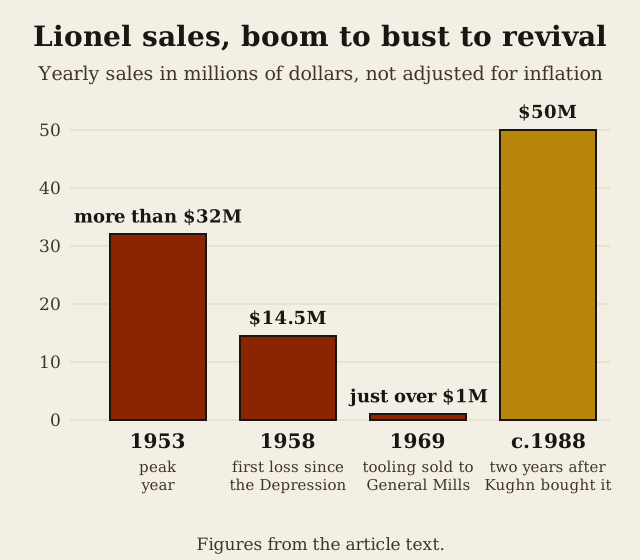
In 1953, its peak year, Lionel's sales reached more than $32 million. That year, Lionel was reportedly the largest toy manufacturer in the world. It employed 2,000 people in 1953. During the 1950s, Lionel outsold its closest competitor, American Flyer, by nearly two to one.
Decline, Bankruptcy and Cowen's Death (1957-1969)
As the 1950s went on, Lionel's sales declined as space and military-themed toys and slot car racing sets grew more popular. The remaining interest in toy and model trains shifted toward HO scale, which gradually overtook O gauge in popularity. The shift caught Lionel off guard. In 1957, it hastily introduced a line of HO scale trains licensed from Rivarossi, along with its own slot car racing sets. Efforts to cut costs by replacing metal castings with unpainted injection-molded plastic were largely unsuccessful. 1957 was Lionel's last profitable postwar year. In 1958, Lionel posted its first yearly loss since the Depression, losing about $470,000 on sales of $14.5 million.

In 1959 Joshua Lionel Cowen stepped down and sold his 55,000 Lionel shares to Roy Cohn, his grand-nephew. Cohn was an attorney who had worked for Senator Joseph McCarthy. Cohn led a group of investors who hoped to win government missile contracts by acquiring electronics firms. He replaced most of Cowen's management. During Cohn's three-and-a-half-year tenure, Lionel lost more than $13 million. By 1966, Lionel's revenue was $28 million, 40 percent of it from government contracts.
Cowen had married Cecilia Liberman, known as "Mimia," in 1905, and the couple had two children. After her death in 1946, he married Lillian (Appel) Herman in 1949. Cowen died on September 8, 1965, in Palm Beach, Florida. He was buried at Union Field Cemetery in Ridgewood, Queens.
In 1967, Lionel bought the American Flyer brand and product line for $150,000 but lacked the money to make use of it. The company filed for bankruptcy on August 7, 1967. By 1969, Lionel's sales had fallen to just over $1 million a year. That year, Lionel sold its train die tooling to the cereal maker General Mills and leased it the right to use the Lionel name.
New Owners: General Mills, Kughn and Neil Young
In 1970, General Mills began making Lionel trains under its MPC division in Mount Clemens, Michigan. MPC introduced a new wheel design with Delrin plastic trucks that reduced rolling friction and is still used by Lionel today. In 1971, Lionel debuted an electronic "Mighty Sound of Steam" system to replace the electro-mechanical air whistles of earlier eras. In 1973, it introduced a line of scale-sized freight cars called Standard O. In 1975, a 75th anniversary freight set paired a U36B diesel engine with rolling stock carrying images from Lionel's past. In 1976, the brand gained wide attention through television commercials featuring Johnny Cash, a longtime Lionel collector. From the 1980s onward, Lionel brought out further operating accessories based on postwar designs, among them the News Stand, the Ice Depot, and the Lumber Mill.
General Mills spun off Kenner-Parker Toys in 1985, and Lionel moved to the new company as a division. In 1986, Detroit real estate developer and toy train collector Richard P. Kughn led a group of investors who paid an estimated $25 million for the Lionel train business. The group incorporated it as Lionel Trains, Inc. Within two years, sales under Kughn rose 150 percent to $50 million a year.
The original Lionel Corporation, meanwhile, had become a holding company for toy stores after 1969. It filed for Chapter 11 bankruptcy in February 1982. The chain grew back to 100 stores by 1991, but discount stores undercut its prices. It filed for Chapter 11 again on June 14, 1991. In 1991, it sold its trademarks to Lionel Trains, Inc. for $10 million. By February 1993, it had closed all but 29 stores in six states, and it went out of business in 1993.
In 1995, Kughn sold Lionel to a group that included rock musician Neil Young and former Paramount Communications chairman Martin Davis. Davis's investment firm, Wellspring, held the majority share. The company was renamed Lionel LLC that year.
Diversification Beyond Trains
Lionel ventured outside its namesake trains more than once. In the postwar years, its construction toy line competed with the Erector Set. The Lionel set used round-head aircraft rivets held by rubber grommets instead of nuts and bolts, so no tools were needed. The finished assemblies lacked the durability of the Erector Set and could be destroyed if stepped on. The deluxe kits came with an AC electric motor, fitted with a worm drive and a reduction gearset, that ran on household current. From 1961 to 1968, Lionel catalogued a line of hands-on science toys under the name Lionel-Porter. Chemcraft chemistry sets, Microcraft microscope sets, and Biocraft biology sets were part of it, as were kits for geology, mineralogy, physics, mathematics, and industrial science and a junior range of tool sets. In the early 1970s, Lionel also bought Morsan Tents from founder Mort Jarashaw.

Lionel as of 2026
The Lionel name has also reached beyond toy aisles and hobby shops into video games, including the Windows title 3D Ultra Lionel Traintown and its sequel, Deluxe. Lionel LLC's recent products have included Bluetooth-enabled train controls that can be operated from a smartphone, as reported in mid-2026.
In March 2026, the collectibles company Round 2 acquired Lionel LLC and formed the Lionel Brands Group. The deal was completed on March 2, 2026 and announced on March 4, 2026. The Lionel Brands Group also covers brands such as Lionel Racing, AMT models, MPC, and Auto World. The March 2026 announcement listed the group's products as model trains, slot cars, die-cast vehicles, model kits, and other hobby products.

How layouts are planned around track, space and operation is covered in our model railroad layout plans article.
Rails & Rivals, our game on Steam, is a turn-based railroad strategy board game for 2 to 6 players: each player runs a rail company, lays track across a hex map and carries goods between cities, and the wealthiest company wins. The how to play page has the rules.
Keep reading
Sources
- Lionel Corporation (Wikipedia)
- Joshua Lionel Cowen (Wikipedia)
- Lionel Trains - National Toy Hall of Fame (The Strong National Museum of Play)
- COOPERMADE: Lionel Model Trains (Cooper Union)
- Lionel Trains (Encyclopedia.com)
- Joshua Lionel Cowen (National Railroad Hall of Fame)
- Lionel Trains (American Heritage)
- Lionel L.L.C. History (FundingUniverse)
- Lionel Legacy Brand Growth (U.S. Chamber of Commerce)
- Praesidian Capital's Portfolio Company Round 2 Acquires Lionel, LLC (Lionel Collectors Club of America)
- Round 2 Acquires Lionel, LLC - Forms Lionel Brands Group (Round 2 Corp)
- Standard Gauge (toy trains) (Wikipedia)
- train99.com (train99.com)
- OO gauge (Wikipedia)