Märklin Model Trains: History of the German Maker

Märklin is a German toy company best known for model railways and technical toys. The company was founded in 1859 in Göppingen, Baden-Württemberg. It originally specialised in doll house accessories.
Founding and family: 1859 to 1888
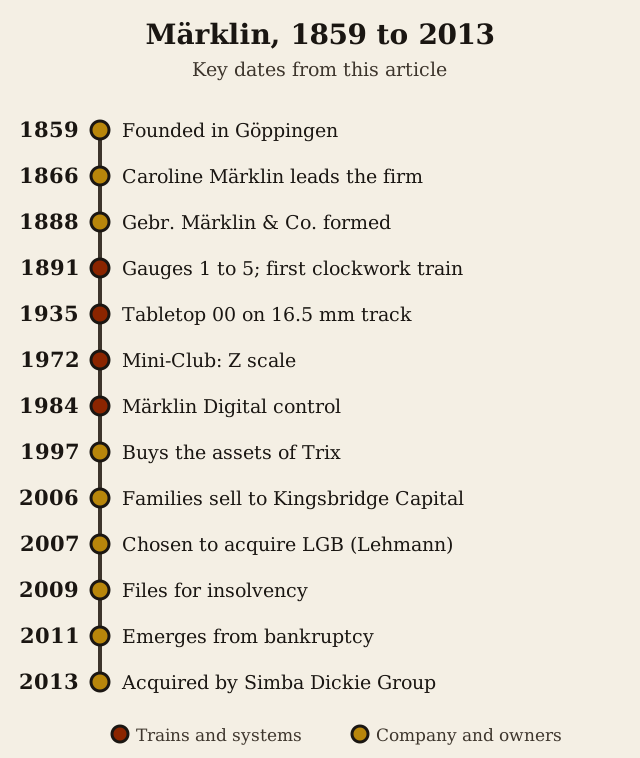
Theodor Friedrich Wilhelm Märklin, who lived from 1817 to 1866, started the firm in Göppingen in 1859 as a maker of household products. After Theodor Märklin's death in 1866, his wife Caroline Märklin led the business until 1888.

In 1888, her son Eugen Märklin and his brother Karl established the unlimited trading company Gebr. Märklin & Co., which included their mother's business.
1891 to 1901: gauge standards and early trains
At the 1891 Leipzig Spring Fair, Märklin introduced a model train that determined the company's fate for the next century. Märklin also set gauges 1 to 5 as toy train standards in 1891 and showed them at the Leipzig Toy Fair. These gauges soon became international standards.
Also in 1891, Märklin brought out its first clockwork train, whose carriages ran on standardised track. The company noted that railway toys could work like doll houses, where a first purchase kept growing with extra accessories for years. So it sold extra track and rolling stock that buyers could add to its boxed sets. Märklin is reported to have begun selling electric-powered trains as early as 1895. O gauge came after those first gauges, though accounts differ on the date and place it anywhere from 1895 to 1901. Märklin created several popular model railway gauges and scales, though not N scale or Wide gauge.

HO scale in 1935 and Z scale in 1972
In 1935, Märklin launched a line of electric tabletop model railroads half the size of common models, running on track 16.5 millimeters wide. Märklin introduced this size about half a year later than rival Trix. Trix showed its Trix Express tabletop railway at the 1935 Leipzig Spring Fair, and Märklin followed with its 00 gauge railway at the 1935 Leipzig Autumn Fair.

Z scale followed in 1972. That year at the Nuremberg Toy Fair, Märklin showed Mini-Club, the smallest electric model train system in mass production anywhere in the world. Märklin built the Mini-Club range in response to N gauge, which Arnold Rapido had brought to market. The name Z scale was assigned after the product line was introduced. Helmut Killian, then Märklin's head design engineer, came up with Z scale, and for decades no scale in the world was smaller. Z is the final letter in both the German and English alphabets, and it was picked to suggest that no commercial model railway scale would ever be smaller. In 1978, a Märklin Z scale locomotive with six coaches earned a place in the Guinness Book of World Records: it ran without a break for 1,219 hours and covered 720 kilometers until its motor gave out.
Z scale trains originally ran on 8 volts DC, and track voltage was increased to 10 volts DC around the year 2000. Märklin announced digital Z scale locomotives, but the plans were cancelled, mainly because of heat dissipation problems in such small locomotives. Z scale was predominantly a European scale at its inception.
Märklin Digital: a control system from 1984
Märklin was one of the earlier model railway makers to offer digital control of trains. The Märklin Digital system for Märklin's three-rail AC train layouts was introduced in 1984 using Motorola microchips. A few years later came a system for two-rail DC locomotives, built as a joint project of Märklin, Lenz GmbH and Arnold GmbH. Arnold used this system in its N scale locomotives. This digital control system was later developed into DCC, or Digital Command Control. Märklin's digital system for three-rail track is not directly compatible with DCC, although the two systems are electrically compatible.

Ownership changes: family control to Simba Dickie
Märklin was family owned from its founding in 1859 until 2006. On May 11, 2006, the Märklin, Friz and Safft families, who had owned the business up to then, sold it to Kingsbridge Capital, a British investment group, and the employees backed the sale. At the time, Märklin had about 70.5 million dollars in debt as a result of several years of slumping sales.
On February 4, 2009, Märklin filed for insolvency at the Göppingen municipal court. On February 5, 2010, Märklin announced a return to profitability. It emerged from bankruptcy on February 17, 2011. The Simba Dickie Group announced its plan to buy Märklin on March 21, 2013. The deal secured the future of Märklin and its LGB brand, and it guaranteed Märklin's staff their jobs until 2019. Märklin was acquired by the Simba Dickie Group in 2013. On July 22, 2013, managing director Stefan Löbich left Märklin.
Trix and LGB: brands that joined the Märklin group
Trix, a German company, started out making Trix metal construction sets. In 1935 it began producing the electrically powered Trix Express model trains. Under the name Trix Twin Railway, the Trix Express model railway was sold in England from the end of 1935, with locomotives made in Germany and repainted in England. In 1938, the English range was expanded after Trix co-founder Stephan Bing was driven out of Germany by the Nazis. Trix adopted two-rail production in 1967. Production of British Trix OO gauge trains ceased in 1973. The Minitrix brand covered N gauge models from the late 1960s on; most of them depicted European trains, chiefly German and British ones.

Mangold owned Trix through the 1980s and 1990s and went bankrupt in the late 1990s. In January 1997, Märklin purchased the assets of Trix, adding its DC-operated H0 and N scale lines, and Trix continued as an independent brand. In 2003, Märklin introduced its first N gauge models under the established Minitrix brand. From around 2003 or 2004, Trix made a two-rail version of the Märklin C-track. Trix's 1:87 scale DC brands, Trix International and Trix H0, date back at least to the early 1970s.
LGB was the G scale model railway brand of Ernst Paul Lehmann Patentwerk, a firm in Nuremberg. When LGB arrived, it brought garden model railroading back to life in the United States. With the model train industry in decline, Lehmann started restructuring and cost-saving measures in 2002 and intensified them in 2005. In mid-2006, Lehmann transferred its North American distribution and service subsidiary, LGB of America, to a new United States-based firm, G45. On September 1, 2006, the banks that financed Lehmann, which larger international banks had recently bought, froze the firm's accounts and stopped it from selling its existing stock. Lehmann described the move as a "hostile takeover", and on September 18, 2006, it asked for bankruptcy protection.
Märklin, Piko and Hornby were among the model train manufacturers that bid on Lehmann. On December 22, 2006, it was announced that Lehmann's creditors had selected Hermann Schöntag, then owner of the German Rügen narrow-gauge railway, to purchase the firm. Schöntag preserved the factory, offices and 150 jobs in Nuremberg. His co-investors then withdrew, though. Production came to a halt on March 21, 2007, and Lehmann filed for bankruptcy on April 23, 2007.
The second round of bidders included G45, the new owner of LGB of America, and Märklin. On July 26, 2007, Märklin was selected to acquire Lehmann's assets. Critics objected that the deal would not keep the Nuremberg site or its jobs. In fall 2007, production and shipping started again, and the LGB brand was kept. Märklin said in November 2008 that the American trademark dispute was settled. Walthers took over as the American distributor of LGB products on January 1, 2009.
Beyond trains: other Märklin toys
Over the years Märklin made many other toys as well, among them lithographed tinplate toy cars and boats. From 1909 until well into the 1950s, Märklin sold a range of alcohol-burning model steam engines. These educational toys could be linked to dynamos to provide lighting.

From 1914 to 1999, Märklin produced mechanical construction sets similar to Meccano and Erector. Between 1967 and 1982, the company produced a slot car system called Märklin Sprint.
Collectors, models and recent results
Märklin systematically included a print run number on almost all its printed material, including the boxes its products shipped in. These numbers give the catalogue number, the printer, and the month and year of printing, which is useful for dating an item known to be associated with some printed material. Koll's Preiskatalog, issued in German by Joachim Koll, lists all 00 and H0 models and provides price estimates.
Thieves broke into the Märklin museum in Göppingen in January 2005 and took more than 100 pieces, together estimated to be worth over 1 million euros. The items, which included one-of-a-kind prototypes and pieces dating back to 1891, were recovered in March 2005. The Ticket to Ride board game series honoured the company with its third game, Märklin, released in 2006. Märklin announced in 2010 that it was releasing its sixth Russian Railways model, the Velaro SAPSAN high speed train. It uses the DB ICE 3MF model, first sold in 2008, as its basis.

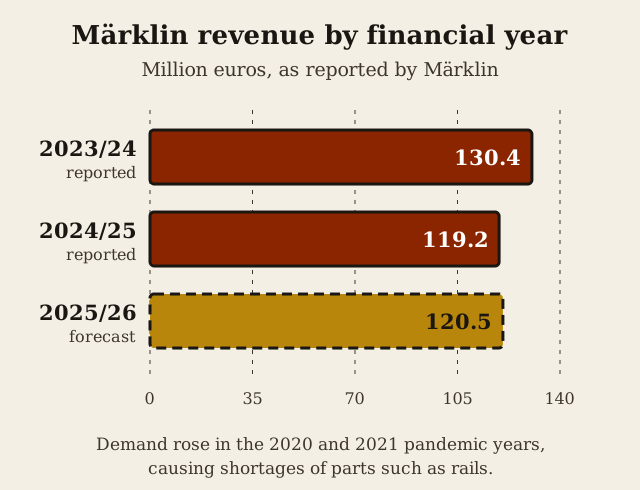
Sales rose at Märklin during the COVID pandemic of 2020 and 2021, and the increase caused shortages of parts such as rails. Märklin also had to hire new employees and apprentices to meet the demand. Märklin reported revenue of 130.4 million euros for the 2023/2024 financial year. Revenue for the 2024/2025 financial year amounted to 119.2 million euros. For the 2025/2026 financial year, Märklin forecast revenue of 120.5 million euros. In 2024, Märklin's investments included a new CNC lathe at its Göppingen plant and an air-heat pump to use waste heat from production at its Hungarian plant.

Rails & Rivals, our game on Steam, is a turn-based railroad strategy board game for 2 to 6 players: each player runs a rail company, lays track across a hex map and carries goods between cities, and the wealthiest company wins. The how to play page has the rules.
Keep reading
Sources
- Märklin (Wikipedia)
- Märklin (Train Collectors Association, Western Division)
- Märklin Holding GmbH History (FundingUniverse (International Directory of Company Histories))
- Z scale (Wikipedia)
- HO scale (Wikipedia)
- Trix (company) (Wikipedia)
- LGB (trains) (Wikipedia)
- Märklin sends out positive signals (Spielwarenmesse (Nuremberg International Toy Fair))
- Märklin welcomes new passengers (Spielwarenmesse (Nuremberg International Toy Fair))