Darjeeling Himalayan Railway: Toy Train History and Route

The Darjeeling Himalayan Railway is a 2 ft (610 mm) narrow-gauge railway that runs 87.48 km from New Jalpaiguri to Darjeeling in the Himalayan foothills of West Bengal, India, built between 1879 and 1881. Known as the toy train, it climbs from the plains near Siliguri to the hill station of Darjeeling using a series of loops and reverses to manage the grade. It is a UNESCO World Heritage Site and still carries passengers today.
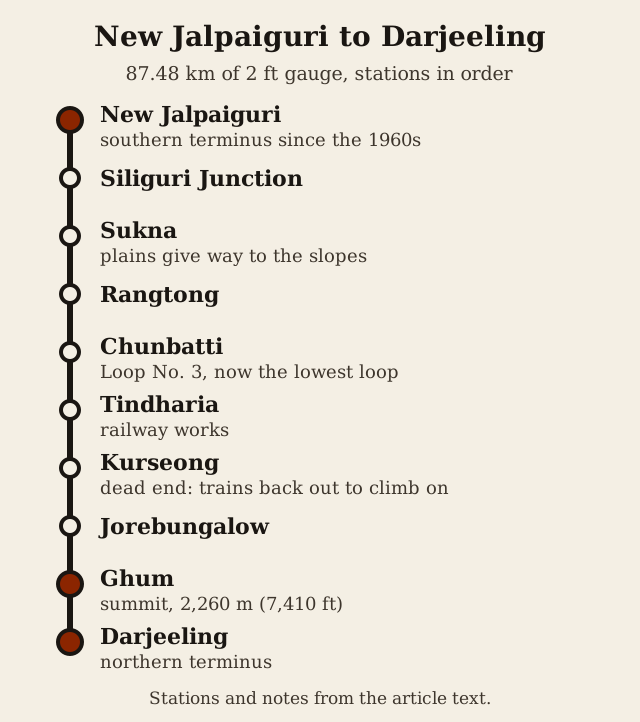
Route: New Jalpaiguri to Darjeeling
New Jalpaiguri became the line's southern terminus after a realignment: in 1962 the line at Siliguri was re-aligned and extended about 4 miles (6 km) to New Jalpaiguri to meet the new broad-gauge line there, with freight service beginning that year and passenger service following in 1964. The locomotive shed and carriage depot that had been at Siliguri Junction were moved to New Jalpaiguri as part of the same change.
- New Jalpaiguri, the southern terminus since the extension of the 1960s
- Siliguri Junction, which became a major station once a new line to Assam was built in the early 1950s
- Sukna, where the landscape changes from flat plains to the wooded lower slopes of the mountains
- Rangtong, with a water tank a short distance above the station
- Chunbatti, home to Loop No. 3, now the lowest loop on the line
- Tindharia, site of the railway's works and sidings used to inspect carriages while locomotives are changed
- Kurseong, a dead-end station that Darjeeling-bound trains must back out of, across a busy road junction, to keep climbing, after which the line passes a busy shopping area
- Jorebungalow, a storage point for tea bound for Kolkata
- Ghum, the line's summit and India's highest station: a museum occupies the first floor of the station building, and the bigger exhibits stand in the former goods yard
- Darjeeling, the northern terminus
For long stretches the track runs alongside Hill Cart Road, part of National Highway 110, so closely that a rockslide can block both the road and the railway at once; where the road is lined with buildings the line can look like an urban tramway. Because of this, locomotives carry very loud horns and whistles that drivers sound almost constantly to warn pedestrians and traffic. According to IRCTC, the New Jalpaiguri to Darjeeling section has 5 major and 498 minor bridges and 177 unmanned level crossings.
Why the toy train runs on 2 ft narrow gauge
Construction of the line began under the Darjeeling Steam Tramway Company on a narrow gauge of 2 ft (610 mm). Steep climbs and tight bends mark the whole route. On the original alignment, gradients ran between 1 in 19 and 1 in 36, and the tightest curves had a radius of just 50 ft. The line was later modified, and by 2021 its steepest gradient was 1 in 23 and its sharpest curve had a radius of 69 ft.

Construction and opening, 1879 to 1881
Siliguri, at the base of the Himalayas, had already been connected to Calcutta by a metre-gauge railway in 1878, while the stretch up to Darjeeling was served only by tanga carts on a road that is now Hill Cart Road. Franklin Prestage, an agent of the Eastern Bengal Railway, proposed building a steam tramway from Siliguri to Darjeeling, and Ashley Eden, lieutenant governor of Bengal, formed a committee to assess whether the plan was workable. On the committee's recommendation, construction began under Prestage in 1879 and had reached Tindharia by March 1880.
Prestage and Colonel F. S. Taylor, R.E., who was the Government of India's Consulting Engineer for Guaranteed Railways, inspected the line and cleared the Siliguri to Kurseong section for traffic from 16 August 1880. The section opened a few days later, on 23 August 1880. The full stretch from Siliguri to Darjeeling opened in July 1881, and the company's name was changed to the Darjeeling Himalayan Railway Company. Eight steam locomotives for the opening had arrived from the works of Sharp Stewart of Manchester, England. Although the line had been built to follow Hill Cart Road, in some places the road's steepness proved more than the early locomotives could handle.

Growth, setbacks and nationalisation, 1882 to 1958
The first fix for the steep road came in 1882, when four loops and four reverses were built between Sukna and Gayabari. The railway then grew steadily, but it was tested repeatedly by the weather. In 1891 Darjeeling's station was renovated, and in 1896 Kurseong received a new station building along with a storage shed. Then came a run of setbacks: an earthquake in 1897 and a major cyclone in 1899 both hit the line, and in 1902 landslips brought on by heavy rain swept away the Teesta bridge, leaving trains to run with passengers and goods moved across the breaks.

By 1910 the railway was carrying 174,000 passengers and 47,000 tons of goods a year, and the first bogie carriages had entered service, replacing the original basic four-wheel carriages. Extension lines were built to Kishanganj in 1914 and Gielkhola in 1915, and at Tindharia the railway's works moved out from behind the locomotive shed onto a bigger site. In 1919, the year the Batasia Loop was built, the line met its first competition: a bus service on Hill Cart Road that reached Darjeeling faster than the train. A major earthquake centred in Bihar in 1934 shook all of northeast India and heavily damaged many buildings in Darjeeling; the railway was also affected but soon recovered and carried much of the material used for repairs. During the Second World War it carried military personnel and supplies to the camps around Ghum and Darjeeling.
After independence the Indian government bought the railway in 1948. In 1950 the Kishanganj to Siliguri and Siliguri to Sevoke sections of its two branch lines were converted to metre gauge as part of the Assam Rail Link Project, while the main Darjeeling line kept its original narrow gauge. In 1958 the railway became part of the Northeast Frontier Railway zone of Indian Railways.
Climbing through loops and reverses
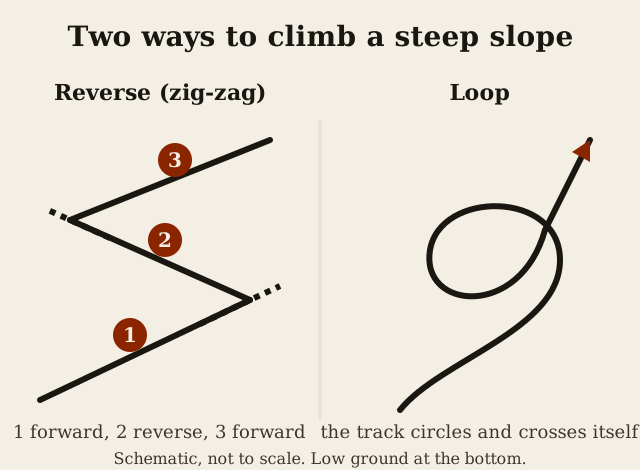
The loops and reverses, or zig-zags, first built between Sukna and Gayabari in 1882 use a simple technique: the train runs forward, reverses, then runs forward again up a slope to gain height without needing an impossibly sharp curve. The best known of the loops is the Batasia Loop, built in 1919 to create an easier gradient on the ascent from Darjeeling; it offers a panoramic view of Darjeeling with Kangchenjunga and other snow-capped peaks in the background. The layout has changed since the original construction: Loop 2 was removed in 1942 after flood damage, Loop 1 above Sukna was removed after flood damage in 1991, a new reverse numbered 1 was added for what is now the line's longest reverse run, and Loop No. 3 at Chunbatti became the lowest loop on the line. Reverses No. 2 and 3 sit between Chunbatti and Tindharia, Loop 4, known as Agony Point, has the tightest curve on the whole railway, and Reverse No. 6 is the last reverse on the climb. Today three loops remain of the original five, and IRCTC counts 5 reverses on the line. At the top of the climb sits Ghum, the line's summit at an altitude of 2,260 metres (7,410 ft) and India's highest railway station, also described as the second-highest railway station in the world reached by steam locomotive.
The B class steam locomotives
Every steam locomotive in service on the Darjeeling Himalayan Railway is an 0-4-0 saddle-tank engine of the B class. Sharp, Stewart and Company built the class at first and the North British Locomotive Company took over later, with construction spanning 1889 to 1925. A total of 34 were built, but by 2005 only 12 remained in use or under repair.

One of the best documented is B-777, one of the first batch of B class locomotives, built by Sharp, Stewart and Co. at the Atlas Works in Glasgow and now preserved at the National Rail Museum in New Delhi. It weighed just 16 tons and had a 0-4-0 wheel arrangement, small enough to work well on the line's tight curves, and it was built as a well-and-saddle-tank locomotive carrying two separate water tanks, a well tank common to all the class and an additional saddle-shaped tank on top of the boiler. B-777 was rebuilt at the Tindharia Workshop in 1917 and was finally withdrawn in 1957; in 1993 it was honoured with its own postage stamp.
Not every modification worked out. In 2002, locomotive No. 787 was rebuilt for oil firing on the same principle used on Nilgiri Mountain Railway No. 37395, gaining a diesel-powered generator to run the oil burner and an electrically driven feed pump, a diesel-powered compressor for the brakes, and a feedwater heater. Trials of the refitted engine were disappointing and it never entered regular service. In early 2019 it was cosmetically restored and put on display on a plinth outside Siliguri Junction station. Only one DHR steam locomotive has ever left India: DHR 778, originally numbered 19, spent years out of use at the Hesston Steam Museum before being sold to the British railway executive Adrian Shooter and restored to working order in the UK. A newly formed trust bought it at auction in 2023, planning to base it at the Statfold Barn Railway and, once its next overhaul was done, to take it to other 2 ft gauge lines.
UNESCO World Heritage listing
UNESCO declared the Darjeeling Himalayan Railway a World Heritage Site in 1999, at the 23rd Session of its World Heritage Committee. The listing presents the railway as an outstanding case of how an innovative transport system can influence social and economic development in a multi-cultural region, work that was meant to serve as a model for similar projects elsewhere. It also names the deep effect that 19th-century railways had on social and economic development around the world as a theme the Darjeeling line shows in an exceptional way. UNESCO ranks it as the earliest hill passenger railway and the most outstanding example of the type. Opened in 1881, it used bold, inventive engineering to carry an effective railway through beautiful mountain country, and it remains fully operational with most of its original features intact.
The Darjeeling Himalayan Railway later became the first entry in a wider group, the Mountain Railways of India, which went on to add the Nilgiri Mountain Railway in 2005 and the Kalka-Shimla Railway in 2008. Both lines that joined it on the list are mountain railways too: the Nilgiri Mountain Railway is a 45.88 km metre-gauge single line that was completed to Coonoor in June 1899 and extended to Ooty in October 1908 and is the only rack and pinion railway in India, while the Kalka-Shimla Railway is a 2 ft 6 in (762 mm) narrow-gauge line running 96.6 km between Kalka and Shimla, built by the Delhi-Ambala-Kalka Railway Company between 1898 and 1903. For the wider Mountain Railways of India listing, UNESCO points to the three lines as outstanding examples of bold, ingenious engineering that solved the problem of running an effective railway through rugged mountains. The three routes sit in the Asia-Pacific region and are grouped under World Heritage Site criteria ii and iv.

The toy train as of 2026
The government of India owns the Darjeeling Himalayan Railway and all its assets, including the stations, line and vehicles, and has placed them in the care of the Ministry of Railways. Operation, maintenance and repair fall to a number of Indian Railways programs, divisions and departments, and the railway is protected under the 1989 Railway Act and the rules that govern public property. The Northeast Frontier Railway handles its day-to-day maintenance and management, and the line has its own director at its head. Diesel locomotives of the NDM-6 class, Nos. 600 to 605, built in 1997, handle most of the scheduled service. Steam-enthusiast specials are still hauled by the vintage British-built B class locomotives described above.

Service has been interrupted more than once in recent decades: the railway closed for 18 months during the Gorkhaland hostilities of 1988 and 1989, and it was stopped again for 18 months from March 2020 to August 2021 because of the COVID-19 pandemic. Full New Jalpaiguri to Darjeeling service resumed on 17 November 2024, after a roughly four-month pause caused by a landslide. For the 2026 Durga Puja season the railway introduced six special joyride services from 1 October 2026: four diesel-hauled one-way trips between Darjeeling and Ghum, and two round trips between Kurseong and Mahanadi, the steam-hauled Red Panda and the diesel-hauled Mukta Dhara. Rather than extending the full New Jalpaiguri to Darjeeling journey, these shorter sections are meant to fit into a holiday based in the hills. Between 1 and 21 October 2026 the railway carried about 12,000 joyride passengers and earned Rs 1.41 crore. The railway also keeps up its community ties: it marked Toy Train Day with a heritage-themed painting competition and an art workshop at Sukna Railway Station, and in July 2026 it reported its highest-ever June revenue: Rs 3.98 crore in June 2026 compared with Rs 3.25 crore in June of the previous year.
Accidents along the route
Running so close to a busy road for most of its length has not spared the toy train from mishaps. A faulty stretch of track derailed a Darjeeling train on 10 January 2017, injuring 10 people, and on 7 May 2019 another train hit a car and left the rails, though nobody was killed or hurt. A different kind of accident followed later that year: on 9 October 2019 a passenger fell from the train while taking a selfie and died from serious head injuries sustained in the fall.

On screen and in preservation
The toy train's fame reaches well beyond railway circles. In the 1969 film Aradhana, Rajesh Khanna sings "Mere Sapno Ki Rani" to Sharmila Tagore, who is riding the train. The railway also features in Barfi!, Main Hoon Na, Parineeta and Raju Ban Gaya Gentleman. In Disney's Planes (2013), an anthropomorphised B class locomotive appears briefly and only just avoids colliding with an airplane flying through a tunnel. In 1975 an episode of the BBC series The World About Us, titled The Romance of Indian Railways, included a section on the Darjeeling Himalayan Railway with colour footage of the original steam trains then in use. The BBC first aired a three-part documentary series on India's mountain railways in February 2010, opening with the Darjeeling line, then moving on to the Nilgiri Mountain Railway and ending with the Kalka-Shimla Railway. Tarun Bhartiya, Hugo Smith and Nick Mattingly directed the films for producer Gerry Troyna. In June 2010 the series received the UK Royal Television Society Award. Film maker Nick Lera made a separate record in his 1999 documentary Toy Train to the Clouds, which captured the line and its locomotives as they were running at the time.
Enthusiasts have organised around the line since 1998, when the Darjeeling Himalayan Railway Society was founded as a preservation and support group; it has reported a membership of more than 750 people across twenty countries. Until his death in December 2022 the society's president was the British railway executive Adrian Shooter, the same figure who had earlier bought and restored locomotive DHR 778 to working order in the UK.

Build your own mountain railway in Rails & Rivals

Rails & Rivals, our game on Steam, is a turn-based railroad strategy board game for 2 to 6 players: each player runs a rail company, lays track across a hex map and carries goods between cities, and the wealthiest company wins. The how to play page has the rules.
Keep reading
Sources
- New Jalpaiguri - Darjeeling (IRCTC (Indian Railway Catering and Tourism Corporation, Govt. of India))
- DHR History (Darjeeling Himalayan Railway Society)
- UNESCO World Heritage Site (Darjeeling Himalayan Railway Society)
- Everyone's cup of tea: Darjeeling's most beloved locomotive (National Rail Museum, New Delhi (via Google Arts & Culture))
- Darjeeling Himalayan Railway (Wikipedia)
- Mountain railways of India (Wikipedia)
- Famous Toy Train Service From New Jalpaiguri To Darjeeling Resumes After Four Months (Outlook India (Outlook Traveller))
- Darjeeling's Heritage Toy Train Gets Six Special Services For Puja Season (Outlook Traveller)
- 12,000 passengers in 21 days: Darjeeling's tiny toy train has a Rs1.41 crore surprise (Business Today)
- Darjeeling Himalayan Railway Celebrates Toy Train Day, Records Highest-Ever June Revenue (The Sentinel (Assam))