Glacier Express: Route, Stops and History

The Glacier Express is a named panoramic train in Switzerland that links the mountain resort of Zermatt with St. Moritz over a 291-kilometre route. It is run jointly by the Rhaetian Railway and the Matterhorn Gotthard Bahn. Its highest point is the Oberalp Pass at 2,033 metres. Zermatt lies below the Matterhorn and St. Moritz is near Piz Bernina, so the trip is also described as running from the Matterhorn to Piz Bernina.
What the Glacier Express Is
The Glacier Express is a named train in Switzerland that runs as a Panorama Express. It connects the railway stations of Zermatt and St. Moritz via Andermatt in the central Swiss Alps. The train omits the stops made by local trains on the same lines.

In 2017 operation of the train passed to Glacier Express AG, a company jointly owned by the two former operators, the Rhaetian Railway (RhB) and the Matterhorn Gotthard Bahn (MGB). Each of the two railways holds a 50 percent stake. From 2003 to 2017, RhB and MGB ran the train directly. MGB itself was formed from a merger of the BVZ and the Furka Oberalp Bahn (FO).
The route crosses three Swiss cantons: Valais, Uri and Graubünden. It passes through two UNESCO World Heritage areas. One of them is the Rhaetian Railway in the Albula/Bernina Landscapes. The operator presents the trip as an eight-hour panoramic journey. On the way to the Engadin lakeland near St. Moritz, the train crosses 291 bridges and runs through 91 tunnels. The operator gives the maximum incline on the route as 12.5 percent.
The Rhaetian Railway and Matterhorn Gotthard Bahn
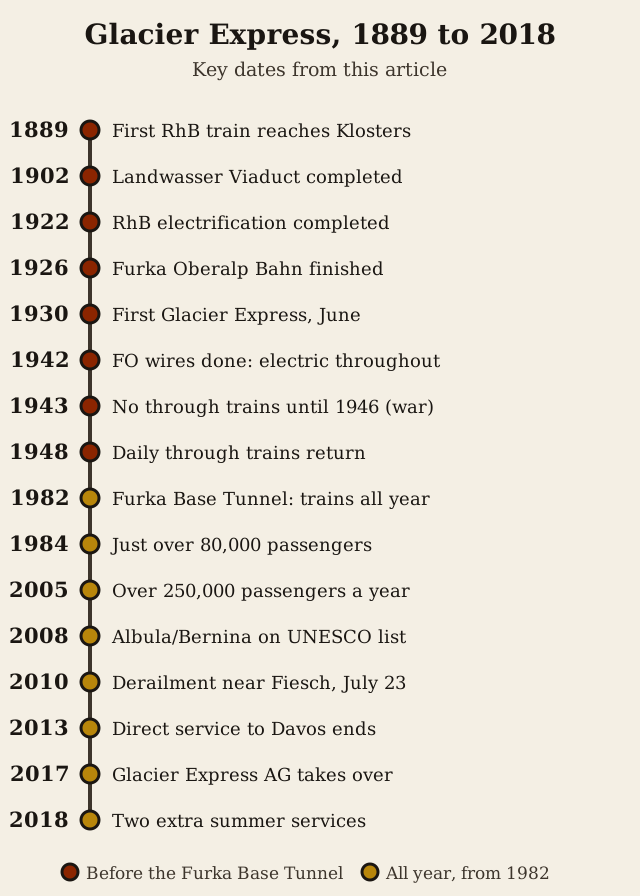
The Rhaetian Railway (RhB) traces its network back to 29 September 1889, when its inaugural train reached the festively decorated station at Klosters. The railway later grew into a 385-kilometre network. In 1913 RhB ran a route electrically for the first time, on the Bever to Scuol line. The electrification of the RhB was completed in 1922. RhB's own history lists the inaugural run of the Glacier Express in 1930.

The Matterhorn Gotthard Bahn (MGB) is part of the BVZ Group. The group's tourist brands include the Gornergrat Railway and the Glacier Express. MGB's line runs from Zermatt to Disentis and from Andermatt to Göschenen. MGB names the Oberalp Pass, at 2,033 metres, as the highest point on its network.
The Glacier Express Route and Stops
The operator's route guide describes these places along the way, in order from Zermatt to St. Moritz:
- Brig, the main town of German-speaking Valais.
- Andermatt, a village at the heart of the Swiss Alpine passes, more than 1,400 metres above sea level.
- Disentis, the largest Romansh-speaking community in Switzerland, reached after the descent from the Oberalp Pass.
- Chur, the cultural centre of the canton and a starting point for journeys into Graubünden.
- Filisur, a village in the Graubünden mountains dominated by the Engadin style of architecture, reached just after the Landwasser Viaduct.
- St. Moritz, the Alpine meeting point for business and high society, where the service ends.
The entire journey can also be made on regular passenger trains run by RhB (lines IR38 and RE7) and MGB (lines R45, R43 and R41/42). These trains do not require a seat reservation. They take just over eight hours end to end, with changes at Brig, Andermatt, Disentis/Mustér and Reichenau-Tamins.

Through the Furka Base Tunnel and Over the Oberalp Pass
The entire line is metre gauge. In total, 23.9 kilometres of the line use the rack-and-pinion system. The rack is used both for climbing steep grades and for controlling the descent.
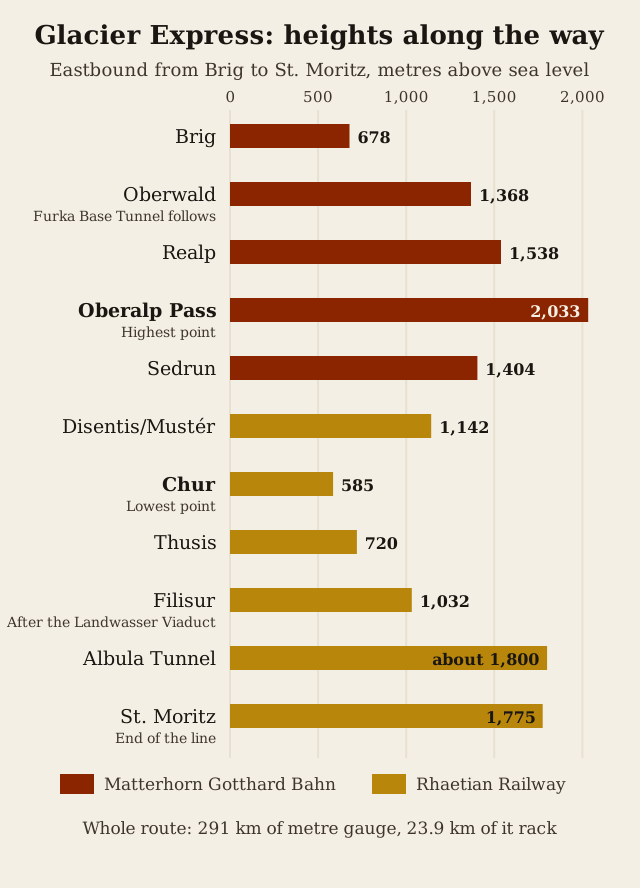
The journey starts in Zermatt, at the head of the Mattertal valley below the Matterhorn. The train descends the valley to Visp and continues to Brig at 678 metres. From Brig it follows the Rhone upstream through the Goms Valley, passing Fiesch, to Oberwald at 1,368 metres in the canton of Valais. At Oberwald the train enters the 15.4-kilometre Furka Base Tunnel. The tunnel bypasses the old line over the Furka Pass, which the Furka Cogwheel Steam Railway reopened in full in 2010. The train leaves the tunnel at Realp, at 1,538 metres in the canton of Uri.
From Realp the train runs down the Urseren valley through Hospental to Andermatt. From Andermatt the line climbs to the Oberalp Pass summit at 2,033 metres, the highest point of the journey. On the far side the train enters Graubünden and descends to Sedrun at 1,404 metres and Disentis/Mustér at 1,142 metres. It then follows the Rhine down the valley past Ilanz and through the Ruinaulta gorge to Chur. At 585 metres, Chur is the lowest point of the journey.

Climbing the Albula Line
From Chur the Glacier Express regains altitude on the Rhaetian Railway. It follows the Posterior Rhine up to Thusis at 720 metres and continues on the Albula line to Tiefencastel. After Tiefencastel the train crosses the Schmittentobel Viaduct and then the Landwasser Viaduct. It runs straight off the viaduct into the Landwasser Tunnel and reaches Filisur at 1,032 metres. At Filisur, travellers can change for a connecting train to Davos.
From Filisur the line climbs through a spiral toward Bergün/Bravuogn. Between Bergün/Bravuogn and Preda the train passes through a series of spirals. The spirals let the line gain roughly 400 metres of height over about 5 kilometres. Preda is the last station in the Albula Valley. Beyond it the train enters the Albula Tunnel under the Albula Pass at about 1,800 metres. It leaves the tunnel in the Val Bever and passes Bever and Samedan on the high Engadin plateau. The service ends at St. Moritz, at 1,775 metres.
The Landwasser Viaduct
The Landwasser Viaduct spans the Landwasser river between Schmitten and Filisur in the canton of Graubünden. It carries the Albula line between Tiefencastel and Filisur. It was built between 1901 and 1902. The engineer Alexander Acatos designed it, and Müller & Zeerleder built it for the Rhaetian Railway. The Rhaetian Railway still owns and operates the viaduct today.
The viaduct is 65 metres high and about 140 metres long. It is made of dark limestone and carries a single track. Its six arch spans are each 20 metres wide and rest on five pillars, which reach 50 metres high. The viaduct stands on a curve with a radius of only 100 metres. The track across it has a gradient of 2 percent. The viaduct was built without scaffolding. Two bridge cranes were used instead, and their iron towers were built into the pillars as the pillars rose. The limestone pillars were built up around a steel-reinforced core. The structure contains more than 9,000 cubic metres of material, about three times the mass of the nearby Solis viaduct. At the time it was considered a challenging feat of engineering, and its construction used several techniques that were new for the era.

The viaduct sits at the 63.070 km mark from Thusis on the Albula line. Passengers approaching from Tiefencastel can see it from some distance away. Shortly before it they cross the Schmittentobel Viaduct, which is itself of considerable size. While crossing the curved Landwasser Viaduct, passengers can see the front of their own train entering the Landwasser Tunnel. The southeastern abutment sits on a high cliff, and the tracks lead directly into the tunnel, which is roughly 200 metres long. The tunnel entrance was placed on a vertical rock face in line with the viaduct. On the far side of the tunnel, the line from Davos Platz joins the Albula line just as both reach Filisur. Passengers on the Davos line get a view of the viaduct from the northeast shortly before that junction.
The Rhaetian Railway calls the Landwasser Viaduct probably Switzerland's most famous viaduct. The viaduct's masonry and track trough were repaired for the first time in 2009. Modular scaffolding was put up around the viaduct for that work. The viaduct lies within the Rhaetian Railway in the Albula/Bernina Landscapes, which was added to the UNESCO World Heritage list in 2008.
History of the Glacier Express Service
The Furka Oberalp Bahn (FO) completed its final section in 1926. This opened the cantons of Valais and Graubünden to further tourist development. It also made way for through coaches between Brig and Chur and between Brig and St. Moritz. In early June 1930 the Visp-Zermatt Bahn was extended along the Rhone Valley from Visp to Brig. For the first time, through coaches could run the full distance from Zermatt to St. Moritz. The first train of these coaches set out in June 1930 under the name Glacier Express. The name honoured the Rhone Glacier near Gletsch on the Furka Pass. Three companies ran the service at first: the Visp-Zermatt Bahn, the Furka Oberalp Bahn and the Rhaetian Railway. Each of the three companies provided salon and passenger coaches for the train, in first, second and third class.
Between Chur and Disentis/Mustér, early passengers could take a hot lunch in a Mitropa dining car. In the early years, electric locomotives hauled the train on the BVZ and RhB sections, while the FO still used steam. Overhead catenary was installed on the FO in 1941 and 1942, which allowed electric operation over the whole route. No through trains ran between 1943 and 1946 because of World War II. Daily through trains came back in 1948, and from then on the dining car ran beyond Disentis/Mustér as far as the summit of the Oberalp Pass. Between the 1950s and the 1970s, the BVZ and the RhB introduced new locomotive classes that shortened the schedule. The dining car service was later extended further, to Andermatt. Snow closed both the Furka Pass and the Oberalp Pass each winter, so until 1982 the Glacier Express operated in summer only.
The Furka Base Tunnel opened in June 1982. From then on the Glacier Express could run all year. The new tunnel also took the train away from the Rhone Glacier that had given it its name. The BVZ, FO and RhB used the change to relaunch the Glacier Express as a tourist attraction. Promotional material stressed its status as the slowest express train in the world. A promotional wine glass with a sloping base was made to show the steepness of parts of the route.
The Glacier Express is often described as the slowest express train in the world.
Passenger numbers rose from 20,000 in 1982 to more than 53,000 in 1983 and just over 80,000 in 1984. The timetable was completely revised in 1985. Between 1986 and 1993 the BVZ and FO invested nearly 40 million Swiss francs in 18 new first class panorama cars. By 2005, more than 250,000 passengers were riding the Glacier Express each year. More panorama cars joined the fleet in 2006, the same year that a few scenes of the documentary The Alps were filmed on board. The direct service to Davos was discontinued in 2013 because of falling passenger numbers. In 2018 two additional summer services were introduced. Each morning one runs from Zermatt to Chur and one runs from St. Moritz to Brig, and both travel back in the afternoon.

The 2010 Derailment Near Fiesch
A Glacier Express train left the rails on 23 July 2010 close to Fiesch, on the Matterhorn Gotthard Bahn line. One passenger was killed and 42 others were injured in the accident. The derailment was caused by the train travelling too fast as a result of human error.
Passengers and Meals on Board
Tourists from Germany and Japan are especially drawn to the Glacier Express, and a growing number of them come from India. The train has little space on board to store fresh ingredients. The operator therefore contracts local businesses and caterers along the route to supply meals as the train reaches each area.

Rails & Rivals, our game on Steam, is a turn-based railroad strategy board game for 2 to 6 players: each player runs a rail company, lays track across a hex map and carries goods between cities, and the wealthiest company wins. The how to play page has the rules.
Keep reading
Sources
- About the Glacier Express (Glacier Express AG)
- Glacier Express homepage (Glacier Express AG)
- Glacier Express route (Glacier Express AG)
- About the Matterhorn Gotthard Railway (Matterhorn Gotthard Bahn)
- RhB History (Rhaetian Railway (RhB))
- UNESCO World Heritage RhB (Rhaetian Railway (RhB))
- Landwasser Viaduct (Graubünden Tourism)
- Glacier Express (Wikipedia)
- Landwasser Viaduct (Wikipedia)