Mount Washington Cog Railway: History and How It Climbs

The Mount Washington Cog Railway is the world's first mountain-climbing cog railway, a rack-and-pinion line up the western slope of Mount Washington in New Hampshire. Sylvester Marsh built it, paying passengers began riding in August 1868, and the first train reached the summit on July 3, 1869. The line climbs an average grade of about 25 percent, and its steepest section, Jacob's Ladder, reaches about 37 percent.
Sylvester Marsh and the charter for a railway up Mount Washington
Sylvester Marsh came up with the idea for a railway up Mount Washington while climbing the mountain, before he applied for a charter. Born in 1803 in Campton, New Hampshire, he was raised on a farm and walked to Boston while still in his teens. He later went to Chicago and grew wealthy as a meat packer, lost that fortune in a financial panic, and built a new one in grain. On the hike that set him thinking, Marsh was caught in a violent storm above the tree line and only just reached the Tip Top House, a stone shelter built on the summit in 1853.
In 1858 Marsh asked the New Hampshire State Legislature for a charter. Legislators nearly laughed him out of the State House and called him "Crazy Marsh", but the charter was granted on June 25, 1858, along with the jibe that once he reached the summit he might as well carry on and build a railway to the moon.
Local tradition holds that the legislature voted permission on the reasoning that harm from operating the railway was no issue, since the design was attempting the impossible, while the benefits were guaranteed. Marsh put up $5,000 of his own money, and he planned to spend that and any other money he raised in the area, including on a new hotel, the Fabyan House, at nearby Fabyan Station to house the visitors he expected. The Civil War then held up any action on the charter until May 1866. Marsh built a prototype engine and a short stretch of demonstration track, then lined up investors, set up the Mount Washington Railway Company that spring, and began building.

Building the Cog Railway to the summit
Everything needed for construction came from the nearest railroad, at Littleton, New Hampshire, 25 miles away, and men and oxen dragged the materials, equipment and supplies through the woods. The line's route kept close to a mountain trail that Ethan Allen Crawford had laid out earlier that century.
Fare-paying passengers began riding on August 14, 1868, while the line was still unfinished, and the first train reached the summit on July 3, 1869. A month later, in August 1869, President Ulysses S. Grant toured New England to get away from the summer heat of Washington, D.C., and rode the cog railway to the top of Mount Washington on that trip.

In the early days of construction, workers wanted to cut the time spent climbing and descending the steep grade, so they invented slideboards, nicknamed devil's shingles, that fit over the cog rack and left enough room for a rider and tools. A descent on a devil's shingle averaged about 15 minutes. The devil's shingles were banned in 1908 after an employee was accidentally killed, and the rack was later redesigned so the old braking mechanism could no longer grip it.
How a cog (rack) railway climbs Mount Washington
On the Mount Washington Cog Railway, the rack is a ladder-like design, one of Marsh's own inventions, built from open bar rungs that the cog wheel's teeth engage; the open design lets snow and debris fall through rather than lodge in the rack.
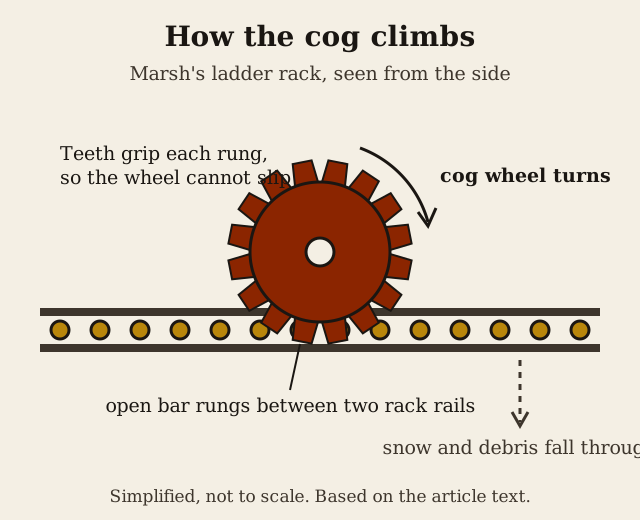
Marsh also devised a ratchet safety cog with gear reduction and a braking mechanism, and he held related patents. Each train is a single locomotive pushing one passenger car up the mountain, and the pair comes back down with the locomotive running in reverse. Both locomotive and car were originally fitted with a ratchet and pawl mechanism that engaged during the climb to prevent roll-back, while both were braked during the descent; design improvements later replaced that ratchet and pawl arrangement with sprag clutches and disc brake assemblies. For a safe descent, Marsh turned the steam locomotives into rolling air compressors: special valves let air into the four cylinders, and the compressed air held the engine's speed down on the downgrade.

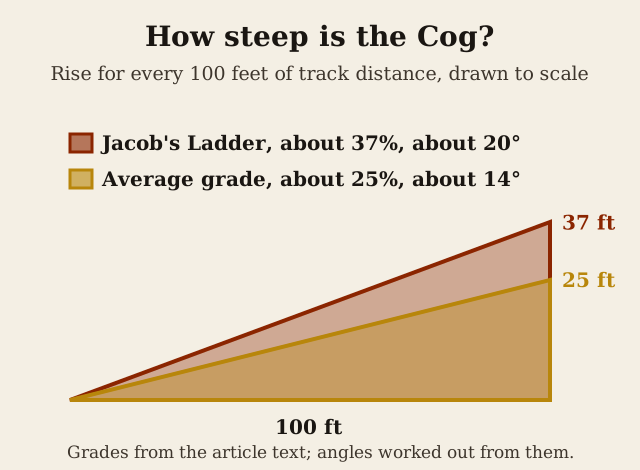
The Mount Washington Cog Railway is about 3 miles long, and about 3 miles of it is on trestle. The average grade is about 25 percent, and the steepest section, Jacob's Ladder, about two-thirds of the way up, reaches a maximum grade of about 37 percent. The line ends just short of the 6,288-foot summit. Trains climb at about 2.8 mph and descend at about 4.6 mph. The track is built to a gauge of 4 ft 8 in, half an inch narrower than standard gauge, so it is technically narrow gauge.
While the Mount Washington line was being built, the Swiss Consul to the United States visited Marsh, and his glowing accounts led the Swiss government to hire Niklaus Riggenbach for a line up Mount Rigi, the Vitznau-Rigi-Bahn, opened in May 1871.
Steam and biodiesel locomotives on the Cog
The Cog Railway's locomotives were fired with wood from 1868 to 1910, when the railway converted to coal for all of its engines. Most of the historic steam locomotives were built by the Manchester Locomotive Works, and later designs introduced horizontal boilers, slanted so that they stay close to horizontal even on the railway's steep grade. Two later steam engines, built in 1972 and 1983, and all seven diesels came out of the railway's own shop at the base of the mountain.
Old Peppersass, the railway's locomotive No. 1, was the world's first cog locomotive and was used to build the line itself; built in 1866 by Campbell, Whittier and Company and originally named Hero, it earned its later nickname from the resemblance of its vertical boiler to a pepper sauce bottle. Peppersass operated until its retirement in 1878, was wrecked during a commemorative run in 1929, and its pieces were later reassembled for static display at the base station.
Steam locomotives
| No. | Name | Built | Status | Notes |
|---|---|---|---|---|
| 1 | Old Peppersass | 1866 | Display | World's first cog locomotive, originally named Hero, wrecked in 1929, reassembled for static display. |
| 1 | Mt. Washington | 1883 | Stored, out of service | Originally No. 7 Falcon, renumbered 1 after rebuilding following the 1895 fire, named Mt. Washington after 1931, retired in the early 1990s. |
| 2 | Ammonoosuc | 1875 | Operational | Originally No. 4 Atlas, renumbered 2 after rebuilding following the 1895 fire, named Ammonoosuc after 1931, fitted with a feedwater heater. |
| 3 | Agiocochook | 1883 | Stored, serviceable | The engine in the fatal 1967 accident, renamed Agiocochook in the mid-1990s, last operated in 2008 after a failed boiler inspection. |
| 4 | Summit | 1883 | Display | Later renamed Chocorua, then No. 8 Moosilauke, retired after the 2009 season, donated to Twin Mountain for static display in July 2013. |
| 6 | Kancamagus | 1874 | Stored, serviceable | Rebuilt from a vertical to a horizontal boiler in 1878, last operated in 2010. |
| 8 | Moosilauke | 1983 | Stored, out of service | Built at the Cog Shop, last operated in 2006. |
| 9 | Waumbek | 1908 | Operational | First horizontal-boiler engine with its cab on the same plane as the boiler, fitted with a feedwater heater. |
| 10 | Col. Teague | 1972 | Display | Built at the Cog Shop, last operated in 2009, placed in October 2015 at the junction of U.S. Route 302 and Base Station Road as an entrance sign. |
The Cog introduced its first diesel locomotive, powered by biodiesel, in the summer of 2008, built by the railroad's own staff with help from a retired mechanical engineer from the Portsmouth Naval Shipyard. The Great Recession and the energy crisis of the 2000s had cut passenger numbers, and a diesel could make three round trips for the cost of one steam round trip. One steam locomotive was converted to oil-firing in 2008, but that attempt failed, and the railway turned to diesel instead. The diesel-hydraulic locomotives were run on B20, a 20 percent biodiesel blend, in the summer season. By 2019, the Cog had completed seven of these diesel-hydraulic locomotives.

Biodiesel locomotives
| No. | Name | Built | Notes |
|---|---|---|---|
| M-1 | Wajo Nanatassis | 2008 | First diesel-hydraulic locomotive; the name means "mountain hummingbird" in the Abenaki language. |
| M-2 | Algonquin | 2009 | Second diesel-hydraulic locomotive. |
| M-3 | Abenaki | 2009 | Third diesel-hydraulic locomotive. |
| M-4 | Agiocochook | 2010 | Fourth diesel-hydraulic locomotive; Agiocochook is a name some Indigenous peoples use for Mount Washington. |
| M-5 | Metallak | 2013 | Fifth diesel-hydraulic locomotive, named after a Native American hunter and guide. |
| M-6 | LaPrade | 2016 | Sixth diesel-hydraulic locomotive, named after Al LaPrade, designer of the railway's first diesel locomotive. |
| M-7 | Kenison | 2019 | Seventh diesel-hydraulic locomotive, named after Charley Kenison, the railway's general manager. |
Accidents on the Mount Washington Cog Railway
Two accidents on the Mount Washington Cog Railway, in 1929 and 1967, killed people. A third, on August 10, 1946, injured 22 people when a flatcar left standing near the summit ran away down the track and hit an ascending passenger train.
The first fatal accident happened on July 20, 1929, and involved locomotive No. 1, Old Peppersass, the same engine used to build the railway and retired from regular service in 1878. After a few years on local display, Peppersass was shipped to the World's Columbian Exposition in 1893, then taken by the Baltimore and Ohio Railroad and stored in Baltimore until the B&O's 1927 Fair of the Iron Horse, which celebrated that railroad's 100th birthday. The Boston & Maine Railroad restored Peppersass at its Concord shops after the fair so it could make a commemorative trip for the Cog Railway's 60th anniversary.
During that 1929 trip, Peppersass ascended to Jacob's Ladder and began a planned descent, but a tooth broke from a gear wheel, the locomotive jumped up and landed to the right of the cog rail, and its friction brake could not stop it from accelerating downhill. The crew jumped to safety, though some suffered broken bones, but Daniel P. Rossiter, a photographer riding the engine to take publicity photos, fell to his death as it plunged off the trestle. The locomotive broke into pieces, though its boiler did not rupture, and the pieces were later put back together for static display.

The second fatal accident came in September 1967, when locomotive No. 3, later renamed Agiocochook, derailed at the Skyline switch about a mile below the summit, killing eight passengers and injuring dozens more. The engine rolled off the trestle, while the passenger car, no longer coupled, slid several hundred feet and hit a large rock. Investigators found that the Skyline switch had not been set properly for the descending train.
Ownership and operations of the railway
Apart from breaks during the World Wars, the railway ran without interruption from 1869. After Marsh's death, the Concord & Montreal Railroad ran it until the Boston & Maine took over. Henry N. Teague, a hotel executive, bought the Cog in 1931; he was known as Col. Teague, though the rank was honorary, and he died in October 1951. Ownership then went to Dartmouth College, his alma mater, while Arthur S. Teague took operational control. Arthur Teague, who really was a colonel and was highly decorated in his military service, was the elder Teague's protégé but no relation, and he bought the railway from Dartmouth in 1962. After he died in 1967, the railway passed to his wife, Ellen Crawford Teague, who sold it to a group of New Hampshire businessmen in 1983.
Wayne Presby and Joel Bedor, both of Littleton, New Hampshire, owned and ran the railway from 1986 to 2017; their families also held the Mount Washington Hotel and Resort in Bretton Woods from 1991 to 2006. In 1995, the railway appointed Charles Kenison as general manager, and together these men led a complete revitalization of the railroad with help from Al LaPrade, a mechanical engineer who had started his career at the Portsmouth Naval Shipyard. The Bedor family sold its stake to Presby in April 2017, making him the last remaining member of the group that had bought the railway in 1983, and he took direct management control in December 2017.

In 1941, the railway added a nine-motion switch along with two spur sidings, each able to hold two trains on their way down while ascending trains carried on to the top, so more round trips fit into a day. Work on a further switch and siding at the summit, so trains could pass each other there, started in 2014. In 2004, a passing loop with automated switches powered by solar-charged batteries replaced the lower Waumbek switch and siding. Trains first ran all winter in the 2004 to 2005 season. Two of the biggest improvement projects in the railway's history were finished in 2021, replacing its rail with rail four times as heavy and finishing a new maintenance facility.
Winter trains, ski trains and hikers
The base station sits at the upper end of the dead-end Cog Base Road, and the route the railway advertised to drivers follows that road's full length from Bretton Woods. A steam engine has to stop once on the climb to take on water, and each steam ride on the line has been put at about a ton of coal.
When winter running resumed in 2020, trains ran in the cold months only as far as Waumbek Station, in an alpine meadow below the tree line at roughly 3,800 to 4,000 feet, rather than to the summit. A winter round trip to Waumbek Station took about one hour, including a stop of about 25 minutes with warming huts and a fire pit.
The Cog Railway's track crosses three hiking trails, including the Gulfside Trail, part of the Appalachian Trail; the railway was running before those trails existed, and the trails cross railroad property. Some hikers have been known to wait for a passing train so they can bare their buttocks at the riders, which is called mooning the Cog, and several hikers were arrested for doing so in 2007. From 2003 to 2006, the Cog ran ski trains that stopped at an intermediate station so passengers could ski down to the Base Station.

Rails & Rivals, our game on Steam, is a turn-based railroad strategy board game for 2 to 6 players: each player runs a rail company, lays track across a hex map and carries goods between cities, and the wealthiest company wins. The how to play page has the rules.
Keep reading
Sources
- Mount Washington Cog Railway (Wikipedia)
- Sylvester Marsh (Wikipedia)
- Sylvester Marsh and the Railway to the Moon (Mount Washington Cog Railway (official operator))
- Among Clouds (American Heritage magazine)
- Mount Washington Cog Railway (American Society of Civil Engineers)
- #18 Mount Washington Cog Railway (American Society of Mechanical Engineers)
- FAQs (Mount Washington Cog Railway (official operator))
- Explore the Cog in Winter (Mount Washington Cog Railway (official operator))
- Mount Washington Cog Railway homepage (Mount Washington Cog Railway (official operator))