Empire Builder Train: Amtrak's Chicago to Seattle Route

The Empire Builder is a daily long-distance passenger train that Amtrak operates between Chicago and either Seattle or Portland, with the train dividing into two sections west of Spokane. Introduced in 1929 as the flagship train of the Great Northern Railway, it was kept on by Amtrak when the company took over the country's intercity rail service in 1971. In 2019, Amtrak described it as crossing the country's northern tier, through the Mississippi River Valley, the Great Plains, the Rockies and the Cascade Range.
The Empire Builder's Route from Chicago to Seattle and Portland
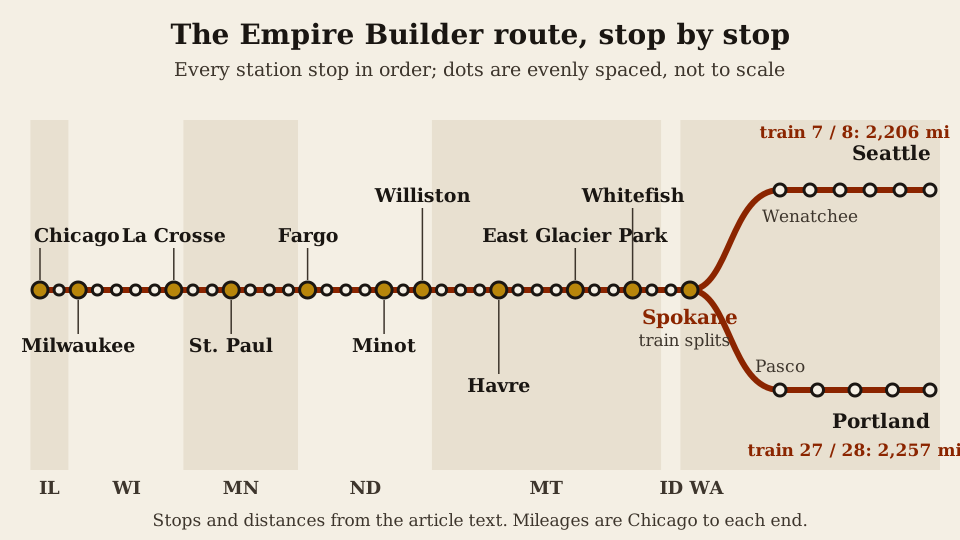
The Empire Builder splits into a Seattle leg and a Portland leg that cover different distances. The Seattle to Chicago run measures 2,206 miles, while the Portland to Chicago run measures 2,257 miles. The route crosses Oregon, Washington, Idaho and Montana before continuing through North Dakota, Minnesota, Wisconsin and Illinois.
Along the way the train makes service stops at Spokane, Washington; Havre, Montana; Minot, North Dakota; and Saint Paul, Minnesota. Among the other major stops are Milwaukee, Wisconsin, Fargo and Williston in North Dakota, Whitefish, Montana, and Vancouver, Washington.
The Empire Builder runs over several host railroads: BNSF Railway's Northern Transcon from Seattle to Minneapolis, the Minnesota Commercial Railway from Minneapolis to St. Paul, Canadian Pacific Kansas City from St. Paul to Rondout, Illinois, and Metra's Milwaukee District North Line from Rondout to Chicago. Between St. Paul and Chicago it follows the route of the former Twin Cities Hiawatha, and since May 2024 that portion has been supplemented by the Borealis.
From Chicago to Spokane, the train's stops in order are:
- Chicago
- Glenview
- Milwaukee
- Columbus
- Portage
- Wisconsin Dells
- Tomah
- La Crosse
- Winona
- Red Wing
- St. Paul
- St. Cloud
- Staples
- Detroit Lakes
- Fargo
- Grand Forks
- Devils Lake
- Rugby
- Minot
- Stanley
- Williston
- Wolf Point
- Glasgow
- Malta
- Havre
- Shelby
- Cut Bank
- Browning
- East Glacier Park
- Essex
- West Glacier
- Whitefish
- Libby
- Sandpoint
- Spokane
West of Spokane, the Seattle section stops at Ephrata, Wenatchee, Leavenworth, Everett and Edmonds before Seattle, while the Portland section stops at Pasco, Wishram, Bingen and Vancouver, Washington, before Portland, Oregon.
The Split at Spokane
At Spokane, Washington, the sections of the Empire Builder bound for Portland and Seattle come together eastbound, and they split apart westbound. The station has been a city landmark since 1891, and its historic depot was renovated, reopening in 1994 with funding pooled from Greyhound, Amtrak, the Federal Railroad Administration, the state of Washington and the city of Spokane.

Heading west, the train divides at Spokane, where a single locomotive carries the remaining cars, including the lounge and cafe car, onward to Portland as train 27, while the first six passenger cars, the baggage car and the locomotives proceed to Seattle as train 7. Eastbound, the sections are combined in reverse, with the Seattle section numbered train 8 and the Portland section numbered train 28.
James J. Hill and the Great Northern Railway's Origins
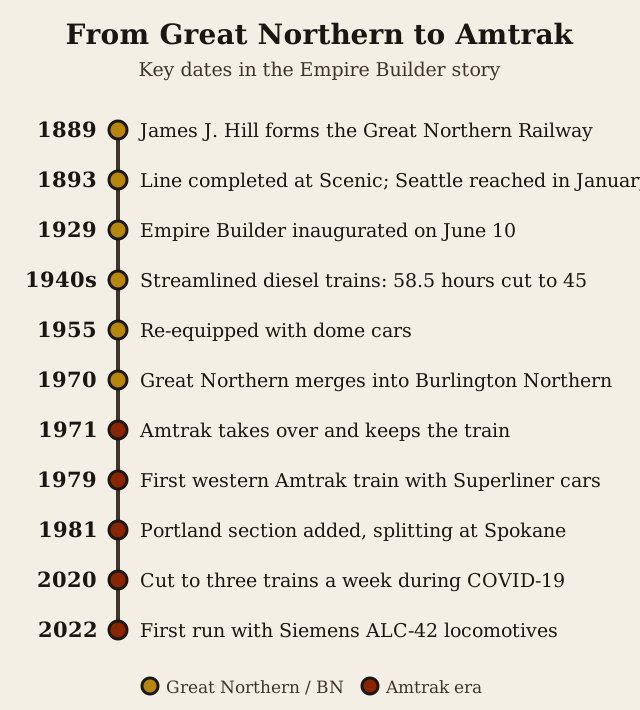
James J. Hill rose from a poor dock clerk to a multimillionaire railroad magnate, and his nickname, the Empire Builder, later gave the Great Northern's 1929 train its name. On September 18, 1889, Hill created the Great Northern Railway out of the bankrupt St. Paul and Pacific, and the Minneapolis and St. Cloud.

Hill built the Great Northern in stages, creating profitable lines first before undertaking further expansion, which let him avoid excessive debt. He bought up smaller lines and lured settlers to what had been considered the wastelands of North Dakota, Idaho and Montana. He reorganized several failing railroads into what became the only successful attempt at a privately funded transcontinental railroad.
The line proceeded west through North Dakota and Montana, crossing the Rocky Mountains at the recently discovered Marias Pass. Official completion of the transcontinental line came at Scenic, Washington, on January 6, 1893, and the line reached its terminus in Seattle the next day, January 7, 1893, just ahead of the worldwide financial panic of that year.
Hill, president of the railroad, built not just a railroad but an empire of towns and ranches along the tracks from St. Paul, Minnesota, to Seattle, Washington. The Great Northern also helped promote the legislation that established Glacier National Park in 1910.
The Great Northern's Empire Builder, 1929 to 1970
On June 10, 1929, the Empire Builder was inaugurated by the Great Northern Railway, and the first westbound train left Chicago that evening. It was named in honor of Hill, who had reorganized failing railroads into that transcontinental line and for that feat had been nicknamed the Empire Builder. At the time, a rail journal described wicker chairs cushioned in silk inside a solarium, walnut door frames that were hand-carved, and drawing rooms trimmed with "old gold."
Thanks to the schedule, riders could view Glacier National Park, which had been established through lobbying by the Great Northern itself, as well as the Cascade Mountains. A tornado struck the eastbound Empire Builder in Clay County, Minnesota, in 1931. The train, carrying 117 passengers, had all of its cars except the locomotive and coal tender thrown off the tracks, with one car thrown 80 feet off the track.
Because of heavy patronage, the Empire Builder ran in two sections during World War II, known as First 1 and Second 1. On August 9, 1945, First 1 halted at Michigan, North Dakota, to deal with an overheated journal, and Second 1 hit it from behind at 45 mph. The rear car of First 1, a "bobtail" car combining an observation section with sleeping berths, was telescoped along practically its entire length by Second 1's engine and was demolished.
After World War II, the Great Northern placed new streamlined, diesel-powered trains into service that cut the scheduled 2,211-mile Chicago to Seattle trip from 58.5 hours to 45 hours. The train was re-equipped with domes in 1955, and passengers then had views from three dome coaches, plus one full-length Great Dome car for first class passengers.
The eastbound Empire Builder and its companion train, the Western Star, travelling in the opposite direction, collided head-on on March 7, 1966. In March 1970, the Great Northern merged with three closely affiliated railroads, the Chicago, Burlington and Quincy, the Northern Pacific, and the Spokane, Portland and Seattle, to form the Burlington Northern, which took over operation of both the Builder and the Western Star, along with the Northern Pacific's North Coast Limited.
Amtrak's Empire Builder Since 1971
Burlington Northern transferred its long-distance trains to Amtrak when Amtrak took over most intercity routes in May 1971, and Amtrak chose to keep running the Builder. To coincide with Expo '74 in Spokane during the summer of 1974, Amtrak introduced a third train, named the Expo '74, running between Spokane and Seattle alongside the Builder and the North Coast Hiawatha. From June 1971 to October 1979, the North Coast Hiawatha, a descendant of the Northern Pacific's own flagship North Coast Limited, ran on the former Northern Pacific route parallel to the Builder, linking the Twin Cities and Spokane by way of Staples, Fargo, Bismarck, Missoula and Helena. The two trains ran combined between Chicago and the Twin Cities and between Spokane and Seattle until June 11, 1973, when Amtrak decided the two services should run separately again.

In October 1979, the Empire Builder became the first of Amtrak's western long-distance trains to receive the new Superliner I cars built by Pullman-Standard. Amtrak added the Portland section in 1981, with the train splitting at Spokane. That year the Seattle section was also rerouted from the old Northern Pacific line to the Burlington Northern's line through the Cascade Tunnel over Stevens Pass, which ended service to Yakima, Ellensburg and Auburn, Washington. The new Portland section returned service to the former Spokane, Portland and Seattle Railroad line along the Washington shore of the Columbia River; the route kept Pasco and added Wishram, Bingen-White Salmon and Vancouver, Washington.
Sleeping car passengers gained extra perks in 2005, when Amtrak added a tasting of wine and cheese in the dining car along with free morning newspapers to the service, though some of these additions were later removed by Amtrak's inspector general in 2013 as a cost-saving measure. Amtrak marked the Empire Builder's 90th anniversary in 2019, by which time the train connected more than 40 communities in eight states; in 2018 it carried 428,854 customers as Trains 7/27 and 8/28.
The Empire Builder had run daily for nearly a century before its schedule was reduced to tri-weekly service in 2020, part of wider cuts Amtrak made to most of its long-distance routes because of the COVID-19 pandemic. Through most of that fall and winter, departures from Chicago ran on Mondays, Thursdays and Saturdays, while trains left Seattle or Portland on Tuesdays, Thursdays and Saturdays. In March 2021, Amtrak announced the train would return to its daily schedule in May 2021.
The Empire Builder leaving Chicago for Seattle in February 2022 became the first train to run with Amtrak's new Siemens ALC-42 locomotives. The locomotives are Buy America compliant and were built at Siemens Mobility's rail manufacturing hub in Sacramento, California. Amtrak said they reduce nitrogen oxide emissions by more than 89% and particulate matter by 95% compared with the locomotives being retired, and reach a greater top speed, 125 mph. Amtrak's announcement listed the Empire Builder and the California Zephyr among the long-distance trains the new locomotives would power.

Equipment, Travel Time and Ridership
The Empire Builder runs with bilevel Superliner passenger cars, as do all Amtrak long-distance trains west of the Mississippi River, with the exception of the baggage car. A typical consist is hauled by two or three GE Genesis or Siemens Charger ALC-42 locomotives.

The Empire Builder's full end-to-end journey is scheduled at 45 to 46 hours, which works out to an average speed of about 50 mph, even though the train reaches 79 mph over most of the route. The timetable allows 45 hours, 15 minutes from Seattle to Chicago and 45 hours, 10 minutes from Portland to Chicago.
Over fiscal years 2007 to 2016, the Empire Builder's annual ridership averaged 500,000, with a high of 554,266 passengers in fiscal year 2008.
The Empire Builder carried 338,993 passengers during fiscal year 2023, up 15.0% from fiscal year 2022 but still 21.8% below pre-COVID-19 levels, when fiscal year 2019 saw the train carry 433,372 passengers. During fiscal year 2022, the train had a total revenue of $49,600,000.
Delays, Flooding and Freight Congestion on the Route
The Empire Builder's route has come under threat from flooding on the Missouri, Souris, Red and Mississippi rivers, occasionally forcing the suspension or alteration of service. Service usually comes back within days or weeks, though Devils Lake in North Dakota, lacking any natural outlet, has long posed a persistent threat. In 2009, BNSF Railway, the track's owner, halted freight traffic through Devils Lake and warned that it would let rising water submerge the line unless Amtrak paid $100 million to raise the track.

BNSF also offered, during that period, to route the Builder onto the Transcon segment between Fargo and Minot, which would have meant losing the Grand Forks, Devils Lake and Rugby station stops; to compensate, BNSF suggested Amtrak add a stop at New Rockford, North Dakota. In 2010, analysts estimated Amtrak would soon have to either rebuild the bridge crossing the lake at Churchs Ferry or reroute its passenger trains. In June 2011, Amtrak and BNSF agreed to split the rebuilding cost one-third each, leaving the remainder to come from federal and state governments. North Dakota then received a TIGER grant of $10 million from the US Department of Transportation in December 2011 to help cover its share. During the latter part of June and most of July 2011, the route was also blocked by flooding of the Souris River close to Minot, North Dakota, which had occurred that spring and summer.
A separate problem came from an oil boom in the Bakken formation, which, combined with a strong harvest in fall 2013, pushed up how many crude oil and grain trains ran on the Northern Transcon through Montana and North Dakota. The resulting congestion led to widespread delays, and in November 2013 the Empire Builder was on time just 44.5% of the time, worse than any other Amtrak route, a sharp change from years when it ranked among the system's best performers for punctuality, ahead of even the Acela Express. The delays sometimes left Amtrak's crews and equipment out of position, forcing Amtrak to cancel runs.
By May 2014, only 26% of Empire Builder trains arrived within 30 minutes of their scheduled time, with delays averaging 3 to 5 hours and, in some cases of freight congestion and severe weather, as long as 11 to 12 hours. Because of the delays, Amtrak adjusted the route's schedule west of St. Paul in 2014; its announcement said BNSF was adding track capacity and anticipated that the Empire Builder could return to its former schedule sometime in 2015. An announcement in January 2015 said the train's normal schedule would resume.
Earlier Route Changes and Dropped Stops
The Empire Builder's stops have changed with several realignments. In 1970, the construction and filling of Lake Koocanusa required realigning 60 miles of track between Stryker, Montana, and Libby, Montana, and building the Flathead Tunnel, which led the Empire Builder to drop service to Eureka, Montana. In October 1979, the train was rerouted over the North Coast Hiawatha's old route between Minneapolis and Fargo, dropping Willmar, Minnesota; Morris, Minnesota; and Breckenridge, Minnesota, while adding St. Cloud, Minnesota; Staples, Minnesota; and Detroit Lakes, Minnesota.
In 2014 the Empire Builder returned to Saint Paul Union Depot. Renovation of that 1917 Beaux Arts terminal ran from 2011 through 2013, producing a multi-mode terminal used by Jefferson Lines, Greyhound Lines, commuter buses and the Metro Green Line, with a light rail connection to downtown Minneapolis. That station took over from the Midway Station, which opened in 1978, following the 1971 abandonment of Saint Paul Union Depot and the 1978 demolition of the Minneapolis Great Northern Depot.


Rails & Rivals, our game on Steam, is a turn-based railroad strategy board game for 2 to 6 players: each player runs a rail company, lays track across a hex map and carries goods between cities, and the wealthiest company wins. The how to play page has the rules.
Keep reading
Sources
- Empire Builder (Wikipedia)
- Spokane, WA - Amtrak Station (SPK) (Great American Stations (Amtrak/USHCA))
- Amtrak Customers Celebrate 90 Years of Empire Builder Service (Amtrak Media)
- View Train (American Heritage)
- Hill, James J. (1838-1916) (HistoryLink (Washington State history encyclopedia))
- Great Northern Railway (Minnesota Historical Society)
- The Great Northern Railway - Glacier National Park (National Park Service)
- New locomotives launched into Amtrak service on national network (Mass Transit Magazine (Amtrak press release reprint))