Railroad Barons: Who They Were and Who They Fought

Railroad barons were the financiers, promoters and executives who controlled America's railroads in the second half of the 19th century, men like Cornelius Vanderbilt, Jay Gould, Collis P. Huntington, James J. Hill and E.H. Harriman, who fought each other for lines, stock and territory as much as they built track. Their best known fights were the Erie War, the Union Pacific and Central Pacific grading race in Utah, and the battle for the Northern Pacific that ended at the Supreme Court.
Which robber barons were railroad men
The Library of Congress notes that the names Jay Gould and James Fisk Jr. are linked in American business history with the age of the robber barons. The pair ran the Erie Railroad together, moved in New York's Tammany Hall political circle, and clashed with J.P. Morgan over the Albany and Susquehanna Railroad. Their fights reached well beyond whichever line was in the headlines that year.
Several of the other men usually grouped under the label ran railroads rather than banks or factories. Cornelius Vanderbilt ran the New York Central. Edward Henry Harriman (1848-1909), an executive of the Union Pacific, was one of the dominant figures in the industry in the late 19th century. Collis P. Huntington was a promoter and manager of the Central Pacific, and James J. Hill built the Great Northern out of St. Paul, Minnesota.
Cornelius Vanderbilt and the New York Central
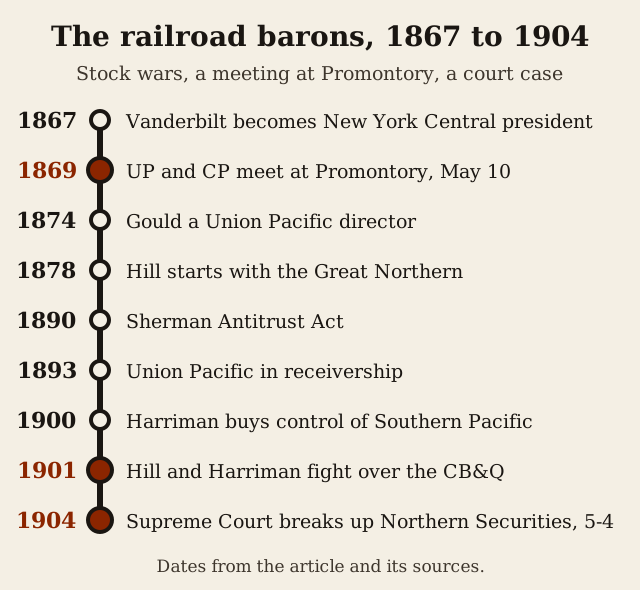
Cornelius Vanderbilt was known throughout his life by the nickname "Commodore," a name that stayed with him for the rest of his career. In 1867 he became president of the New York Central, already one of the largest railroads in operation. Next he joined the New York Central to the Hudson River Railroad, and by 1869 the merged company was worth about $90 million, twice what the two lines had been worth before.

The Erie War: Vanderbilt against Gould, Fisk and Drew
Much of the Erie Railroad's stock was owned by Cornelius Vanderbilt before Jay Gould, James Fisk and Daniel Drew moved to supplant him. Gould, Fisk and Drew responded by issuing fraudulent new Erie stock to weaken Vanderbilt's position, in the fight that became known as the Erie War: in total they issued 100,000 new shares of Erie stock to block his takeover. When New York law threatened to undo the move, Gould went further and bribed legislators in Albany to legalize the stock conversion. The fight was messy, but in the end Vanderbilt ceded control of the Erie to the three men.

Jay Gould was born May 27, 1836, in Roxbury, New York, and had worked with his father in the hardware business before moving into railroads and finance. He did not stay with the Erie for good. By 1874 he was a director of the Union Pacific Railroad and had soon taken control of its operations, trading one of the country's biggest eastern railroads for one of its two transcontinental lines.
Collis P. Huntington and the Central Pacific
Collis P. Huntington was a promoter and manager of the Central Pacific, the railroad that built east from California while the Union Pacific built west. He was one of the Central Pacific's "Big Four", with Leland Stanford, Charles Crocker and Mark Hopkins. The two lines met at Promontory, Utah, on May 10, 1869, completing the first transcontinental railroad.

Thomas Durant, Crédit Mobilier and the race to Promontory
Thomas C. Durant secured control of the Union Pacific Railroad, assumed its vice presidency, and named an associate as a figurehead president rather than take the top title for himself. Crédit Mobilier was his next tool for milking the railroad, in the words of PBS American Experience: the construction contract for the line went to Herbert Hoxie, who handed it to Durant, and Durant transferred it to Crédit Mobilier, a company he and his associates controlled.

The Union Pacific and the Central Pacific were racing each other for a reason beyond pride: huge land grants and government subsidies were tied to how much track each company laid, so both railroads strained hard to build more line than the other. In Utah that competition turned almost absurd. Union Pacific and Central Pacific grading crews actually met and passed one another, building duplicate, overlapping roadbeds, with grades often running within sight of one another for miles. Once the two lines finally joined at Promontory Summit, Oliver and Oakes Ames prepared to oust Durant from the Union Pacific for good, but he resigned first and moved on to other railroad projects rather than wait to be pushed out.
James J. Hill, the Empire Builder, against E.H. Harriman
James J. Hill earned the nickname "the empire builder," which the Great Northern later gave to its flagship train, the Empire Builder. Working out of St. Paul, Minnesota, he assembled a rail network piece by piece: the Great Northern in 1878, the Northern Pacific in 1896, and the Chicago, Burlington and Quincy in 1901, a system that stretched from Duluth all the way to Seattle.

Edward Henry Harriman, an executive of the Union Pacific Railroad, built his own power more gradually. The Union Pacific went into receivership in 1893, and Harriman joined the syndicate that reorganized it, gaining a seat on its board of directors four years later. In 1900 a further opportunity arose when the Southern Pacific Railroad's holdings were put up for sale, and Harriman purchased enough securities to control the entire transportation network running along the Pacific Coast.
The two men collided directly in 1901, when Harriman tried to take the Chicago, Burlington and Quincy Railroad away from Hill. Harriman was backed by the Kuhn-Loeb financial group, while Hill had the support of financier J.P. Morgan, and the two sides battled for stock control of the line. Hill fought off that attempt on the CB&Q, and also fought off a separate, furious effort by Harriman to seize control of the Northern Pacific out from under him by buying up its stock.
Northern Securities and the Supreme Court
Rather than keep fighting stock battle after stock battle, Hill and Harriman eventually agreed to create the Northern Securities Company. It was a holding company designed to bring most of the rail lines west of the Mississippi River under its control. They cooperated with banker J.P. Morgan and financier John D. Rockefeller to set it up, and the resulting company held majority shares in the Chicago, Burlington and Quincy, the Northern Pacific, and the Great Northern railroads, bringing Hill's and Harriman's former battlegrounds under one roof.
President Theodore Roosevelt had his Justice Department move to break up Northern Securities, arguing it was an illegal combination acting in restraint of trade, and used the Sherman Antitrust Act of 1890, officially titled "An Act to Protect Trade and Commerce Against Unlawful Restraints and Monopolies," to do it. The case reached the Supreme Court, which ruled 5-4 in favor of the federal government. The Court's reasoning was blunt: under the holding-company scheme one person held control of both roads, and any reason for the two of them to compete was wiped out.


Laying track and planning the best routes is also the basic shape of a game of Rails & Rivals, our game on Steam: a turn-based railroad strategy board game for 2 to 6 players in which each player runs a rail company on a hex map. The how to play page has the rules.
Keep reading
Sources
- Cornelius Vanderbilt (Encyclopedia.com (Gale))
- Robber Barons: Gould and Fisk (Library of Congress)
- Jay Gould (Encyclopedia.com (Gale))
- Collis Potter Huntington (Encyclopedia.com (Gale))
- Edward Henry Harriman (Encyclopedia.com (Gale))
- Hill, James J. (1838-1916) (Minnesota Historical Society (MNopedia))
- Northern Securities Case (Theodore Roosevelt Center, Dickinson State University)
- Northern Securities Co. v. United States, 193 U.S. 197 (1904) (Cornell Law School, Legal Information Institute)
- Thomas C. Durant (PBS American Experience)
- Parallel Grading (National Park Service)