Railroad Time Zones of 1883: The Day of Two Noons

On November 18, 1883, American and Canadian railroads replaced the patchwork of local sun time with standard time zones, in a changeover remembered as the Day of Two Noons. The railroads adopted the system on their own, more than three decades before Congress made it federal law.
The problem of local sun time before 1883
Local sun time set the clock in nearly every American and Canadian town before 1883. Cities measured the path of the sun across the meridian to set their clocks, and across latitudinal distances these readings varied, creating a patchwork of more than 144 local times across North America. By the early 1880s, railroads alone were running on an estimated 80 different times.
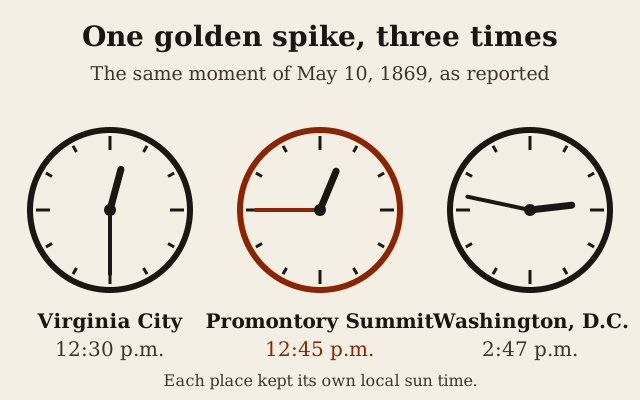
The 1869 golden spike ceremony showed how confusing this was in practice. The moment the spike was driven was reported as 12:45 p.m. at Promontory Summit, 12:30 p.m. in Virginia City, and 2:47 p.m. in Washington, D.C., each place simply keeping its own local solar time. A single national event had three official times depending on where a person happened to be standing.
More than 8,000 American towns still kept their own local time by 1883, even though over 53,000 miles of track had already been laid across the country (Linda Hall Library).
Charles Dowd's early plan for four zones
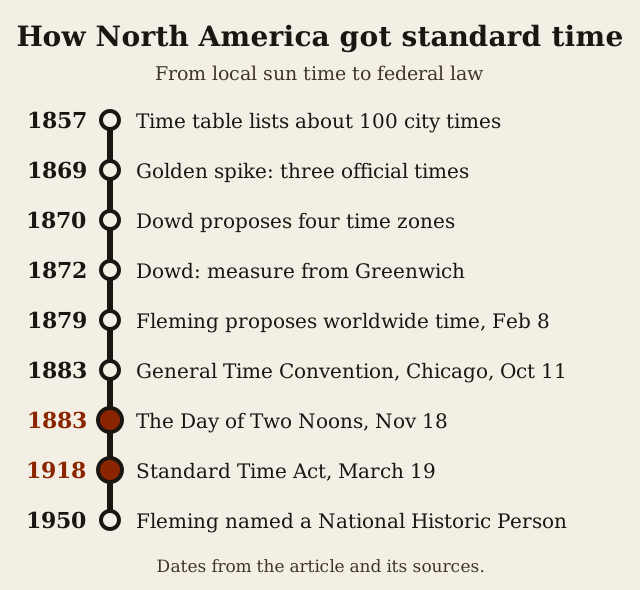
Charles Ferdinand Dowd saw where the trouble lay for people traveling west: every town kept its own solar time, so a trip by rail was confusing, hard to plan and unreliable. In 1870 Dowd suggested four time zones set at different meridians, naming them Eastern, Central, Mountain and Pacific.
Dowd's scheme was the first practical and comprehensive plan to standardize time across the United States. His proposal did not take hold immediately, but more than a decade later some of his ideas were accepted when standard time was finally implemented by the railroads on November 18, 1883 (Saratoga County History Center).

William F. Allen and the General Time Convention
William F. Allen turned the idea of standard time into a workable plan for the railroads themselves. Railroad officials met as the General Time Convention at the Grand Pacific Hotel in Chicago on October 11, 1883, and Allen laid out his proposal for standard time zones before them.
Allen called for "unity of action" and worked tirelessly to publicize the information needed to build consensus for ratifying what became known as Railway Time, according to the Linda Hall Library.
None of it would have worked without the telegraph. Using telegraph signals, the stations within each time zone set their clocks to match one another, something that had never been done before. The telegraph line, not the sun, became the thing every station clock answered to.

The Day of Two Noons: November 18, 1883
November 18, 1883 is remembered by the Union Pacific Railroad Museum as "the Day of Two Noons," the day railroads across the United States and Canada implemented a system of time zones. The US Naval Observatory confirms that standard time in time zones was instituted in the US and Canada by the railroads on that date, after most cities and towns had used some form of local solar time up to that point.
The nickname described exactly what clocks did that day. The name came from what happened in the eastern part of each zone: noon arrived once by sun time, then a second time after clocks and watches were turned back to the new standard railroad time. On November 18, 1883, clocks in several cities struck noon two times, first by the old local time and then by the new standard time.

How one railroad carried out the changeover
The Kansas Pacific Railroad left a detailed paper trail of how the switch actually worked on the ground. A railroad circular ordered the Kansas Division to change to 90th Meridian, or "Central," time at the moment standard time began on Sunday, November 18, 1883. The circular spelled out exactly how much clocks would move: 90th Meridian time was nine minutes faster than the railroad's existing Jefferson City standard, and a full hour faster than 105th Meridian time.
The circular also gave crews a precise procedure for the switch itself:
All train men East of Wallace must compare time at first telegraph office at which they arrive after nine o'clock a.m. with the standard time transmitted as above, setting their watches to correspond.

Sandford Fleming, advocate of Standard Time
Sandford Fleming carried the standard time idea beyond any single railroad's timetable. Parks Canada designated Fleming a National Historic Person in 1950, describing him as a railway survey and construction engineer and an advocate of Standard Time. The citation's wording, "railway survey and construction engineer, advocate of Standard Time," placed Fleming alongside Dowd and Allen as one of the figures credited with pushing the continent toward a single, agreed clock.

From railroad custom to federal law: the Standard Time Act of 1918
Standard time stayed an industry custom, not a law, for thirty-five years after the Day of Two Noons. The US Naval Observatory notes that standard time in time zones was not established in US law until the Act of March 19, 1918, often called the Standard Time Act.
The law carried the formal title "An Act to save daylight and to provide standard time for the United States". It gave the Interstate Commerce Commission authority over the time zone boundaries that the railroads had drawn up on their own in 1883 (Library of Congress). The same 1918 Act also established daylight saving time, itself a contentious idea from the start, according to the US Naval Observatory.

Other early voices for standard time
Dowd's 1870 proposal was not his final recommendation. In 1872, he urged that the four zones be measured from the meridian through Greenwich rather than Washington, D.C. Sandford Fleming proposed worldwide Standard Time at a meeting of the Royal Canadian Institute on February 8, 1879. Cleveland Abbe advocated standard time to better coordinate international weather observations (Wikimedia Commons).
The scale of the old problem is visible in an 1857 comparative time table that listed local times in roughly 100 American cities, a reference rail passengers consulted so they could plan journeys around the clock differences between towns along their route. That such a table was already necessary a generation before 1883 shows how long local time had been complicating travel before the railroads finally agreed on a fix (Wikimedia Commons).


Rails & Rivals, our game on Steam, is a turn-based railroad strategy board game for 2 to 6 players: each player runs a rail company, lays track across a hex map and carries goods between cities, and the wealthiest company wins. The how to play page has the rules.
Keep reading
Sources
- Whose Time Is It Anyway? A Brief History of Standardized Time Zones in the United States (Library of Congress (Law Library blog))
- Time is of the essence... or the railroad? (Union Pacific Railroad Museum)
- Charles Ferdinand Dowd (Saratoga County History Roundtable / Saratoga Springs History Museum)
- Kansas Pacific Railroad standard-time circular, 1883 (University of Nebraska-Lincoln, Railroads and the Making of Modern America)
- Standard Time Act (Wikipedia)
- History of U.S. Time Zones (U.S. Naval Observatory)
- Fleming, Sir Sandford National Historic Person (Parks Canada)
- The Transcontinental Railroad: Time Standardization (Linda Hall Library)