Stockton and Darlington Railway: 1825 and Locomotion No. 1

From 1825 to 1863, the Stockton and Darlington Railway ran as a railway company in north-east England. It was the world's first public railway to use steam locomotives, and it officially opened on 27 September 1825. Its first line connected collieries near Shildon with Darlington and Stockton in County Durham, and carrying coal to ships soon became its main business.
Why the Stockton and Darlington Railway Was Built
Coal from the inland mines of southern County Durham was once carried away on packhorses, and later on horse-drawn carts as the roads improved. The harbour of Stockton-on-Tees spent heavily in the early 19th century on straightening the River Tees to improve navigation downstream of the town. The harbour then looked for ways to increase trade to recoup those costs.
Edward Pease, a Quaker woollen manufacturer from Darlington, was the main promoter of the railway. Pease had earlier backed efforts to improve navigation on the lower Tees, so that County Durham collieries could compete with those of Tyneside to supply coal to London. Those efforts were abandoned in favour of a railway. The Stockton and Darlington Railway Act 1821 allowed a railway from the River Tees at Stockton to Witton Park Colliery.
This opening chapter sits at the start of the broader railroad history timeline that runs from these County Durham coalfields to the high-speed railways built between 1964 and 2007.
Edward Pease and George Stephenson: The People Behind the Line
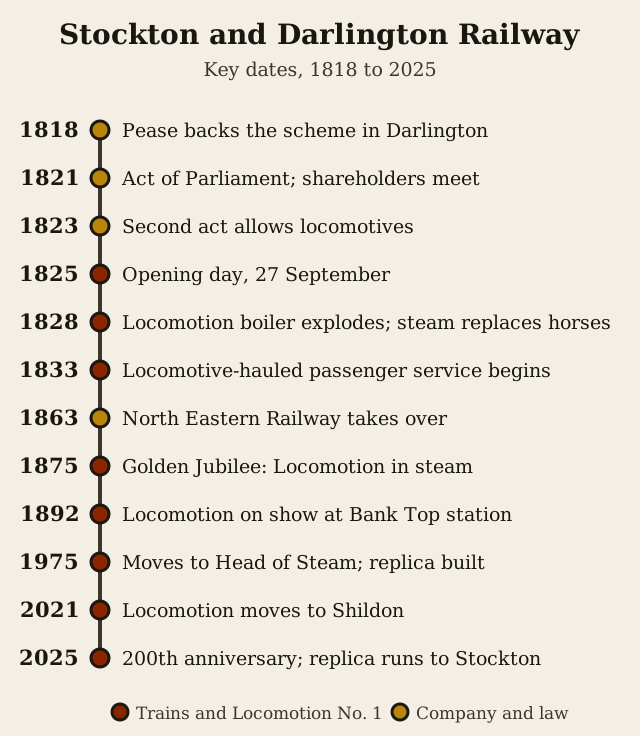
Edward Pease (1767 to 1858) backed the railway scheme at a public meeting in Darlington on 13 November 1818. Pease promised investors a five per cent return. The shareholders met on 12 May 1821 and made Thomas Meynell chairman, with Jonathan Backhouse as treasurer. Most members of the managing committee were Quakers, among them Thomas Richardson, Edward Pease and his son Joseph Pease.

George Stephenson (1781 to 1848) was born at Wylam in Northumberland, 9 miles west of Newcastle upon Tyne. Pease, concerned about the competence of the surveyor George Overton, asked Stephenson, an experienced enginewright at the Killingworth collieries, to meet him in Darlington. The shareholders elected Stephenson as the railway's Engineer on 22 January 1822, at a salary of £660 a year. Stephenson pressed for steam locomotives to be used on the line.
Stephenson designed an iron truss bridge to carry the line over the River Gaunless. Ignatius Bonomi, an architect from Durham, designed the Skerne Bridge, which took the line across the River Skerne.
Building the Line and the 1825 Opening
A ceremony in Stockton marked the laying of the first track at St John's Well. A second act of Parliament, which allowed the use of locomotives, received royal assent on 23 May 1823. In 1823, George Stephenson, his son Robert Stephenson, Edward Pease and Thomas Richardson set up Robert Stephenson and Company at Forth Street in Newcastle upon Tyne. In 1824, the railway ordered two steam locomotives and two stationary engines from the new works.
On 16 September 1825, with the stationary engines in place, Locomotion No. 1 left the works, and the following day the company advertised that the railway would open on 27 September 1825. On 26 September 1825, after travelling by road from Newcastle, Locomotion No. 1 was set on the rails at Aycliffe Lane station for the first time. That evening, a railway coach named Experiment arrived and was attached to the locomotive. Pease, Stephenson and other committee members then made a trial run to Darlington, with James Stephenson, George's elder brother, at the controls.
On opening day, a stationary engine drew 12 waggons of coal up Etherley North Bank by rope. A waggon of flour bags was added, and horses hauled the train across the Gaunless Bridge to the foot of Brusselton West Bank. There, thousands watched a second stationary engine draw the train up the incline. At Mason's Arms Crossing at Shildon Lane End, Locomotion No. 1, the coach Experiment and new coal waggons fitted with seats were waiting.

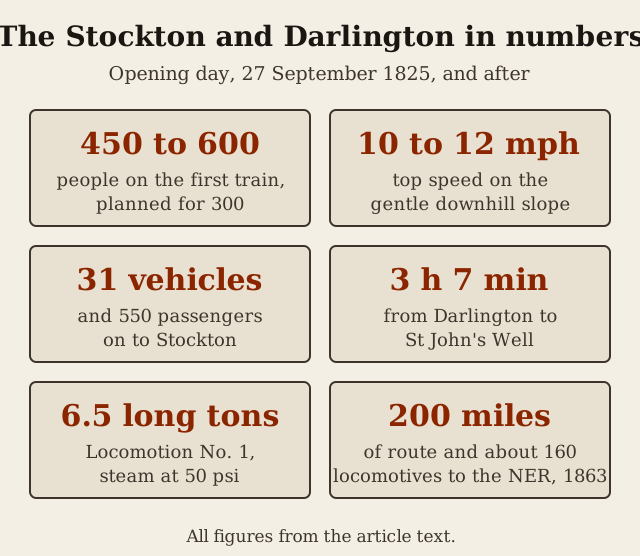
The directors had allowed room for 300 passengers, but the train left carrying between 450 and 600 people. Brakesmen rode between the waggons, and a man on horseback carrying a flag led the train off. On the gentle downward slope, the train reached 10 to 12 mph. A stop of 35 minutes was needed to repair the locomotive. An estimated 10,000 people welcomed the train when it stopped at the Darlington branch junction.
Two waggons for the Yarm Band were then attached, and the locomotive set off for Stockton hauling 31 vehicles with 550 passengers. The last stretch of track to the quayside at Stockton had not yet been finished. The train therefore halted at a temporary passenger terminus at St John's Well, 3 hours and 7 minutes after leaving Darlington.
Locomotion No. 1: Design and the Opening Train
Locomotion No. 1, originally named Active, is an early steam locomotive built in 1825 by George Stephenson and his son Robert Stephenson at Robert Stephenson and Company. Locomotion became the first steam engine to pull a train with passengers on board on a public line. The Stockton and Darlington Railway Company ordered it in September 1824. Its design built on George Stephenson's experience with his earlier Killingworth locomotives, one of the early steps among the steam locomotive types covered elsewhere on this site.

Timothy Hackworth and James Kennedy supervised the construction of Locomotion. The locomotive weighed about 6.5 long tons. Locomotion used steam at 50 psi from a centre-flue boiler. The boiler fed a pair of vertical cylinders, 9 inches in diameter with a 24-inch stroke, which were half embedded in the boiler. A pair of cross-heads above the cylinders passed the power through connecting rods, using a loose eccentric valve gear.
Locomotion is thought to be the first locomotive whose driving wheels were linked by coupling rods. The coupling rods considerably reduced the chance of the wheels slipping. Its boiler had a single flue, which gave it less heating surface for its volume of water than later boiler designs had. Rapid advances in locomotive design left Locomotion obsolete within a decade. The author H. C. Casserley thought Locomotion No. 1 mattered more as the first locomotive to pull a passenger train on a public railway than for the innovations in its design.
On 1 July 1828, the boiler of Locomotion No. 1 exploded while the train was stopped at Aycliffe Lane station. The explosion killed the driver, John Cree, and wounded the water pumper, Edward Turnbull. Cree had tied down the arm of a safety valve, which let the boiler pressure rise until it exploded. The locomotive was rebuilt and returned to service. Locomotion pulled the opening train of the Middlesbrough and Redcar Railway, a Stockton and Darlington Railway subsidiary, on 4 June 1846.
Gauge: From Killingworth to the World Standard
The first track laid at St John's Well had its rails 4 feet 8 inches apart. That was the same gauge George Stephenson had used on his Killingworth Railway.
The Stockton and Darlington line was a success, and the Liverpool and Manchester Railway, the first intercity line, opened in 1830 using the same gauge. The gauge was later widened to 4 feet 8.5 inches and named standard gauge. The full story is in our piece on why standard gauge is 4 ft 8.5 in.
Horse and Steam Working on the Line
Passenger traffic on the Stockton and Darlington Railway began on 10 October 1825, after the required licence was bought, using the coach Experiment hauled by a horse. The coach was at first timetabled to take two hours from Stockton to Darlington, for a fare of 1s. In April 1826, the running of the coach was contracted out for £200 a year. By then, the timetabled journey had been cut to 1 hour 15 minutes, and passengers could ride outside for 9d. Innkeepers also began running coaches on the line.

There were no stations in these early years. Passengers in Darlington boarded the coaches close to the north road crossing. In Stockton, they picked up at different points along the quay.
Horses on the line could haul up to four waggons. The dandy waggon, a small cart at the back of the train that carried the horse downhill, came into use in mid-1828. In 1828 the company's committee chose to swap horses for locomotives on the main line, beginning with the coal trains. Some colliery owners resisted the change.
The railway bought out the coach companies in August 1832. A locomotive-hauled mixed passenger and small goods service between Stockton and Darlington began in 1833.
Early Operating Challenges
Stone was used for the sleepers west of Darlington and oak to the east. Stephenson would have preferred stone throughout, but the stone was quarried in the Auckland area and the transport cost was too high.

The locomotives were unreliable at first. Soon after opening, a wheel on Locomotion No. 1 broke, and the engine could not return to traffic until 12 or 13 October 1825. Hope, the line's second locomotive, arrived in November 1825. Hope needed a week of work before it could run, as its cast-iron wheels were a source of trouble.
The railway opened owing money and unable to raise further loans. By August 1827, the company had paid its debts. During 1827, its shares rose from £120 at the start of the year to £160 at the end.
On 19 March 1828, the boiler of locomotive No. 5 exploded at Simpasture Junction. One of the two firemen was killed. The driver, George Stephenson's older brother, was unharmed. In 1828, two locomotive boilers exploded within four months of each other, both because the safety valves had been left fixed down while the engine was stationary.
Growth Through the 1830s
In 1830, the company opened new offices in Darlington. A second track from Stockton to the foot of Brusselton Bank was laid in 1831 and 1832. The track was upgraded to 64 lb per yard rails by 1839.
By the late 1830s, the railway had modern passenger locomotives, some with four wheels. Some modified road coaches were still in use alongside modern railway carriages. Some first-class carriages had three compartments seating eight passengers each, and second-class carriages seated up to 40.
Jonathan Backhouse stepped down as treasurer in 1833 to become a Quaker minister, and Joseph Pease took his place. Representatives of the Stockton and Darlington Railway and the York and North Midland Railway formed the Great North of England Railway, a planned line from York to Newcastle. The plan was to seek permission in 1836 for the harder section, which crossed the hills between Darlington and Newcastle. A bill for the easier line south of Darlington to York was to follow a year later.

Growth, the 1863 Merger and Locomotion No. 1 in Preservation
The Stockton and Darlington Railway suffered severe financial difficulties at the end of the 1840s. The company was nearly taken over by the York, Newcastle and Berwick Railway. The discovery of iron ore in Cleveland, and the extra revenue that followed, let the company pay its debts.
The North Eastern Railway took over the Stockton and Darlington Railway in 1863, gaining 200 route miles of line and about 160 locomotives. The lines were managed as the independent Darlington Section until 1876. Much later, the North Eastern Railway itself became part of the London and North Eastern Railway. Much of the original route later became part of the Tees Valley Line.
Locomotion No. 1 was used on the railway until 1850. Joseph Pease and Partners then bought it and used it as a stationary pumping engine at their West Collieries until 1857. Joseph Pease and his family paid £50 to restore the locomotive, saving it from the scrapyard. Locomotion No. 1 was one of the first locomotives to be restored for preservation.
Locomotion No. 1 was steamed for the railway's Golden Jubilee in September 1875. The locomotive went on show in Philadelphia in 1876, then in Chicago (1883), Liverpool (1886), Paris (1889) and Edinburgh (1890). In June 1881, Locomotion also joined a locomotive procession held for the George Stephenson Centenary.
From 1892 to 1975, Locomotion stood on static display on a platform at Darlington's Bank Top station. From 1975 to 2021, the locomotive was on display at the Head of Steam museum at Darlington North Road station. In 2021, Locomotion No. 1 moved to the Locomotion museum in Shildon.

The original locomotive is too fragile to return to steam. A working replica was built in 1975 for the railway's 150th anniversary and was later based at Beamish Museum. In September 2025, the replica made a three-day journey to Stockton for the railway's 200th anniversary.

The Stockton and Darlington Railway was not the first railway, and a train had already carried passengers before it opened. Its 1825 opening was still seen as proof that steam railways could work as public transport.
Rails & Rivals, our game on Steam, is a turn-based railroad strategy board game for 2 to 6 players: each player runs a rail company, lays track across a hex map and carries goods between cities, and the wealthiest company wins. The how to play page has the rules.
Keep reading
Sources
- Stockton and Darlington Railway (Wikipedia)
- Locomotion No. 1 (Wikipedia)
- George Stephenson (Wikipedia)
- Edward Pease (railway pioneer) (Wikipedia)
- Track gauge (Wikipedia)
- George Stephenson (1781-1848) (Network Rail)
- 2025: Celebrating 200 years of the Stockton & Darlington Railway (National Railway Museum)
- Steam locomotive No. 1 'Locomotion', Stockton & Darlington Railway (Science Museum Group Collection)