California Zephyr Route: Chicago to the Bay Area Explained

What the California Zephyr Is
Amtrak runs the California Zephyr, a long-distance passenger train, from Chicago to Emeryville in the San Francisco Bay Area. Its route takes it through Omaha, Denver, Salt Lake City and Reno. At 2,438 miles it is Amtrak's longest daily route. The trip between the two end points takes a little over 52 hours.
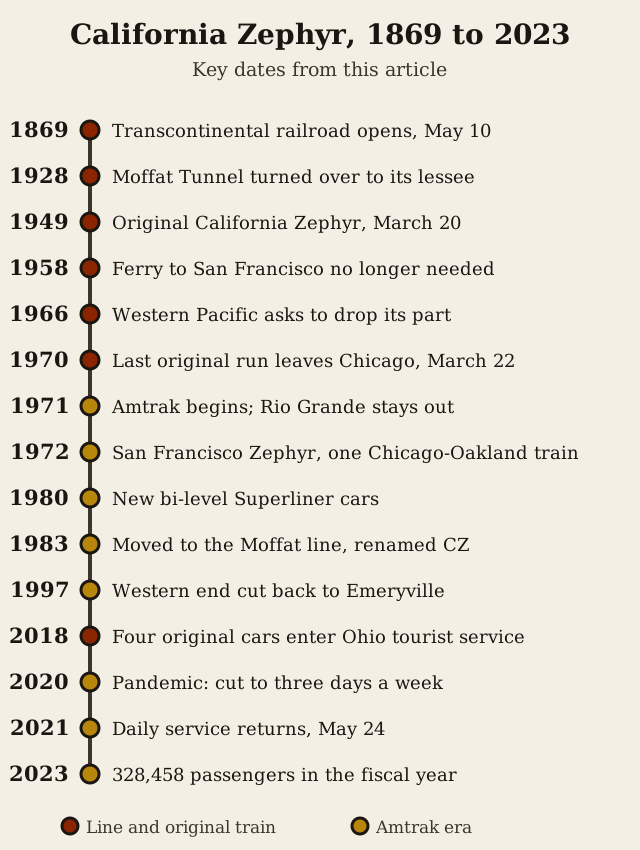
In fiscal year 2023 the train carried 328,458 passengers, up 13.1 percent from FY2022. That total was still below the 410,844 passengers who rode it in FY2019, before the COVID-19 pandemic.

The Route from Chicago to Emeryville
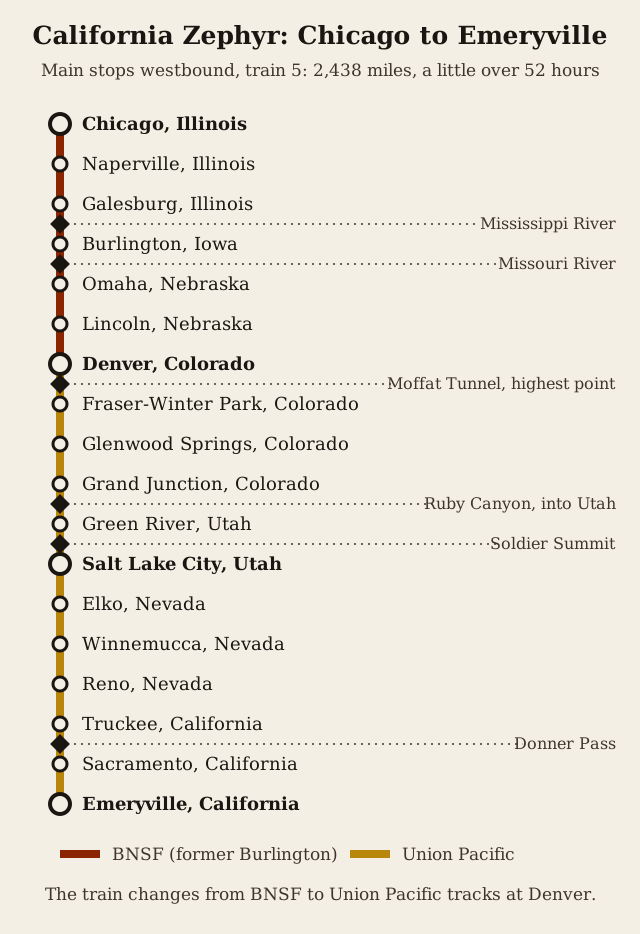
Amtrak numbers the California Zephyr as train 5 westbound and train 6 eastbound. It serves about three dozen stations in seven states: Illinois, Iowa, Nebraska, Colorado, Utah, Nevada and California. Leaving Chicago Union Station, the westbound train follows the Metra BNSF Line, with an early stop in Naperville, Illinois. It then passes through Aurora, Illinois, and crosses the Illinois prairies. The main stops in westbound order include:
- Chicago Union Station, Illinois
- Naperville, Illinois
- Galesburg, Illinois
- Burlington, Iowa, where the train crosses the Mississippi River on the Burlington Rail Bridge
- Omaha, Nebraska, reached after crossing the Missouri River from Council Bluffs, Iowa
- Lincoln, Nebraska
- Denver, Colorado, at Denver Union Station
- Fraser, Colorado, at the Fraser-Winter Park station
- Glenwood Springs, Colorado
- Grand Junction, Colorado
- Green River, Utah
- Salt Lake City, Utah
- Elko, Nevada
- Winnemucca, Nevada
- Reno, Nevada
- Truckee, California
- Sacramento, California
- Emeryville, California
From Omaha the train runs overnight through southern Nebraska and northeastern Colorado, arriving in Denver in the morning. At Denver the train switches from BNSF to Union Pacific tracks. Between Chicago and Denver, both the original and the current California Zephyr use the former Chicago, Burlington and Quincy line, which passed to Burlington Northern in 1970 and became part of BNSF Railway at the end of 1996.
Crossing the Rocky Mountains: the Moffat Tunnel
The Moffat Tunnel carries the California Zephyr under the Continental Divide in Colorado. West of Denver the train runs over Union Pacific's Central Corridor through the Tunnel District. The bore is 6.2 miles long and runs under a shoulder of James Peak. It was formally turned over to its lessee on February 26, 1928. The tunnel's apex is the highest point the California Zephyr reaches. It is also the highest point on the whole Amtrak network.
Once out of the tunnel, the line runs beside the Colorado River all the way from Winter Park Resort to Ruby Canyon, which lies west of Grand Junction. Ruby Canyon is also where the train enters Utah. Between Denver and Fraser-Winter Park, the Zephyr shares its route with the Winter Park Express, a seasonal train for skiers. Since 2021, Rocky Mountaineer tourist trains have also used the Moffat Tunnel on a route between Denver and Moab, Utah. Between Denver and Salt Lake City, the Amtrak train uses the former Denver and Rio Grande Western main line, the same route through Colorado that the original California Zephyr used.

Through Utah the route traces the southern edge of the Book Cliffs until the cliffs end near Helper. It then crosses the Wasatch Mountains, cresting at Soldier Summit. From the summit it descends into the Wasatch Front to reach Salt Lake City.
Climbing the Sierra Nevada
From Salt Lake City the route loosely follows Interstate 80. The train passes the Great Salt Lake on its southern shore and then crosses the Bonneville Salt Flats heading for Nevada. After entering Nevada at Wendover, the line passes the Toano Range via Silver Zone Pass and crosses the Goshute Valley. It then tunnels under the Pequop Mountains and skirts the northern edge of the Ruby Mountains. The line first reaches the Humboldt River near Wells and loosely follows it to the river's end in the Humboldt Sink near Lovelock. Beyond the sink the tracks cross the center of the Forty Mile Desert. On the far side of the desert, the Truckee River gives the line its path to Reno and up into the Sierra Nevada in California.
In California, the tracks round Donner Lake and cross the Sierra Nevada at Donner Pass. They then descend a high ridge between the American and Yuba Rivers, through Emigrant Gap. The Central Pacific Railroad built the first line over these mountains, and its Summit Tunnel at Donner Pass was the longest tunnel on the transcontinental railroad. The winter of 1866-67, while the tunnel was being built, was the worst then recorded in the Sierra Nevada, with over 44 feet of snow.

Below the mountains the line enters California's Central Valley, with stops in Sacramento and Davis. It crosses the Benicia Bridge and runs along San Pablo Bay, with stops in Martinez and Richmond. At Richmond, BART connects to Berkeley and Oakland. The trip ends in Emeryville, where Amtrak Thruway service connects to San Francisco.
The Original California Zephyr, 1949 to 1970
The original California Zephyr replaced the Exposition Flyer in 1949 and used the same route. The train was a partnership of three railroads: the Chicago, Burlington and Quincy Railroad, the Denver and Rio Grande Western Railroad and the Western Pacific Railroad. It ran between Chicago and Oakland via Omaha, Denver, Salt Lake City and Oroville. Actress Eleanor Parker named the train in San Francisco on March 19, 1949. California Lieutenant Governor Goodwin Knight, San Francisco Mayor Elmer Robinson and Western Pacific President Harry A. Mitchell looked on. The California Zephyr was inaugurated on March 20, 1949. On that first run, each woman aboard received silver and orange orchids that had been flown in from Hilo, Hawaii.
The Budd Company built six ten-car trainsets for the service. The Burlington received three of them, the Western Pacific two and the Rio Grande one. Each set included five Vista-Dome cars. The California Zephyr was the first long-distance train to carry dome cars in regular service. The train was scheduled to pass the scenery on its route in daylight. Until 1958, a West Coast trip began or ended with a ferry ride between San Francisco's Transbay Terminal and Oakland Pier.

The train's hostesses, called Zephyrettes, were the idea of Velma McPeek, the Burlington's Supervisor of Passenger Train Services. Zephyrettes worked as tour guides, first-aid responders and babysitters. Former Zephyrette Julie Ann Lyman described the job as "the railroad's answer to the air line stewardess."

In the 1960s the train began to lose money even when sold out. In 1966 the Western Pacific applied to discontinue its portion of the train. The Interstate Commerce Commission refused after public outcry. In 1969 the same commission called the California Zephyr a unique national asset. Even so, the final westbound run of the original California Zephyr departed Chicago on March 22, 1970, reaching Oakland two days later. The original train had operated for 21 years and 2 days. It ended just before Amtrak began service.
From the Original Train to the Amtrak Service, 1971 to 2022
Railpax, renamed Amtrak in late April 1971, first intended to revive the California Zephyr. Under that plan, the train would have run on the Burlington Northern to Denver, on the Rio Grande from Denver to Ogden, Utah, and on the Western Pacific beyond Ogden. The Western Pacific had already shed the last of its money-losing passenger service by ending the California Zephyr. That made the Western Pacific ineligible to take part in Amtrak's formation. On April 12, 1971, the Western Pacific refused to cooperate, and the Southern Pacific route between Ogden and Oakland was chosen instead. On April 26, 1971, the Rio Grande also chose not to join Amtrak. The Rio Grande feared that added Amtrak service would crowd its single-track main line. It chose to run its own Denver to Ogden train, the Rio Grande Zephyr. Amtrak instead pieced together a Denver, Cheyenne and Ogden routing on the Union Pacific.
Between the spring of 1971 and the summer of 1972, travelers between Chicago and Oakland had to use two trains: the Denver Zephyr to Denver and the City of San Francisco beyond it. Amtrak later combined them into one Chicago to Oakland train, the San Francisco Zephyr. Its name paid homage to both the California Zephyr and the San Francisco Chief. In July 1980 the San Francisco Zephyr received new bi-level Superliner I cars built by Pullman-Standard. At the same time it began exchanging through cars at Ogden with the Pioneer from Seattle and the Desert Wind from Los Angeles.
In 1983 the Rio Grande elected to join Amtrak, citing increasing losses on its passenger service. The Rio Grande ran the last Rio Grande Zephyr on April 24, 1983. Amtrak then moved the San Francisco Zephyr onto the Rio Grande's Moffat Subdivision between Denver and Salt Lake City, its original preference in 1971. The change was scheduled for April 25, 1983, but a mudslide at Thistle, Utah, closed the line. The mudslide delayed the change until July 16, 1983. With the new route, Amtrak renamed the train the California Zephyr. Amtrak invited a former Zephyrette, Beulah Bauman, to christen the train.
The exchange point with the Pioneer and the Desert Wind moved from Ogden to Salt Lake City. That created a train of 16 Superliner cars running from Chicago to Utah, the longest train Amtrak had operated outside the Auto Train. Amtrak needed at least four EMD F40PH locomotives to pull it over the steep grades of the Moffat Subdivision. The Pioneer and the Desert Wind were both discontinued in 1997.
The western terminus was cut back to Emeryville when Oakland's Central station closed on August 5, 1994. The train returned to Oakland when Jack London Square station opened on May 12, 1995. It was cut back to Emeryville again on October 26, 1997. In April 2020, service between Reno and Denver was suspended for about a month during the COVID-19 pandemic. In October 2020 the train was cut to three days a week. Daily service returned on May 24, 2021. From January 19 to May 23, 2022, staffing and equipment shortages during the Omicron wave cut the schedule to five days a week.
The Original and Amtrak Routes
The Amtrak train that took the California Zephyr name in 1983 was the second to carry it. The original train was a private operation, and it took another route across Nevada and California. The two routes split at Weso, Nevada, near Winnemucca. Instead of passing through Reno, the original was routed via Gerlach, Nevada. In California its route ran through Portola, Oroville, Sacramento, Stockton and Pleasanton, ending at the Oakland depot.

West of Wells, Nevada, today's train uses the Overland Route, the line of the former City of San Francisco. Across central Nevada, the two old lines have been combined for directional running. As a result, the exact spot where the train switches lines depends on its direction of travel. The Overland Route was part of the first transcontinental railroad, which was built between 1863 and 1869. That railroad opened to traffic on May 10, 1869, after the last spike was driven at Promontory Summit.
Riding the Zephyr as of 2024
As of 2024, a typical California Zephyr had two GE Genesis or Siemens locomotives and bi-level Superliner cars. The consist included a Viewliner II baggage car, a transition sleeper, two Superliner sleepers, a diner, a Sightseer Lounge and three coaches. As of 2024, the train offered two classes of service: Coach and Private Rooms. The private rooms were Roomettes, Bedrooms, Bedroom Suites, Family Bedrooms and Accessible Bedrooms. The Sightseer Lounge offered panoramic views from its upper level and a cafe selling meals, snacks and drinks below.
The original train's Budd-built cars have proven popular with private car owners, and a number of them still run on tourist railroads. The Cuyahoga Valley Scenic Railroad, outside Cleveland, Ohio, bought four of the cars in 2018: the Silver Lariat, Silver Solarium and Silver Rapids, plus the baggage car Silver Peak. The four cars entered service there in September 2018. As of 2024, the largest collection of preserved original California Zephyr equipment was at the Western Pacific Railroad Museum in Portola, California. In March 2024 the Colorado Railroad Museum announced events for the original train's 75th anniversary.

Rails & Rivals, our game on Steam, is a turn-based railroad strategy board game for 2 to 6 players: each player runs a rail company, lays track across a hex map and carries goods between cities, and the wealthiest company wins. The how to play page has the rules.
Keep reading
Sources
- California Zephyr (Wikipedia)
- California Zephyr (1949-1970) (Wikipedia)
- Amtrak celebrates 75th anniversary of California Zephyr's first trip (Global Railway Review)
- Moffat Tunnel (Wikipedia)
- Celebrating the California Zephyr (Colorado Railroad Museum)
- Summit Tunnel Historic Landmark (American Society of Civil Engineers (ASCE))
- Golden Spike / Transcontinental Railroad (National Park Service)