Durango and Silverton Narrow Gauge Railroad: Route and History

The Durango & Silverton Narrow Gauge Railroad (D&SNG) runs heritage trains on 3 ft (914 mm) narrow-gauge track, covering about 45 miles between Durango and Silverton, Colorado. The Denver and Rio Grande Railroad (D&RG) opened the route in 1882 to carry silver and gold ore from the San Juan Mountains. The D&SNG was formed in March 1981, when the Denver and Rio Grande Western Railroad sold the line. The railroad is a federally designated National Historic Landmark District. The American Society of Civil Engineers named it a National Historic Civil Engineering Landmark in 1968.
The Route from Durango to Silverton Along the Animas River
Durango lies at an elevation of 6,512 feet above sea level. Silverton lies at about 9,300 feet. The line follows the Animas River and crosses it five times on the way to Silverton.
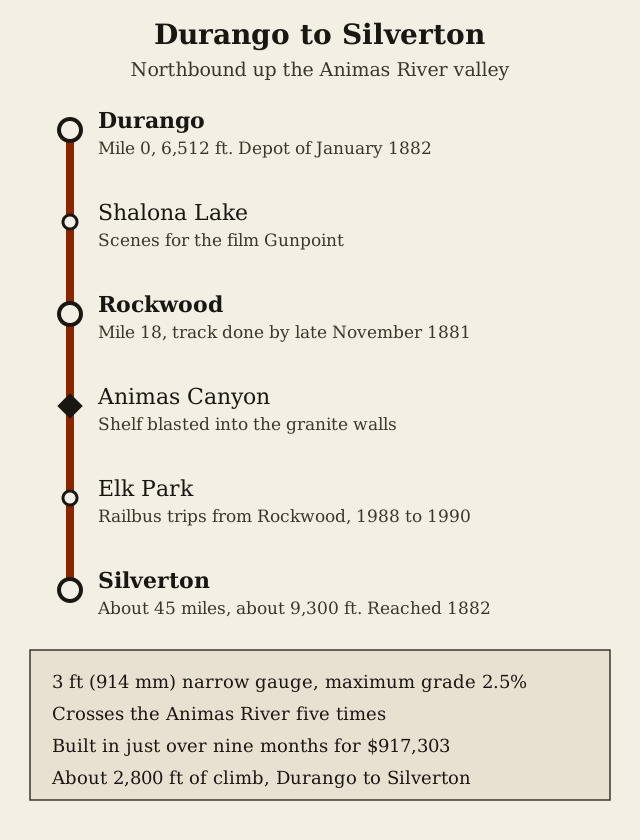
Heading north out of Durango, the line passes these places:
- Durango, whose depot dates from January 1882 and survives in its original form.
- Shalona Lake, just south of Rockwood, where scenes for the film Gunpoint were shot.
- Rockwood, where the first 18 miles of track out of Durango were completed by late November 1881.
- Animas Canyon, where builders blasted the steep granite walls to leave a narrow, level shelf for the track.
- Elk Park, farther up the canyon, the destination of the first Animas River Railway railbus trip out of Rockwood on May 7, 1988.
- Silverton, the end of the line, which the D&RG reached on July 10, 1882.
Why the Durango and Silverton Runs on 3 ft Narrow Gauge Track
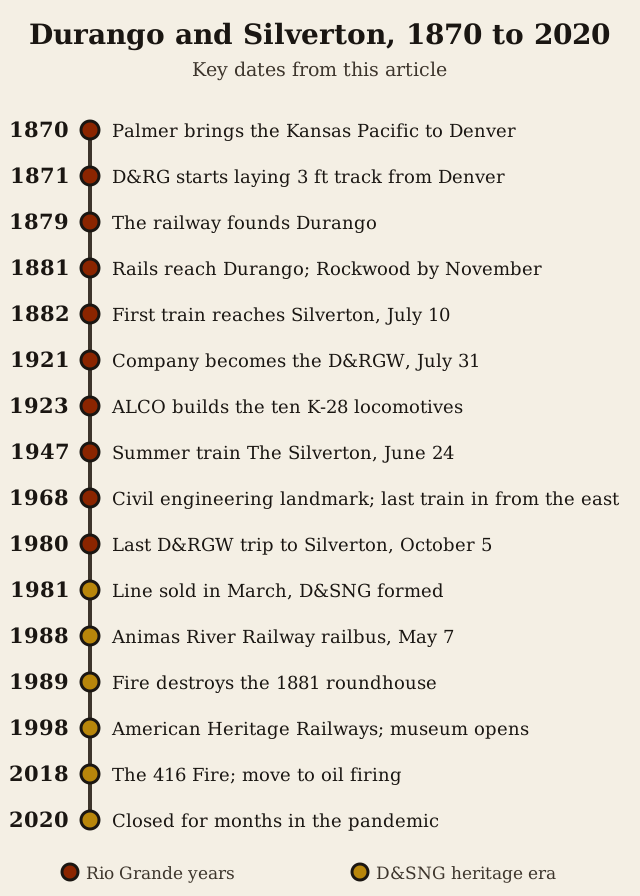
William Jackson Palmer (1836-1909) was a former Union general in the American Civil War. He arrived in Colorado once he had managed the Kansas Pacific Railway's construction into Denver in 1870. In Denver, he planned a 3 ft narrow-gauge railroad south from Denver to El Paso, Texas. Track laying for the Denver & Rio Grande Railway started in 1871, heading south from Denver. Palmer and his associates agreed that 3 ft gauge would suit the mountainous country. They also expected its lower construction costs to help the new railroad survive.

The D&RG's plans later grew to include extensions through the mining country of central and southwestern Colorado. The Silverton line was the last piece of the San Juan Extension, built to the same 3 ft (914 mm) gauge as the rest of the system. Our guide to track gauge explains how narrow, standard and broad gauges differ, and our piece on why standard gauge became the norm traces how the wider measurement spread.
Building the Line to the San Juan Mines, 1879 to 1882
Durango was founded by the Denver & Rio Grande Railway in 1879. The railroad reached Durango in 1881 and started building the final stretch to Silverton the same year. At least 500 laborers worked on the line. Most of them were Irish and Chinese immigrants. The labor crew was paid $2.25 per day.
The first 18 miles to Rockwood were completed by late November 1881. Past Rockwood, the line ran into the Animas Canyon, a narrow gorge with steep granite walls. The builders blasted the canyon cliffs to leave a narrow, level shelf for the tracks. The D&RG reached Silverton on July 10, 1882. The 45-mile line took just over nine months to build and cost $917,303. Its builders used the first steel rails produced in Colorado. The railway's maximum grade is 2.5 percent, a significant surveying and construction feat in such rugged terrain.

From Ore to Tourists: The D&RGW Years
The D&RG re-emerged as the Denver and Rio Grande Railroad in 1886. After the Colorado lines and Utah's Rio Grande Western were reorganized together, on July 31, 1921, the company took the name Denver and Rio Grande Western Railroad (D&RGW). Known by then as the Silverton branch, the line struggled once the Panic of 1893 hit and free silver coinage ended. Into the middle of the twentieth century, mining kept declining, highway trucks competed for freight and passenger revenue stayed small.

After World War II, domestic tourism grew across the country, and the Silverton branch benefited. Hollywood movies filmed along the line in the late 1940s gave it national exposure. The railroad started The Silverton, a summer-only passenger train, on June 24, 1947. A short time later, it painted a locomotive and four coaches in a colorful yellow scheme, and this "Painted Train" began a new era of tourism. Freight traffic kept falling, and during the 1950s The Silverton ran as a mixed train.
Later, a modernized D&RGW petitioned to abandon the Silverton branch. The Interstate Commerce Commission refused because tourist patronage kept rising. The railroad responded by investing in more rolling stock, track maintenance and improvements to the Durango depot. As ridership grew, the D&RGW ran a second train to Silverton on certain days.
The last train to run into Durango from the east ran on December 6, 1968. The track between Chama and Durango was removed by 1971. From 1971, the Silverton branch and the Cumbres and Toltec Scenic Railroad were the only remnants of the Rio Grande's narrow-gauge system. The Silverton's final trip as a D&RGW train came on October 5, 1980.
New Owners and the Heritage Railroad Since 1981
In March 1981, the D&RGW sold the line, and the D&SNG was formed. Until then, the Rio Grande had run the route as Subdivision 12-B of its Alamosa or Colorado Divisions. Charles Bradshaw Jr., of Florida, founded the D&SNG to buy the right-of-way and equipment and to grow the line's passenger business. With help from former Rio Grande operating managers and a larger staff, Bradshaw put his plans in motion at once. For the first time in many years, the line ran double-headed trains and extra scheduled trains beyond the old summer-only service.
The Durango yard facilities were also improved in the 1980s. An extension was added to the old roundhouse, and a new car shop went up on the site of the original car barn. The depot was extensively repaired and modified inside. Durango's tourist image grew as new businesses opened and the old railroad town was revamped.

In the winter of 1989, fire destroyed the original 1881 Durango roundhouse. All six operable locomotives were inside and were damaged, but not beyond repair. All of them were eventually restored to operating condition. A new roundhouse was built on the same site, with a facade of bricks salvaged from the original building.
Bradshaw later sold the D&SNG to First American Railways, Inc., of Hollywood, Florida. In 1998, Allen Harper, then chairman of First American Railways, resigned and founded American Heritage Railways. In July 1998, American Heritage Railways became the railroad's new owner. American Heritage Railways later moved its headquarters to Durango.
The K-28 and K-36 Steam Locomotives
Two of the D&SNG's steam classes, the K-28 and the K-36, are both 3 ft gauge 2-8-2 "Mikado" type locomotives. The American Locomotive Company (ALCO) built all ten K-28s for the Denver & Rio Grande Railroad in 1923, at its Schenectady Locomotive Works. They hauled express passenger trains over the narrow-gauge lines, among them The Silverton from Durango to Silverton. The three K-28s that stayed with the D&RGW, Nos. 473, 476 and 478, were assigned to the Durango to Silverton tourist trains from the 1950s onward. The D&SNG inherited all three when it took over the Silverton branch in 1981.

The larger K-36s were built for the D&RGW by Baldwin Locomotive Works and shipped to the Rio Grande in 1925. The K-36s worked mainly as freight locomotives out of Alamosa to Durango and to Farmington, New Mexico. K-36 No. 481, the engine at the head of the train in the photo at the top of this page, went to the D&SNG in March 1981. It was the first K-36 to run to Silverton, after bridge and right-of-way improvements let the larger engines reach the town. Its sister engine No. 480 also went to the D&SNG in March 1981.
The D&SNG Museums in Durango and Silverton
The D&SNG has opened two museums, one in Durango and one in Silverton, and both show historic railway equipment used on the D&RGW line. The D&SNG Museum opened in 1998 in the Durango roundhouse, with half of the roundhouse for the museum and the other half for the steam engines. Its collection includes memorabilia from the D&RGW and other railroads, artifacts from the Durango and Silverton areas and an HO scale train layout.

Engine 42 was one of six class 70 2-8-0 locomotives that Baldwin built in 1887 for the D&RG. It weighs 35 tons and has 17,100 lbs of tractive effort. The Rio Grande Southern bought the engine in November 1916 and kept it in service until the RGS was dismantled in 1952. Its next owner, from 1958, was Magic Mountain Amusement Park in Golden, Colorado. There it was converted to burn fuel oil and operated briefly. The Woodmoor Corporation bought the Magic Mountain property in 1968. In 1969 the company set engine 42 out for display at the entrance of its Woodmoor subdivision in Monument, Colorado. In 1983, the engine was bought and brought to Durango, and it has never been restored to operating condition.
The Silverton Freight Yard Museum opened in 1999 at the Silverton depot and rail yard. It shows outfit cars, some with kitchen facilities, and side-dump gondolas.
The Short-Lived Animas River Railway
Beginning May 7, 1988, a diesel-hydraulic motorcar and trailer railbus made trips out of Rockwood up the Animas Canyon. The D&SNG set up the Animas River Railway as a separate company to protect its own claim of "100% coal-fired steam locomotives." The railbus carried hikers and fishermen into the canyon. The motorcar, No. 1001, was built in the winter of 1987-88 and named Tamarron. Its trailer, No. 1002, seated 48 passengers on longitudinal seats. Former mail baggage car 66 served as the ticket office and waiting room.

The first trip left Rockwood for Elk Park on May 7, 1988. The 1988 season was meant to run through October 30, but mechanical problems ended it on September 4. The repaired railbus returned to service on May 6, 1989. That summer, Elk Park trips ran twice a day from May 27 through September 15, 1989. The railbus ran one more season on the same schedule, but patronage never met expectations and the service then ended.
The Railroad in Film and Music
Hollywood has used the line for decades. The 1952 film Denver and Rio Grande, starring Sterling Hayden, was filmed on the line in the D&RGW era. The Sons of Katie Elder (1965), starring John Wayne and Dean Martin, opens with D&RGW trains traveling along the Animas River. Butch Cassidy and the Sundance Kid (1969), starring Paul Newman, Robert Redford and Katharine Ross, and Support Your Local Gunfighter (1971), starring James Garner, Suzanne Pleshette and Harry Morgan, also feature the railroad.

In the D&SNG era, the line appears in The Tracker (1988), a television film released by HBO Films with Kris Kristofferson as its star. The train at the start of The Prestige is the D&SNG. In 2022, musician Anthony D'Amato filmed his "Long Haul" music video on the line. The train is also the subject of the song "The Silverton" by C. W. McCall.
The 416 Fire, Oil Firing and the Pandemic
In June 2018, the railroad shut down for several weeks because of a wildfire named the 416 Fire. The railroad's coal-burning steam locomotives were suspected of sparking the blaze. In mid-September 2018, a group of local businesses and residents sued the railroad and its owner in civil court. After the fire, the railroad began rebuilding its steam locomotives to burn oil instead of coal, because oil firing gives off no airborne embers. The railroad closed for several months in 2020 because of the COVID-19 pandemic.
Our Railroad Game

Rails & Rivals, our game on Steam, is a turn-based railroad strategy board game for 2 to 6 players: each player runs a rail company, lays track across a hex map and carries goods between cities, and the wealthiest company wins. The how to play page has the rules.
Keep reading
Sources
- Durango and Silverton Narrow Gauge Railroad (Wikipedia)
- Durango & Silverton Narrow Gauge Railroad - History (Durango & Silverton Narrow Gauge Railroad (official operator))
- The Route & Train Stops (Durango & Silverton Narrow Gauge Railroad (official operator))
- Durango-Silverton Narrow Gauge Branch - Historic Civil Engineering Landmark (American Society of Civil Engineers)
- Rio Grande class K-28 (Wikipedia)
- Rio Grande class K-36 (Wikipedia)
- Durango & Silverton Quick History (DRGW.net (Rio Grande historical archive))