The Ghan Train: Adelaide to Darwin Route and History

The Ghan is an experiential tourism passenger train that crosses Australia between Adelaide and Darwin by way of Alice Springs and Katherine. As of 2026, it is operated by Journey Beyond. As of 2026, the journey, including extended stops for off-train tours, takes more than two days to cover nearly 3,000 km between Adelaide and Darwin.
What The Ghan Is
Aimed at experiential tourism, The Ghan is a passenger service that links Australia's southern coast with its northern one. It follows the Adelaide-Darwin rail corridor, passing through Adelaide, Alice Springs and Darwin.
The average length of a Ghan is 774 metres. During periods of high demand, the train is sometimes extended to up to 44 carriages and 1,096 metres. As of 2019, Guinness World Records lists The Ghan as the longest passenger train in scheduled service. Guinness notes that longer passenger trains have been assembled for one-off events or specific charters. As of 2026, two Pacific National NR class locomotives haul the train. AN class and DL class locomotives were used before them. As of 2026, locomotive crews come from Pacific National, while the on-train staff are employed by Journey Beyond.

The Route from Adelaide to Darwin
Adelaide marks the southern end of The Ghan's route, and from there the train heads north through the Red Centre toward Australia's tropical north. The train stops at Adelaide, Alice Springs, Katherine and Darwin. On the journey north, the Journey Beyond itinerary also includes a stop at Marla, an outback outpost in the remote reaches of South Australia.
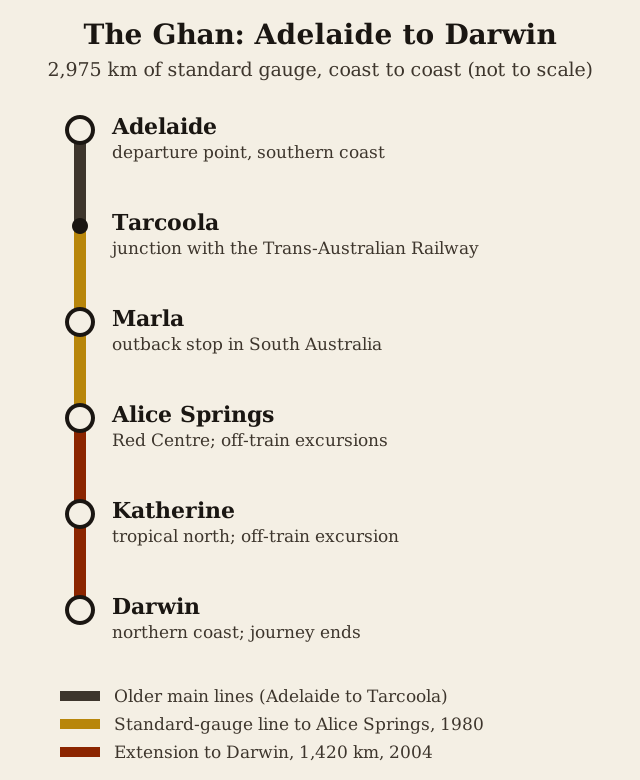
- Adelaide: the train's departure point for the run north.
- Marla: a remote outback outpost in South Australia on the Adelaide to Darwin leg.
- Alice Springs: reached through the MacDonnell Ranges, where passengers are offered a choice of off-train excursions.
- Katherine: a stop in the tropical north with its own off-train excursion.
- Darwin: where the journey concludes on Australia's northern coast.
Where the Name "The Ghan" Comes From
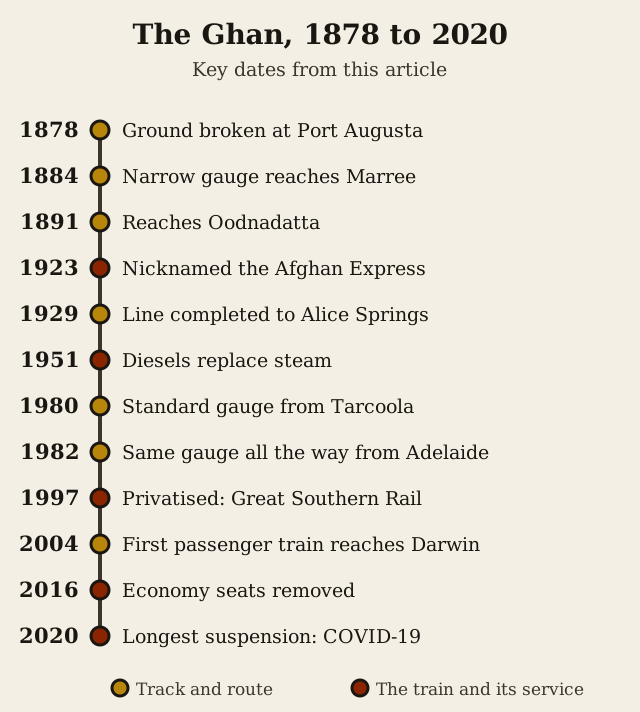
The Ghan's name is a shortened form of its older nickname, The Afghan Express, which is reputed to have been given to the train by one of its own crews in 1923. One account holds that the name honours the Afghan cameleers who arrived in Australia in the late 19th century to help British colonists find a way into the country's interior. A contrary view holds that the name began as a veiled insult.
As early as 1924, European pastoralists commonly called the notoriously unreliable fortnightly steam train the Afghan Express in a ribald sense. By 1951, when diesel-electric locomotives replaced steam engines, this disparaging meaning had faded away, like the cameleers.
The Afghan cameleers arrived well before the train took its name. The Blackwell brought 31 Afghans into Port Augusta. On New Year's Eve 1865, onlookers gathered to see 124 camels hoisted onto the shore. By the 1890s, there were some 800 Afghan males in Australia. At Marree in the early 1890s, two brothers, Faiz and Tagh Mahomet, had over 900 camels and gave work to about 100 other Afghans. The train between Adelaide and Darwin takes its name in honour of the role Afghans played in the transport industry.
A separate account from the Pichi Richi Railway traces the name to the inaugural through passenger train with a sleeping car in 1923. At Quorn, an Afghan passenger left the train to pray, and a railwayman joked that if he was the only passenger, the train would have to be called the Afghan Express.

The Original Narrow-Gauge Line, 1878 to 1980
Construction of what was then called the Port Augusta to Government Gums Railway began in 1878, when William Jervois broke ground at Port Augusta. Laid to narrow gauge, the track arrived at Hawker in June 1880 and Beltana in July 1881. Marree followed in January 1884, then Oodnadatta in January 1891. The extension to Alice Springs was completed in 1929. Until then, the final leg of the journey north was still made by camel.
Although there were plans from the outset to extend the railway all the way to Darwin, The Ghan was losing money by the time the line reached Alice Springs, and the further extension north was suspended indefinitely. The original route followed the same path as the overland telegraph, believed to be the route John McDouall Stuart had taken crossing Australia in 1862. Starting in August 1929, The Ghan ran on this line, by then called the Central Australia Railway, built as a narrow-gauge line to Alice Springs under the Commonwealth Railways' Chief Engineer, N. G. Bell.
Washouts of the track made the narrow-gauge Ghan notorious for delays. A flatcar immediately behind the locomotive carried spare sleepers and tools so that passengers and crew could repair the line themselves. The service ran fortnightly at first, becoming weekly in the 1930s, then twice weekly from 1956 to 1975 before reverting to weekly. During World War II, the service had to be greatly expanded, straining the line's limited water supplies so badly that demineralisation towers were built along the track to allow the use of bore water. Diesel locomotives needed far less water, so when a new Alice Springs line was built in the 1970s, engineers could route the replacement through much drier country between Tarcoola and Alice Springs. The last narrow-gauge service left Alice Springs on 26 November 1980.

The New Standard-Gauge Line to Alice Springs
A new standard-gauge line opened in October 1980, running to Alice Springs from Tarcoola on the Trans-Australian Railway, the line the Indian Pacific follows across the Nullarbor Plain. It replaced what was left of the narrow-gauge line. The new line was built west of the former line, to avoid floodplains where the original line was often washed away during heavy rain. It was also hoped that the new line would improve the train's timekeeping.
Alice Springs gained a new standard-gauge station on 9 October 1980, superseding the narrow-gauge station that had served the town since the line first reached it in 1929. The first Ghan on the new standard-gauge route departed Adelaide in December 1980, initially running as a broad-gauge service as far as Port Pirie. Once the Adelaide to Crystal Brook section was converted to standard gauge in 1982, the whole journey ran on the same track gauge throughout.
A second weekly Ghan service ran between May and October in the years that followed. In November 1998, one weekly service was extended from Adelaide through to Melbourne, and from April 1999 the other service was diverted to run to Sydney via Broken Hill. The extensions were withdrawn in November 2002 and March 2003 respectively.

The 2004 Extension to Darwin
The extension of standard-gauge track from Alice Springs to Darwin opened in January 2004, closing a 1,420 km gap. It was thought to rank as Australia's second-largest civil engineering project, with nothing bigger built since the Snowy Mountains Scheme. Line construction began in July 2001. The first passenger train reached Darwin on 3 February 2004, after 126 years of planning and at a cost of $1.3 billion.
The AustralAsia Railway Corporation's project built the 1,420 km of standard-gauge track between Alice Springs and Darwin, under the Asia Pacific Transport consortium, with ADrail as design and construction contractor and Freightlink as operator. Freight used the line before passengers did: the first freight train departed Adelaide on 15 January 2004 and pulled into Darwin on 17 January 2004. The project reported 95.3 per cent local industry participation, spending $681 million in the Northern Territory and $346 million in South Australia.
The completed Adelaide-Darwin main line runs 2,975 km on 1,435 mm standard gauge from coast to coast. Because the line lets more freight move north, there is hope that Darwin can become an additional trade link with Asia. Ahead of the Darwin connection, one locomotive took the name of Steve Irwin, the wildlife expert known internationally as a symbol of outback Australia, as a way to promote the new service and tourism to the region.
The Ghan's Ownership and Timetable, 1997 to 2026
The Ghan was privatised in 1997 and has since been operated by Great Southern Rail, the company now known as Journey Beyond Rail Expeditions. Sydney investment fund Allegro Funds bought Great Southern Rail in March 2015.
Funding changes have shaped how often The Ghan runs. In August 2015, after the federal government decided to end its funding of the service, Great Southern Rail announced that The Ghan's frequency would be reduced from twice weekly to once weekly. In July 2016, all economy class seats were removed. The cheapest fare rose sharply as a result, and the train came to be classed as a purely luxury service instead of an affordable, practical choice for intercity commuters. A second service that had run between June and September until 2016 recommenced in May 2019 due to demand.
COVID-19 restrictions and border closures caused the longest suspension in the train's existence, five months from March to August 2020. Services were halted once more for the last run of the 2020 season, this time because South Australia went into lockdown. As of 2026, the Ghan Expedition's Wednesday departure from Darwin operates from March to November, with an additional Saturday departure from Darwin running from April to October.

Rails & Rivals, our game on Steam, is a turn-based railroad strategy board game for 2 to 6 players: each player runs a rail company, lays track across a hex map and carries goods between cities, and the wealthiest company wins. The how to play page has the rules.
Keep reading
Sources
- The Ghan (Wikipedia)
- Adelaide to Darwin (Journey Beyond Rail Expeditions)
- The Ghan Expedition 2026 Timetable (Journey Beyond Rail Expeditions)
- Alice Springs railway station (Wikipedia)
- Adelaide-Darwin railway line (Wikipedia)
- Afghans (History Trust of South Australia (SA History Hub))
- The Afghans / The Ghan Story (Pichi Richi Railway)
- The Railway (AustralAsia Railway Corporation)
- Longest passenger train in scheduled service (Guinness World Records)