The Indian Pacific: Sydney to Perth Train Route and History

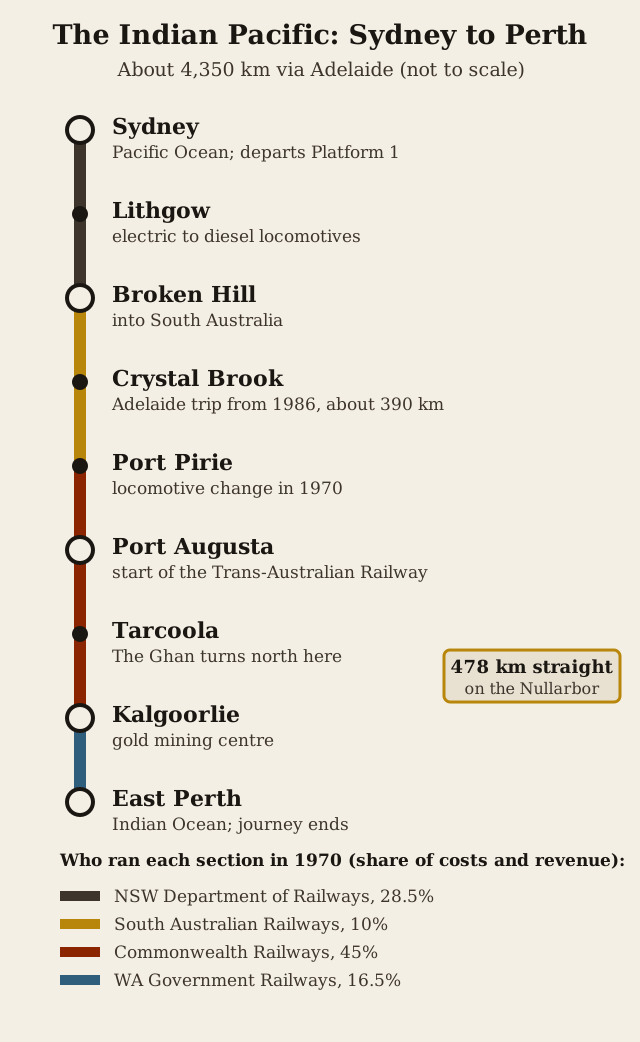
The Indian Pacific is a passenger train that crosses Australia between Sydney, on the Pacific Ocean, and Perth, on the Indian Ocean. The first service left Sydney on 23 February 1970. Gauge conversion projects in South Australia and Western Australia had made a rail journey across the continent possible without a break of gauge. The trip via Adelaide covers about 4,350 km. The journey took 75 hours in 1970 and 65 hours by 2010. The route includes a 478 km straight on the Trans-Australian Railway across the Nullarbor Plain, which Guinness World Records lists as the longest railroad straight. As of 2022, the train ran once a week in each direction.
The Sydney to Perth route via Adelaide
The route leaves Sydney on the Western and Broken Hill lines to Broken Hill. Leaving Broken Hill, the train heads south to Adelaide on the Broken Hill to Crystal Brook line, crossing into South Australia. Before the Crystal Brook to Adelaide line was converted to standard gauge, passengers bound for Adelaide had to change trains at Port Pirie. From August 1986 the Indian Pacific made an out-and-back trip to Adelaide, adding about 390 km to the journey.

From Crystal Brook the train heads north to Port Augusta and then follows the Trans-Australian Railway to Kalgoorlie, a stretch that includes the 478 km Nullarbor straight. Leaving Kalgoorlie, the train travels over the Eastern Goldfields and Eastern lines, ending its run at East Perth. In 1970 the journey took 75 hours. After infrastructure improvements and quicker locomotive and crew changes, it took 65 hours by 2010, despite the longer distance.
- Sydney
- Broken Hill, New South Wales
- Adelaide, South Australia
- Port Augusta, South Australia
- Kalgoorlie, Western Australia
- East Perth, Western Australia
The Nullarbor Plain and the long straight
Crossing the Nullarbor Plain, the Trans-Australian Railway links Port Augusta in South Australia with Kalgoorlie in Western Australia. On the Nullarbor the line runs dead straight for 478 km, although not level. Guinness World Records lists it as the longest railroad straight. The straight lies between Nurina and Loongana in Western Australia and between Ooldea and Watson in South Australia. In 1990 Geoscience Australia measured its length as 478.193 km.

As of 2024, The Ghan also used the line between Port Augusta and Tarcoola, where it left the line to head north to Darwin.
Building the Trans-Australian Railway, 1912 to 1917
The six Australian colonies federated in 1901 to form the Commonwealth of Australia. One inducement held out to Western Australians to join was the promise of a federally funded railway linking their state with the rest of the continent. Legislation allowing the route to be surveyed was passed in 1907. Completed in 1909, the survey endorsed a route running from Port Augusta, then the railhead at the head of Spencer Gulf, via Tarcoola to Kalgoorlie, the gold mining centre in Western Australia, a span of 1,063 miles.
Legislation authorising construction was passed in December 1911 by the Fisher Commonwealth Government, and work began at Port Augusta in September 1912. Construction officially got under way on 14 September 1912, when Governor-General Lord Thomas Denman turned the first sod at a ceremony held in Port Augusta. Work went on from both ends through mainly dry and desolate country until the two halves met at Ooldea on 17 October 1917. The finished line is 1,691 km long and built to 1,435 mm standard gauge. The first passenger train left Port Augusta five days after the two halves met and reached Kalgoorlie 42 hours and 48 minutes later.

The first Indian Pacific, 1970
The standard-gauge line linking eastern and western Australia was completed in late 1969, closing the last break of gauge on the route between Sydney and Perth. The new train was originally to be named The Transcontinental, but in 1969 a joint meeting of transport ministers adopted the name Indian Pacific instead.
During a test run out of Port Pirie on 18 February 1970, an Indian Pacific set hit a derailed freight train close to Locksley, tearing open the sides of several carriages. Promotional trips to Newcastle and Canberra for travel agents were made, ahead of the launch, using a full Indian Pacific set. The inaugural train left Sydney from Platform 1 on 23 February 1970. It carried 122 invited guests from Sydney to Perth. It arrived at East Perth Terminal on time on 26 February, where a crowd of around 10,000 people greeted it. Only the Trans-Siberian Railway and the Canadian then ran longer passenger trains by distance, which made this the third longest at the time.

Operators, 1970 to 2024
From 1970 the Indian Pacific was run jointly by the four railway administrations whose networks it crossed, which split costs and revenue by distance, with Western Australian Government Railways taking 16.5%, the Department of Railways New South Wales 28.5%, Commonwealth Railways 45% and South Australian Railways 10%. Each administration supplied its own locomotives and crews over its own section, New South Wales from Sydney to Broken Hill, South Australian Railways from Broken Hill to Port Pirie, Commonwealth Railways from Port Pirie to Kalgoorlie, and Western Australian Government Railways from Kalgoorlie to Perth. Locomotives were changed at Lithgow, where power switched from electric to diesel, and again at Broken Hill, Port Pirie and Kalgoorlie. Because of a motive power shortage at Westrail, Australian National locomotives hauled the Western Australian leg of the service from October 1973 until March 1977.
In February 1993, after an agreement reached with the State Rail Authority and Westrail in 1992, Australian National took over operation of the Indian Pacific. From January 1994 the train was hauled by Australian National CL class locomotives.

The Indian Pacific went to Great Southern Rail in October 1997, together with The Ghan and The Overland, for $16 million, as part of Australian National's privatisation. The buying consortium included Serco, RailAmerica, Macquarie Bank, Legal & General and GB Railways. Along with 186 items of rolling stock, most of them former Commonwealth Railways stainless steel carriages, the sale also included Alice Springs railway station and the Adelaide Parklands Terminal. Great Southern Rail owned the passenger car fleet and ran the service, while Pacific National provided the motive power. From November 1997 the Indian Pacific was hauled by NR class locomotives.
Serco paid its consortium partners $18.9 million in October 1999 for their remaining 50.8% stake, becoming sole owner of Great Southern Rail. In 2015 Serco sold the business to the private equity company Allegro Funds. Sixteen months later, Allegro sold a 70% stake to Quadrant Private Equity. Great Southern Rail took the name Journey Beyond Rail Expeditions in 2019, before the brand later reverted to simply Journey Beyond. Quadrant Private Equity sold its 13 brands, the trains among them, for a reported A$600 million in January 2022. Crestview Partners, a private equity firm based in New York, owned the buyer, the Hornblower Group, which was based in San Francisco. Hornblower failed to find a buyer in 2023 and filed for bankruptcy in February 2024. Journey Beyond's activities were then separated from the group and came under the sole ownership of Crestview Partners.
Frequency and service changes over the decades
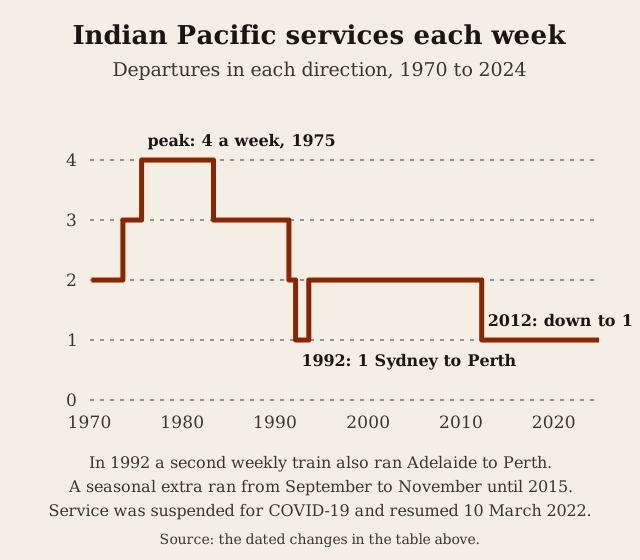
The number of Indian Pacific services each week changed many times after the 1970 launch.
| Date | Change |
|---|---|
| 1970 | Launched with two services a week in each direction |
| 21 July 1973 | Third weekly service added |
| 23 July 1975 | Fourth weekly service added |
| 26 April 1983 | Reduced to three services a week |
| June 1991 | Reduced from three services a week to two |
| 1 March 1992 | One service a week between Sydney and Perth, plus one between Adelaide and Perth |
| August 1993 | Second weekly service resumed |
| 28 March 2012 | Reduced from two departures a week to one |
| July 2016 | Red Service withdrawn |
| 10 March 2022 | Resumed running after a long COVID-19 suspension |
A second, seasonal service also ran between September and November each year until 2015. Red Service, the equivalent of economy class, was withdrawn in July 2016 after a Federal Government subsidy was withdrawn. That made Red Service no longer financially viable.
Journey time and classes of service
A one-way trip takes between 70.5 and 75 hours, depending on scheduling and daylight saving periods. As of 2024, Journey Beyond gave the train's average speed as 85 km/h, with a maximum of 115 km/h.
As of 2022, two levels of service were offered: Platinum and Gold. A premium class of travel, Platinum Service, began in 2008. Gold Service, the former first-class service, offered complimentary meals in the restaurant car along with roomette or twinette sleeper cabins. As of 2025, motorail was no longer available on the train.

Rails & Rivals, our game on Steam, is a turn-based railroad strategy board game for 2 to 6 players: each player runs a rail company, lays track across a hex map and carries goods between cities, and the wealthiest company wins. The how to play page has the rules.
Keep reading
Sources
- Indian Pacific (Wikipedia)
- The Indian Pacific Today (Railways and Tramways of Australia (railtram.com.au))
- Trans-Australian Railway (Wikipedia)
- Longest railroad straight (Guinness World Records)
- About the Indian Pacific (Journey Beyond (operator))
- 23 February (Indian Pacific inaugural run) (Railways and Tramways of Australia (railtram.com.au))
- History of the Indian Pacific (Railways and Tramways of Australia (railtram.com.au))
- Journey Beyond (Wikipedia)
- Defining Moments in Australian History: The Trans-Australian Railway (Australian Geographic)