Mallard Locomotive: LNER A4 4468 and the 1938 Speed Record

Mallard is LNER Class A4 No. 4468, a streamlined 4-6-2 "Pacific" steam locomotive built at Doncaster Works in 1938 to a design by Sir Nigel Gresley. On 3 July 1938 it reached 126 mph on Stoke Bank, south of Grantham, the world speed record for steam locomotives, which still stands. It went to the National Railway Museum in York for preservation in 1975.
What Is Mallard? The LNER Class A4 No. 4468
Mallard is one of Gresley's A4 Pacifics, a class of 35 streamlined locomotives built for the London and North Eastern Railway (LNER) to haul long distance express passenger trains at high speed. In Whyte notation it is a 4-6-2, with four leading wheels, six driving wheels and two trailing wheels; our Whyte notation guide explains the system. The locomotive is 70 feet long and weighs 165 long tons with its tender, and in preservation it wears its original LNER garter blue with red wheels.

Before the Second World War the A4s were worked hard. Trains such as the Silver Jubilee and The Coronation could only keep time if the engines ran well above 90 mph, and they often reached 100 mph in ordinary service. By the time it was retired in 1963, Mallard had run almost one and a half million miles (2.4 million km).
Nigel Gresley and the Streamlined A4
Nigel Gresley was the LNER's chief mechanical engineer. The first four A4s entered service in 1935 with "Silver" in their names, to haul the non-stop Silver Jubilee between London King's Cross and Newcastle. The streamlined, wind tunnel tested shape made the class instantly recognisable.

In 1936 Gresley ordered a batch of six more A4s from Doncaster Works. Each was named after a bird, a nod to Gresley's fondness for breeding wild birds, and they carried a new double Kylchap chimney and blastpipe to throw the exhaust clear. Smoke still drifted round the front of the engine and left the driver only a narrow view, so Gresley used Mallard, the 28th A4, as a test bed. A wooden 1/12 scale model of Mallard was smoke tested in a wind tunnel, a fix was found, and it was built into the locomotive's final design.
Building Mallard at Doncaster in 1938
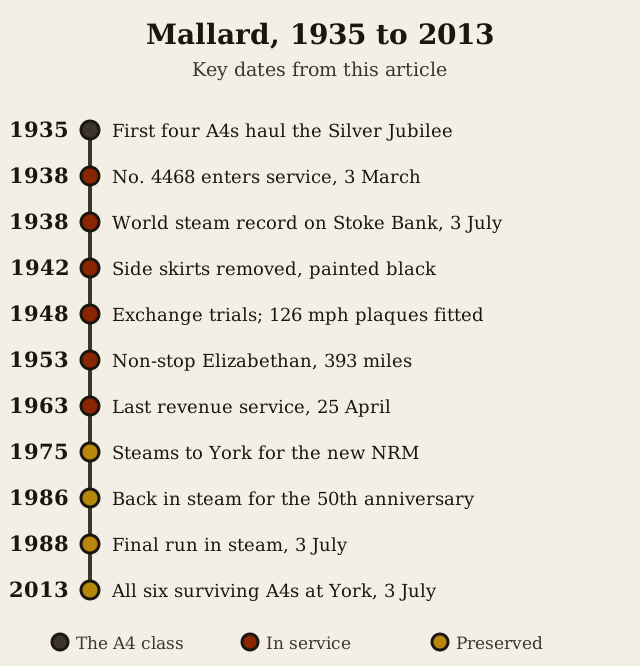
Mallard left Doncaster Works and entered service on 3 March 1938 as No. 4468. It was only four months old when it set the record. Over its 25 year career it carried twelve different boilers and seven tenders, a normal life for a big express engine whose parts were swapped at every overhaul. It was based at Doncaster, then at Grantham from 21 October 1943, and finally at King's Cross Top Shed from 11 April 1948.

The A4s were built with streamlined side skirts, or valances, over the wheels. These were removed on 13 June 1942 to make wartime maintenance easier, when Mallard was also painted plain black. They were refitted when it was restored for preservation in 1963.
The 1938 World Speed Record on Stoke Bank
On 3 July 1938, officially during a trial of a new quick acting Westinghouse brake, Mallard hauled a seven coach train of 240 tons that included a dynamometer car to record its speed. The driver was Joseph Duddington, known within the LNER for taking calculated risks, and the fireman was Thomas Bray. A permanent 15 mph speed restriction just north of Grantham held the train back as the crew tried to build up speed for the long downhill run of Stoke Bank.
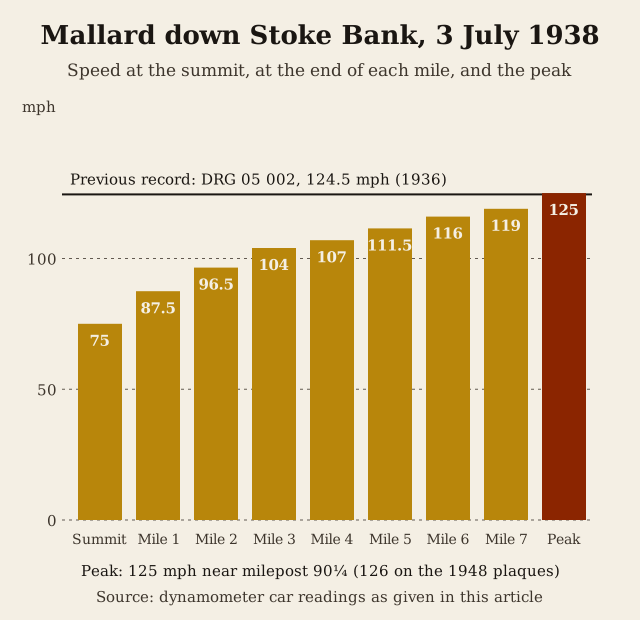
Mallard topped the bank at 75 mph and accelerated all the way down. The speeds at the end of each mile from the summit were 87.5, 96.5, 104, 107, 111.5, 116 and 119 mph, and readings every half mile after that reached 125 mph near milepost 90¼, between Little Bytham and Essendine. The crew believed 130 mph would have been possible if the train had not needed to slow for the junctions at Essendine.
The record came at a cost. The A4s had a weak point in the big end bearing of the middle cylinder, so it had been fitted with a "stink bomb" of aniseed oil that would release its smell if the bearing overheated. After the record the bearing did overheat, the crew eased off to 70 to 75 mph, and Mallard came off the train at Peterborough and went to Doncaster Works for repair. The LNER's publicity department had expected this and had press photographs ready in advance; the Ivatt Atlantic that replaced Mallard was barely in sight when they started handing them out.
125 or 126 mph?
The exact figure has been argued over ever since. The dynamometer car recorded speed on a paper roll that moved 24 inches for every mile, and staff calculated speeds from the distance between timing marks. Right after the run, they worked out a maximum of 125 mph averaged over five seconds. A reading of 126 mph appeared for a single second, but Gresley did not accept it as reliable, and 125 mph was the figure first published.
Gresley planned another attempt in September 1939, but the outbreak of the Second World War stopped it. In 1948 plaques reading 126 mph, designed by the headmaster and steam enthusiast Harry Underwood, were fixed to the locomotive, and 126 became the accepted figure. One recent analysis argues that the paper roll did not move at a constant rate, and that the safest verified figure is a sustained 124 mph for almost a mile.

Either way, no steam locomotive has officially gone faster. Germany's DRG Class 05 No. 002, which set the previous record in 1936 at 124.5 mph (200.4 km/h), did it on level track with a lighter four coach train of 197 tons, while Stoke Bank runs slightly downhill. Unconfirmed claims of higher speeds by Pennsylvania Railroad duplex locomotives in the United States have never been verified. Our fastest steam locomotives guide compares all the contenders.
The 1948 Locomotive Exchange Trials
Britain's railways were nationalised in 1948, and British Railways tested express locomotives from each of the former "Big Four" companies against one another to find the best mix of speed, power and economy with coal and water. The results helped shape the later BR Standard locomotives. The express classes compared were the former LMS Princess Coronation, the LNER A4, the Southern Merchant Navy and the Great Western King.

Three A4s represented the Eastern Region: Mallard, then numbered E22, with 60033 Seagull and 60034 Lord Faringdon, all fresh from overhaul at Doncaster. On 8 June 1948 Mallard ran from London Waterloo towards Exeter with a train of 505 tons. Despite adverse signals that slowed it to a crawl at Hook, it reached Salisbury in 108 minutes 28 seconds, only five and a half minutes late. Mallard then failed, and on 10 June Seagull took over and ran the same section in 96 minutes 22 seconds after leaving three minutes late, so it arrived three and a half minutes early.
The Elizabethan and the End of Mallard's Career
In its British Railways years Mallard, now No. 60022, was one of only 22 locomotives with a corridor tender, which had a narrow passage through it so a fresh crew could take over without stopping. That made it a natural engine for The Elizabethan, which ran non-stop over the 393 miles between King's Cross and Edinburgh Waverley from 1953 and in its day was the longest non-stop run in the world. The six and a half hour trip needed two crews. In December 1961 Mallard hauled the last steam hauled northbound Elizabethan.

Mallard was chosen for preservation as early as December 1960, a decision confirmed on 29 August 1962. Its final revenue earning service ran on 25 April 1963. It then went to Doncaster Works to be restored to its original 1938 appearance, with garter blue paint, side skirts and a non-corridor tender. On 24 February 1963, shortly before withdrawal, it also returned to the Waterloo to Exeter line to haul a Locomotive Club of Great Britain railtour.
Mallard in Preservation
After restoration Mallard went to the Museum of British Transport in Clapham, south London. In the 1970s, after the ban on main line steam in Britain was relaxed, it hauled a train from Stewarts Lane in Battersea to York via the Midland Main Line on 12 April 1975, ahead of the opening of the National Railway Museum, which has been its home ever since.

For the 50th anniversary of the record it was restored to working order. Its first run was from York to Doncaster on 26 March 1986, followed by special trains across England in 1986 and 1987. Its final run in steam was on 3 July 1988, exactly 50 years after the record, from Doncaster to Scarborough and back. Several family members of the 1938 crew were on board, and the trip marked the release of a commemorative Mallard postage stamp.
Where Mallard Is Displayed (since 1975)
Mallard is part of the National Collection at the National Railway Museum in York. It was shown outside the museum in July 2003 for the 150th anniversary of Doncaster Works, and in July 2008 beside the three other A4s preserved in Britain, the first time they had been together since preservation. On 3 July 2013, the 75th anniversary of the record, all six surviving A4s were brought together at York, including Dwight D. Eisenhower from the United States and Dominion of Canada from Canada, and the six were later shown together at the museum's Shildon site. Mallard itself spent June 2010 to July 2011 on display at Shildon.
Mallard also has a life beyond the museum. A painting of it in post-war condition is the cover of Blur's 1993 album Modern Life Is Rubbish, and Hornby has made models of it since 1958, when its Hornby Dublo range first produced one in OO gauge. Our model train scales guide explains OO and the other sizes. Mallard's fellow LNER record breaker, the A3 Flying Scotsman, was the first steam locomotive officially recorded at 100 mph, four years before Mallard's run.

Mallard's record was as much about publicity as engineering: the LNER wanted the fastest trains in Britain and made sure everyone knew it. Rails & Rivals, our game on Steam, is a turn-based railroad strategy board game for 2 to 6 players: each player runs a rail company, lays track across a hex map and carries goods between cities, and the wealthiest company wins. The how to play page has the rules.
Keep reading
Sources
- London & North Eastern Railway steam locomotive 'Mallard' (Science Museum Group)
- Mallard (Grace's Guide to British Industrial History)
- Mallard: streamlined for speed (National Railway Museum (York))
- LNER Class A4 4468 Mallard (Wikipedia)
- LNER Class A4 (Wikipedia)
- Sharing Mallard's moment in time (Science Museum Group blog)
- Dwight D. Eisenhower (National Railroad Museum, Green Bay, Wisconsin)
- London & North Eastern Railway Steam Locomotive 'Flying Scotsman' (Science Museum Group)