Steam vs Diesel vs Electric: Types of Locomotives

It is common to classify locomotives by their source of energy, and the kinds compared here are steam, diesel and electric. A steam locomotive burns fuel, usually coal, wood or oil, to boil water into steam that moves pistons connected to its driving wheels. A diesel locomotive is powered by a diesel engine, and its types differ in how that power reaches the wheels: through an electric, hydraulic or mechanical transmission. An electric locomotive is powered only by electricity, supplied through an overhead line, a third rail or an onboard battery.
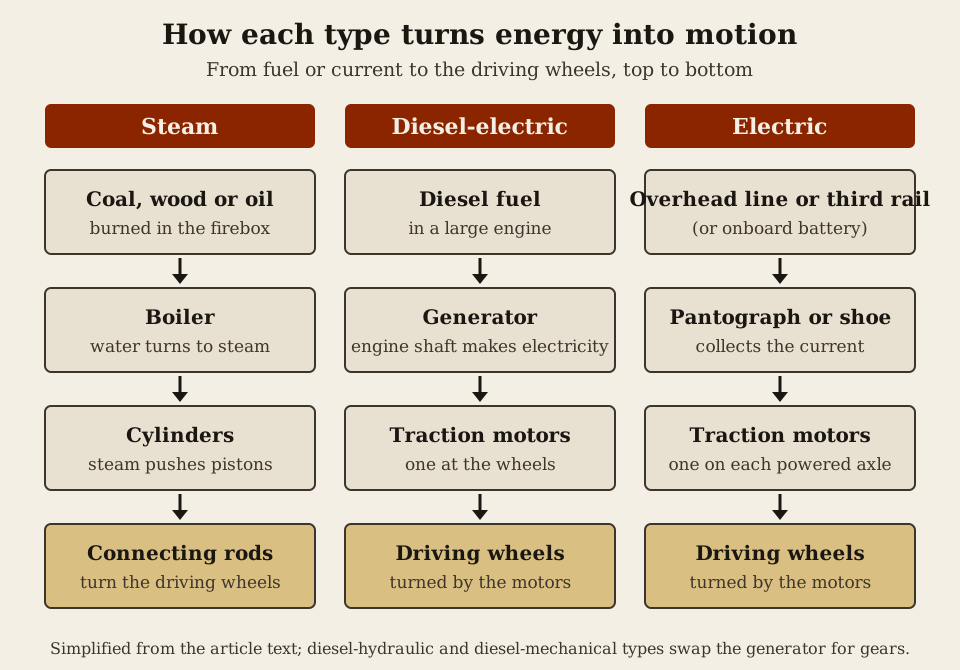
The three main types of locomotive
Before locomotives existed, trains on railways were moved by simpler means: people, horses, gravity, or fixed engines that hauled them along with cables. A locomotive either makes its own power by burning a fuel like wood, coal, petroleum or natural gas, or draws electricity supplied from outside the train.

Locomotives also differ by the job they do. A freight locomotive is usually built for a strong pull at start-up and plenty of power over long runs, so it can get a long, heavy train moving and keep it going, typically giving up some top speed in exchange. Passenger locomotives usually develop lower starting tractive effort but can run at the higher speeds needed to keep to a timetable.
How a steam locomotive turns coal and water into motion
In a steam locomotive, the main source of power is a steam engine, and most designs also carry their own boiler to produce the steam. Coal is burned in the firebox, and the heat turns the water in the boiler into steam, though wood or oil can also be used as fuel. The high-pressure steam is directed into the cylinders, where it pushes the pistons back and forth. The cylinders are double-acting: steam enters first one end and then the other, so the piston gets a push in both directions of travel. The pistons connect to the driving wheels through connecting rods, and as the pistons move they turn the wheels. Tank, tender and articulated steam locomotives are covered in steam locomotive types explained.

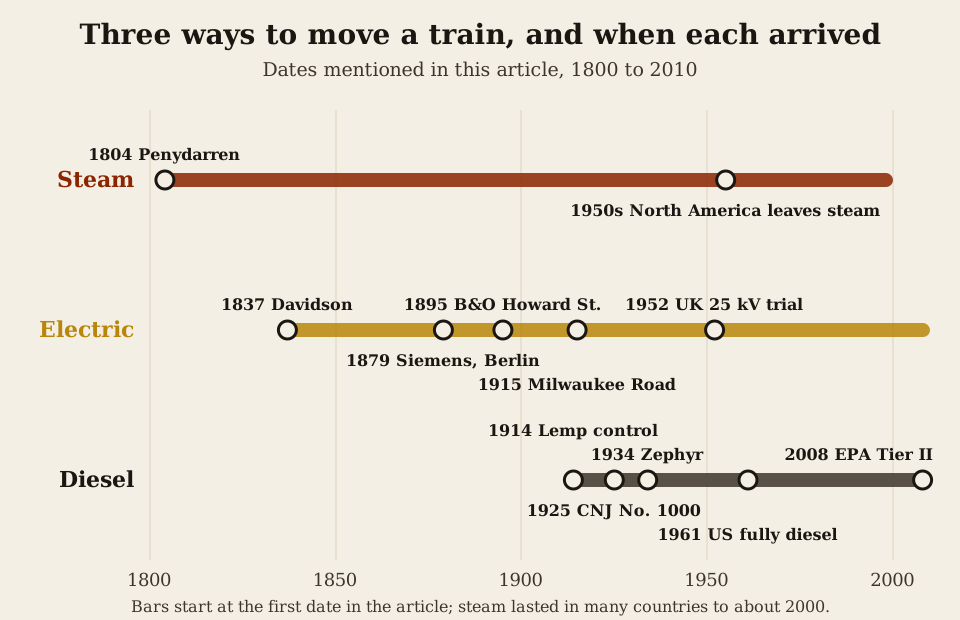
In 1802 Richard Trevithick built the first full-scale railway steam locomotive that worked, made for the Coalbrookdale ironworks in Shropshire, England, but no surviving record shows it running there. The first recorded railway journey under steam came on 21 February 1804, when another Trevithick locomotive pulled a train in South Wales from the Penydarren ironworks at Merthyr Tydfil to Abercynon. Accompanied by Andrew Vivian, it ran with mixed success.
How diesel locomotives work: diesel-electric, diesel-hydraulic and diesel-mechanical
A diesel locomotive is a locomotive whose power source is a diesel engine, and several types have been developed that differ mainly in how the mechanical power is conveyed to the driving wheels. In a diesel-electric locomotive, a large diesel engine turns a shaft that drives a generator, and the electricity powers large electric motors at the wheels called traction motors. Some diesel-electrics use DC generators and others use AC. Modern AC locomotives offer better traction and adhesion, and railways put them on trains with heavier loads. A diesel-mechanical locomotive has a mechanical transmission, much like the gearbox in most road vehicles. This type of transmission is generally limited to low-powered, low-speed shunting locomotives, lightweight multiple units and self-propelled railcars. A diesel-hydraulic locomotive uses one or more torque converters combined with fixed-ratio gears. Diesel-electric locomotives were chosen around most of the world, but a few countries turned to diesel-hydraulics instead, most notably Germany, Finland and Japan, as well as Britain for a time.

Early in the development of diesel power, several transmission systems were tried, some working better than others, and electric transmission eventually won out as the most popular. Hermann Lemp, an electrical engineer at General Electric, developed a dependable DC electrical control system in 1914 and patented it. His design used a single lever to control both engine and generator together, and it was the prototype for all diesel-electric locomotive control. General Electric built three experimental diesel-electric locomotives using Lemp's design in 1917 and 1918.
In India, the WDM-3A class of diesel-electrics was developed by Banaras Locomotive Works for Indian Railways and has hauled both passenger and freight trains. The class entered service in 1994, and its name stands for broad gauge, diesel, mixed traffic, with 3,300 horsepower. The E el-2 was a much earlier Soviet diesel-electric locomotive, designed by a team led by Yury Lomonosov and built in Germany. It was completed in 1924, and it hauled trains from 1925 to 1954. Rorke's Drift was a diesel-mechanical shunting locomotive built by Drewry of Preston in 1934 for the London, Midland and Scottish Railway. It was one of nine prototypes the railway ordered in 1934 to test the concept of shunting with diesel locomotives. D2860 is a Class 02 diesel-hydraulic shunting locomotive built by the Yorkshire Engine Company in 1960. It was one of twenty such shunters with 170hp Rolls-Royce engines built for British Railways.
Why railways switched from steam to diesel
The first diesel-electric locomotive to succeed commercially was CNJ No. 1000, produced in 1925 by General Electric working with Ingersoll-Rand and the American Locomotive Company. Other railroads were quick to follow, as diesel-electrics handled yard switching more efficiently, being easy to maneuver and economical to run. That led to the dieselization of the American railroad fleet and the eventual end of the steam era. I-R 91 of the Illinois Railway Museum dates from 1926; it was the eighth production diesel locomotive made for any U.S. railroad. Its design combined electric-locomotive features with a 300-horsepower diesel engine to make a low-speed switching locomotive that was simple to maintain and cleaner than steam engines.

The Winton 201-type diesel engine that powered the 1934 Pioneer Zephyr marked an important step as diesel-electric power took over from steam locomotives. By 1961, the United States had converted to diesel trains. As diesel technology improved, diesels grew less expensive to build and run, until owning and operating one cost less than a steam locomotive. Diesels generally emit less sulphur dioxide and fewer greenhouse gases than steam locomotives, though they still emit large amounts. In 2008, the United States Environmental Protection Agency mandated Tier II pollution standards for all new or refurbished diesel locomotives, cutting allowable soot by 90% and requiring an 80% reduction in nitrogen oxide emissions.
The steam locomotive remained by far the most common type of locomotive until after World War II. North America moved away from steam during the 1950s, and in other parts of the world the change came later. Steam was a familiar technology that used widely available fuels, and it continued to be used in many countries until the end of the 20th century.
How an electric locomotive works
An electric locomotive is a locomotive powered only by electricity. The electricity is supplied to moving trains through a nearly continuous conductor running along the track, usually an overhead line or a third rail at track level, or from an onboard battery. The power used is either direct current (DC) or alternating current (AC). A catenary is a network of overhead wires that supplies electric power to trains, and trains connect to it through pantographs. Of the main collection methods, the pantograph is best suited for high-speed operation. Many suburban lines and mass transit systems pick up power from a third rail rather than an overhead wire. Nearly every electric locomotive drives its wheels with axle-hung traction motors, fitting one motor to each powered axle.
Locomotives with an onboard diesel engine are classed as diesel-electric rather than electric locomotives, because their generator and motors serve only as a power transmission system. The first electrified railways ran on DC, because AC was poorly understood at the time and the insulation needed for high-voltage lines did not yet exist.
Not every locomotive fits neatly into steam, diesel or electric. Hybrid, or dual-mode, locomotives use two or more types of motive power. Electro-diesel locomotives can run either from an electricity supply or from an onboard diesel engine, which lets them provide continuous journeys along routes that are only partly electrified. The EMD FL9 and the Bombardier ALP-45DP are examples of hybrid locomotives. A battery-electric locomotive is an electric locomotive powered by onboard batteries. They fill in where an ordinary diesel or electric locomotive would not suit the job, such as hauling maintenance trains on electrified lines while the power is switched off. They are also used in industrial facilities where a combustion-powered locomotive could pose a risk of fire, explosion or fumes in a confined space. In over-the-road service, a battery locomotive can top up its charge by soaking up energy from dynamic braking.

When and why electric traction took hold
Robert Davidson, a chemist from Aberdeen, built the first known electric locomotive in 1837, and it was powered by galvanic cells. Werner von Siemens presented the first electric passenger train at Berlin in 1879, with a locomotive driven by a 2.2 kW motor. The train, made up of the locomotive and three cars, reached 13 km/h and carried 90,000 passengers in four months on a 300 m circular track. Its 150 V DC electricity was supplied through a third insulated rail and collected by a contact roller. The world's first electric tram line, built by Siemens, opened at Lichterfelde near Berlin in 1881.

The Baltimore and Ohio Railroad demonstrated the first electrified main line railroad on 27 June 1895, at the Howard Street Tunnel in Baltimore, and commercial operation began four days later. A city ordinance prevented smoke vents in the tunnel, and the need to reduce the dense smoke and toxic fumes there drove the project. General Electric supplied the project's locomotives, which had ten times the power of any electric locomotive built and run before them. Its success demonstrated to the world that electric propulsion of railroad locomotives was practical. Within five years, major terminal electrification projects were planned in cities such as New York City and Paris. In 1915, the Chicago, Milwaukee, St. Paul and Pacific electrified its line from East Portal to Harlowtown with 3000 V DC catenary.

Charles Brown, then working for Oerlikon in Zürich, designed the first practical AC electric locomotive. Brown had already shown in 1891 that three-phase AC could carry power over long distances, sending it 280 km from a hydroelectric plant at Lauffen am Neckar to Frankfurt am Main West. He noted that three-phase motors delivered more power for their weight than DC motors, and that without a commutator they were easier to build and look after. Their drawback was size: they were far bigger than the DC motors of that era, so they had to sit inside the locomotive body rather than in bogies under the floor. In 1894, Hungarian engineer Kálmán Kandó developed a new type of three-phase asynchronous electric drive motor that was more effective than the synchronous motors used in earlier designs. The first use of Kandó's designs was on a short three-phase AC tramway at Evian-les-Bains in France, which was built from 1896 to 1898.
In the early twentieth century, as steam power began to reach its practical limits, electric locomotives offered cleaner operation, faster acceleration and reduced maintenance compared with steam. Electric traction did especially well in tunnels, in mountainous country and on crowded city routes, all places where smoke and steam caused trouble. In Britain, the City and South London Railway opened in 1890 as the country's first heavy-rail electric railway, powered by a 500V DC third rail. Smoke from steam trains in the Mersey tunnel drove passengers onto the ferries, and the Mersey Railway was electrified in 1903 with a 600V DC fourth rail. The North Eastern Railway's 1904 electrification of its lines to Tynemouth and South Shields reduced costs by 50% and doubled passenger numbers. As a trial in 1952, the Morecambe and Heysham line became the first UK line electrified at 25kV AC. In 1956, a report concluded that overhead 25kV AC should be the standard for future British electrification.
Steam vs diesel vs electric at a glance
Power source, how that power reaches the wheels, a key date and where or why each type was used line up like this for all five types:
| Type | Power source | How it reaches the wheels | Key date | Where and why it was used |
|---|---|---|---|---|
| Steam | Coal, wood or oil burned to make steam | Steam pushes pistons linked to driving wheels by connecting rods | First recorded steam-hauled railway journey in 1804 (Trevithick) | A familiar technology using widely available fuels, and the most common type until after World War II |
| Diesel-electric | Diesel engine driving a generator | Generator electricity powers traction motors at the wheels | First commercially successful example in 1925 (CNJ No. 1000) | More efficient yard switchers thanks to maneuverability and cost-effective operation, and later cheaper to own and operate than steam |
| Diesel-hydraulic | Diesel engine | Torque converters and fixed-ratio gears | Example built in 1960 (D2860) | Chosen instead of diesel-electric by a few countries, most notably Germany, Finland and Japan, and Britain for a time |
| Diesel-mechanical | Diesel engine | Mechanical transmission like a road vehicle | Prototypes ordered in 1934 (Rorke's Drift) | Generally limited to low-powered, low-speed shunting locomotives, lightweight multiple units and railcars |
| Electric | Electricity from an overhead line, a third rail or an onboard battery | Axle-hung traction motors, one for each powered axle | First electrified main line in 1895 (B&O, Howard Street Tunnel) | Cleaner operation, faster acceleration and reduced maintenance, with particular success in tunnels, mountains and dense urban routes |

Rails & Rivals, our game on Steam, is a turn-based railroad strategy board game for 2 to 6 players: each player runs a rail company, lays track across a hex map and carries goods between cities, and the wealthiest company wins. The how to play page has the rules.
Keep reading
Sources
- Locomotive (Wikipedia)
- How a steam locomotive works (Great Central Railway (heritage railway operator))
- How a Steam Locomotive Works (National Railway Museum (steamlocomotives.org))
- Diesel-Electric Locomotives (Edison Tech Center)
- CNJ No. 1000 Quick Facts (B&O Railroad Museum)
- I-R 91 diesel locomotive (Illinois Railway Museum)
- Pioneer Zephyr (American Society of Mechanical Engineers)
- Diesel-mechanical locomotive, 'Rorke's Drift' (Science Museum Group / National Railway Museum)
- Diesel-hydraulic locomotive, Class 02 0-4-0 No D2860 (Science Museum Group / National Railway Museum)
- Electric Locomotives (steamlocomotive.com)
- Mainline Electrification of the Baltimore and Ohio Railroad, 1895 (Engineering and Technology History Wiki (IEEE))
- Railway 200: 183 years of UK railway electrification (Rail Engineer)
- What in the World is Catenary? (NJ Transit)
- Diesel locomotive (Wikipedia)
- Electric locomotive (Wikipedia)
- Indian locomotive class WDM-3A (Wikipedia)
- Soviet locomotive class E el-2 (Wikipedia)