The Jacobite Steam Train: Route, Viaduct and History

The Jacobite steam train is a steam locomotive-hauled tourist service that runs over part of Scotland's West Highland Line between Fort William and Mallaig, on a line of 41 miles (66 km) each way, for an 84-mile round trip. West Coast Railways began running the train under the Jacobite name in 1995, over a route that also served as the Hogwarts Express line in the Harry Potter films.
What The Jacobite Is and Who Runs It
The Jacobite is a tourist train pulled by a working steam locomotive. It uses part of Scotland's West Highland Line, travelling from Fort William to Mallaig and back, and the 84-mile round trip passes lochs, mountains and the sea.
The service takes its name from the historic Jacobite political movement, which has many local connections to the area the line passes through.
The carriages are British Railways Mark 1 vehicles. They belonged to British Rail, which painted them blue and grey, before passing to West Coast Railways, which repainted them in a close match of British Rail Maroon. These Mark 1 coaches use vacuum brakes, while a separate set of British Railways Mark 2 carriages with air brakes is kept at Fort William for the afternoon service. These older carriages are at the centre of the door-locking dispute described below, and for the 2026 season West Coast Railways lists Mark 2 heritage carriages.
Various steam locomotives have hauled the service over the years, mostly of types used on the route before regular steam ended in 1967. They include K4 No. 61994 The Great Marquess, designed for the route in the 1930s; LNER Peppercorn Class K1 No. 62005 Lord of the Isles, a type developed from the K4 in the 1940s; and LMS Stanier Class 5 4-6-0s, known as the Black Fives, among them Nos. 44871, 45212 and 45407. West Coast Railways' 2026 Jacobite page names a Black Five as the engine.

The Jacobite Route: Fort William to Mallaig
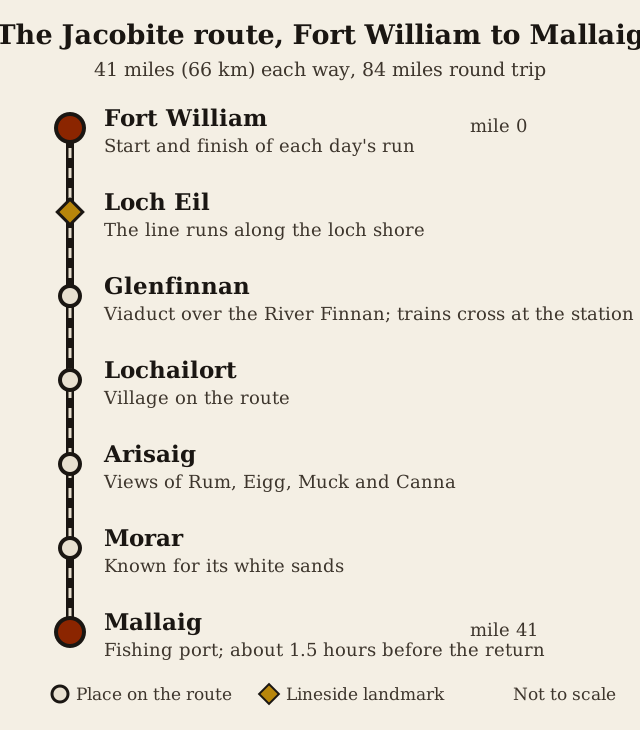
Each way, the Jacobite covers 41 miles from Fort William to Mallaig. The train runs beside Loch Eil, goes through Glenfinnan and across Glenfinnan Viaduct, then continues to Arisaig. At Glenfinnan station it passes the regular service trains. In order, the main places on the route are:
- Fort William, where the service begins and ends each day.
- Glenfinnan, where the train crosses the Glenfinnan Viaduct and meets regular service trains at Glenfinnan station.
- Lochailort, one of the villages the train passes through.
- Arisaig, a village on the route with views of the Small Isles of Rum, Eigg, Muck and Canna.
- Morar, known along this stretch of line for its white sands.
- Mallaig, the fishing port at the end of the line, where passengers get an hour and a half before the return.
The route is the same one shown in the Harry Potter films. For every film, the train that played the Hogwarts Express came from the company that runs The Jacobite, which also let Warner Brothers shoot on the route. The locomotive used to pull the Hogwarts Express on screen, GWR 4900 Class 5972 Olton Hall, has been kept at Warner Bros. Studio Tour London, the Making of Harry Potter, since 2015 and can be seen during studio tours.
Glenfinnan Viaduct: Who Built It and Why
Glenfinnan Viaduct stands in north-western Scotland, in the Lochaber district, where it takes the West Highland Line through Glenfinnan. Built between 1897 and 1901, it stands at the head of Loch Shiel and looks out over the loch and the Glenfinnan Monument.

Work on the extension from Fort William to Mallaig started in January 1897, with the line opening on 1 April 1901. Robert McAlpine & Sons built the viaduct, with Simpson & Wilson as engineers, By October 1898 enough of it was finished for materials to be carried over the valley on it. It was built at a cost of 18,904 pounds.
Concrete was chosen because the local hard schist was difficult to work. The viaduct is built from mass concrete, which unlike reinforced concrete contains no metal reinforcement and is formed by pouring concrete into formwork, which makes it strong in compression but weak in tension. It has 21 semicircular spans of 50 feet (15 m), crosses the River Finnan at a height of 100 feet (30 m) and is built on a curve of 792 feet. At 416 yards (380 m) long, it is the longest concrete railway bridge in Scotland, a measurement confirmed by Historic Environment Scotland's listing, which also notes the viaduct's thicker pylons flanking the centre portion of its continuous semicircular arch rings. For comparison, Ribblehead Viaduct in England is 440 yards (400 m) long with 24 arches, as our Settle-Carlisle Railway guide explains.
A long-standing legend held that a horse had fallen into one of the viaduct's piers during construction in 1898 or 1899. In 1987, Professor Roland Paxton used a borescope inserted into boreholes to search the only two Glenfinnan piers large enough to hold a horse, and found no evidence of one. Acting on local hearsay in 1997, he investigated the nearby Loch nan Uamh Viaduct by the same method and found its piers full of rubble. Scanning technology used in 2001 finally located the remains of a horse and cart inside the large central pylon of the Loch nan Uamh Viaduct, not Glenfinnan.
More than a century after it opened, the viaduct still carries daily ScotRail services and Jacobite steam train services. Network Rail began a 3.4 million pound repair project on it in April 2024.
Glenfinnan Viaduct's Harry Potter Fame
Glenfinnan Viaduct has featured in four of the Harry Potter films, appearing on screen as the crossing used by the Hogwarts Express, including in the Dementor scene in Harry Potter and the Prisoner of Azkaban (2004). Network Rail describes the viaduct as "world-famous, particularly after its appearances in the Harry Potter films."

VisitScotland's Harry Potter itinerary highlights crossing the viaduct for its views over Loch Shiel, which served as the filming location for Hogwarts' Lake. The viaduct is sometimes called the Harry Potter Bridge, and the association has brought hundreds of thousands more tourists to the area each year, putting real strain on the small hamlet of Glenfinnan. Once the films came out, a handful of near misses between trains and people on foot led British Transport Police to tell fans to keep off the viaduct.
The viaduct also appears away from film and television. The Bank of Scotland's 2007 series of banknotes depicted different Scottish bridges as examples of engineering, and the 10 pound note in that series features Glenfinnan Viaduct.
History of the West Highland Line and the Mallaig Extension
Nicknamed the Iron Road to the Isles, the West Highland Line connects Glasgow in central Scotland with two Highland ports, Mallaig and Oban. No railway in Great Britain lies further west. Only two lines reach Scotland's remote and mountainous west coast: this one and the Kyle of Lochalsh Line, which runs from Inverness to Kyle of Lochalsh.
The Craigendoran to Fort William section opened on 11 August 1894, built by the West Highland Railway and sponsored by the North British Railway. The Fort William to Mallaig extension was a separate undertaking: the Mallaig Extension Railway received Royal Assent on 31 July 1894, the West Highland Railway approved its construction at an annual meeting in January 1895, and the act guaranteeing its government subsidy passed in 1896 after delays in the House of Commons. It was the first major British railway line built with a subsidy from the UK Government, and the project relied on that government financial support from the very beginning.
The first plan for the line put its terminus at Roshven, with a deep water port to be built there, but local landowners objected and Mallaig was picked instead. Building the railway took four years, and it was among the world's earliest large projects built with mass concrete.
The Mallaig Extension opened on 1 April 1901 and was operated by the North British Railway. Glenfinnan Station opened to passengers that same month, handling both passenger and freight traffic in its early days. Once the railway reached Mallaig, the port was transformed within ten years from a small crofting-fishing community into a vigorous fishing centre, and the West Highland Railway's arrival at Fort William in 1894 had already transformed life across the Highlands more broadly.
Glenfinnan station is also home to a museum dedicated to the history of the West Highland Line, the Glenfinnan Station Museum, founded in 1991 to preserve the station and its story and given a major transformation between 2009 and 2013.

Readers of the independent travel magazine Wanderlust voted the West Highland Line the top rail journey in the world in 2009. It beat Russia's Trans-Siberian line and Peru's Cuzco to Machu Picchu line. ScotRail later reported that the line had won a vote as the world's most scenic railway for a second year running. Our Trans-Siberian Railway guide covers the runner-up.
The Jacobite's History: From West Highlander to the 2026 Season
At the Grouping of 1923 the Mallaig Extension passed to the London and North Eastern Railway, and at Nationalisation in 1948 it joined British Railways. Steam worked the line for its first 66 years. Regular steam trains on the West Highland Line ended in 1967 under the British Rail Modernisation Plan, which swapped steam locomotives for diesels.
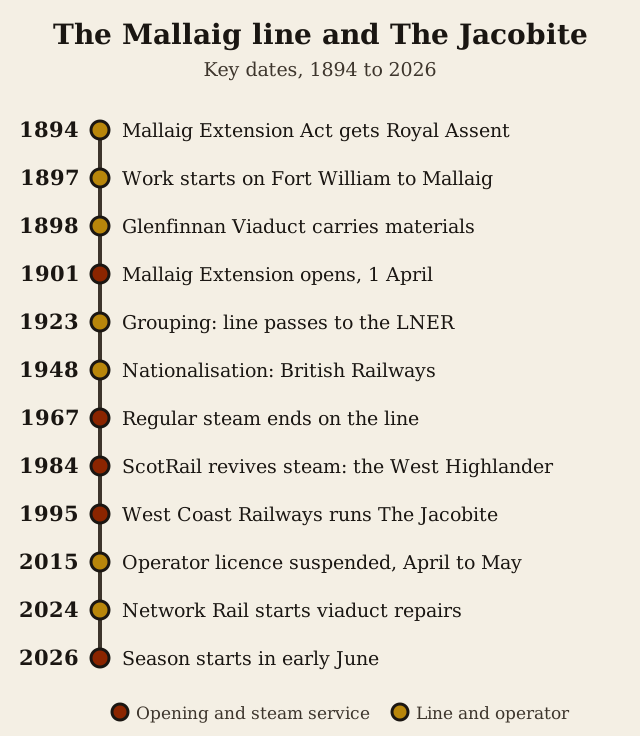
In 1984, ScotRail brought back a steam-hauled service, the West Highlander, on part of the line. The aim was to draw tourists and raise income on a route that relied heavily on subsidy. It proved successful, continued in subsequent years and was later renamed The Lochaber. After British Rail was privatised, West Coast Railways received the licence to operate the West Highlander trains in 1995, and that summer it started running them under a new name, The Jacobite.
In the West Coast Railways timetable that Wikipedia cites, archived in 2019, the morning train departed Fort William at 10:15 and arrived in Mallaig at 12:25, with the return leaving Mallaig at 14:10 and arriving back in Fort William at 16:00. On Mondays to Fridays, it crossed the afternoon train at Glenfinnan, the only regular crossing of two steam services passing each other anywhere on the national network. That afternoon train dates from 2011. Demand led West Coast Railways to add a second daily Jacobite from Fort William to Mallaig for the first time that year, hauled by Ian Riley's Black 5 44871 with a spare rake of coaches that had previously worked The Cambrian. It first ran on Wednesdays, Thursdays and Fridays from June 2011 to August 2011, rose to five days a week in 2012, and in the 2019 timetable departed Fort William at 14:30 and returned at 20:30.

The service has faced repeated disruption since 2015. West Coast Railways' operating licence was fully suspended from 3 April 2015, after one of its trains passed a signal at danger at Wootton Bassett Junction in March 2015, and the ban was lifted on 8 May 2015. The Office of Rail and Road (ORR) banned the company from the main line again from 17 February 2016 to 23 March 2016. Safety concerns led to another suspension in July 2023, with passengers offered full refunds, and services resumed in August 2023. In January 2024, the ORR revoked West Coast Railways' exemption to run its hinged-door carriages, and in March 2024 the company suspended all Jacobite services, due to start on 28 March 2024, while it sought a new exemption from the requirement to fit central locking systems in its carriages. The suspensions drew complaints from the local community over the economic impact of fewer tourists visiting the region, and competing operator Locomotive Services Limited ran a trial excursion called The West Highlander over the Jacobite's route in April 2024 while the West Coast Railways operation was shut down. The morning Jacobite returned on 15 April 2024 using modern coaching stock as a stopgap, but the carriages proved unpopular and expensive to run, requiring a diesel locomotive attached to the rear of the train just to power their air conditioning. The ORR later declined the 2024 exemption request because of missing paperwork.
In April 2026, West Coast Railways postponed the start of the season again while it sought permission to run its older rolling stock while fitting central locking over a period of years. Its revised application asked for a 13-year exemption, until 2039. With the ORR's decision still pending in June 2026, the 2026 season began in early June 2026 using Mark 2 carriages fitted with pressure vents, so no diesel locomotive was needed on the rear to power their electrics. On 14 June 2026, a West Coast Railways locomotive derailed during a run-round at Mallaig.
The Jacobite's 2026 Season
West Coast Railways lists the 2026 morning Jacobite service as running from Monday 1 June 2026 to Friday 23 October 2026, seven days a week, between Fort William and Mallaig. The 2026 afternoon service is listed separately, running from Wednesday 10 June 2026 to Friday 25 September 2026, also seven days a week. Both services follow the same route described above, past Loch Eil, Glenfinnan Viaduct, Lochailort, Arisaig and Morar.

Rails & Rivals, our game on Steam, is a turn-based railroad strategy board game for 2 to 6 players: each player runs a rail company, lays track across a hex map and carries goods between cities, and the wealthiest company wins. The how to play page has the rules.
Keep reading
Sources
- The Jacobite (West Coast Railways)
- The Jacobite (steam train) (Wikipedia)
- Glenfinnan Viaduct (Wikipedia)
- Listed Building LB310 - Glenfinnan Railway Viaduct over River Finnan (Historic Environment Scotland)
- Harry Potter itinerary (VisitScotland)
- Harry Potter (film series) (Wikipedia)
- Mallaig Extension Railway (Wikipedia)
- The Mallaig Railway (Mallaig Heritage Centre)
- West Highland Line (Wikipedia)
- West Coast Railways (Wikipedia)
- Repairing the world-famous Glenfinnan Viaduct (Network Rail)
- Glenfinnan Viaduct restored for future generations (Rail Engineer)
- History (Glenfinnan Station Museum)