Railroad Brotherhood History: Engineers to Porters

In the United States, railroad brotherhoods are labor unions of railroad workers, and they first appeared in 1863. Until recent years, they remained largely independent of one another and of the American Federation of Labor. The Brotherhood of Locomotive Engineers is regarded as the oldest labor organization in the United States.
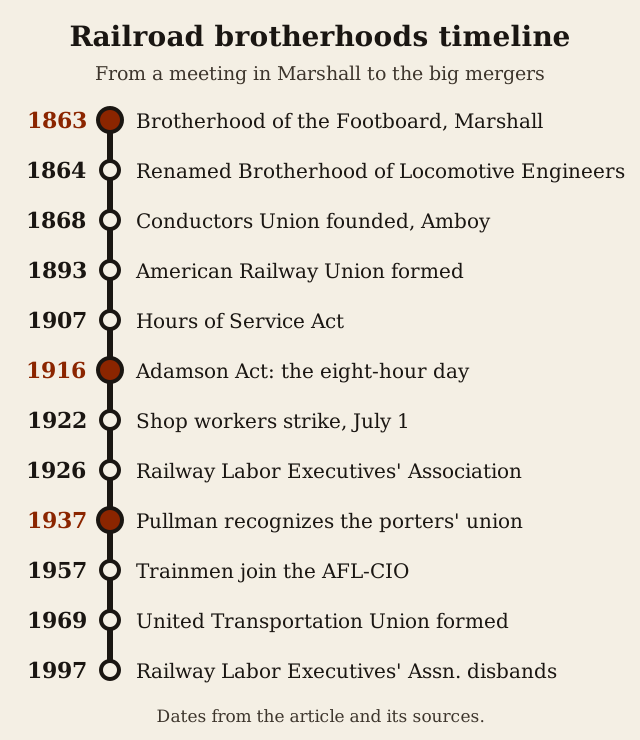
The First Brotherhood, 1863
Before the brotherhood formed, Michigan Central locomotive engineers earned $60 a month, but only if they covered at least 2,500 miles, regardless of how long the runs took.
William D. Robinson, a Michigan Central locomotive engineer, brought 19 fellow engineers together at his home in Marshall, Michigan on May 8, 1863, and the group founded the Brotherhood of the Footboard. A monument commemorating the founding still stands in Marshall. At the organization's first national convention in Indianapolis in August 1864, members renamed it the Brotherhood of Locomotive Engineers.

Conductors, Firemen and Trainmen Join the Ranks, 1868 to 1899
The Order of Railway Conductors and Brakemen traces its origins to 1868, when T.J. "Tommie" Wright founded it as the Conductors Union in Amboy, Illinois. In December 1869, the Brotherhood of Locomotive Engineers formed its Pacific Division No. 110 in Rocklin, California, and the division moved to Sacramento the following June. The California State Railroad Museum Library and Archives holds the division's records, a 2-linear-foot collection of 15 volumes and miscellaneous papers.
Eugene V. Debs became a charter member and secretary of the Vigo Lodge of the Brotherhood of Locomotive Firemen on February 27, 1875. Debs argued that firemen needed cross-craft cooperation, insisting that the other railroad crafts had to be organized too before firemen could have any real power. In 1899, the Brotherhood of Railroad Trainmen moved its national Grand Lodge headquarters to Cleveland.
Growth, Goals and Rivals, 1870 to 1916
After 1870, as large railroad systems grew rapidly and consolidated, union organizations sprang up across the entire nation. By 1901, 17 major railway brotherhoods were operating, and they generally got along amicably with management, which saw them as useful. The leading unions were the Brotherhood of Locomotive Engineers, the Brotherhood of Locomotive Firemen, the Order of Railway Conductors and the Brotherhood of Railroad Trainmen.

Their chief aim was to build insurance and medical packages for members and to negotiate work rules favoring their own membership, such as seniority and grievance procedures. One of the earliest labor agreements the Brotherhood of Locomotive Engineers secured with a railroad was with the New York Central in 1875. The brotherhoods stayed outside the American Federation of Labor and fought off more radical rivals, including the Knights of Labor in the 1880s and the American Railway Union in the 1890s.
The Hours of Service Act of 1907 capped the hours that dispatchers and telegraph operators could work within any 24-hour period, which effectively forced railroads to roughly double their staff of skilled telegraph operators.
The brotherhoods consolidated their power in 1916: after threatening a nationwide walkout, they pushed through the Adamson Act, federal legislation guaranteeing railroad workers ten hours of pay for an eight-hour shift. Lobbying by the Brotherhood of Locomotive Engineers contributed to that law.
Strikes That Tested the Brotherhoods
Firemen on the Baltimore and Ohio Railroad said their reduced wages left them unable to meet daily expenses, even as the company paid a 10 percent dividend to its stockholders.

at the present prices the firemen cannot pay their daily expenses, much less support their families
The 1877 strike brought the nation's commerce to a halt, with major violence in Baltimore and Pittsburgh. It spread because the strikers turned the rail network itself, the very instrument of national unity, into their means of protest.
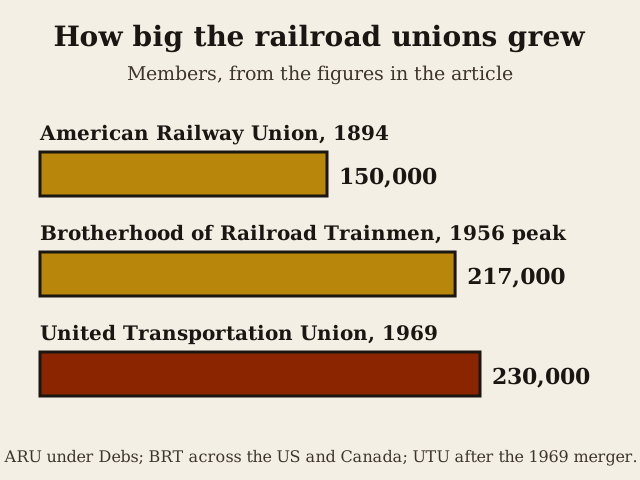
The American Railway Union, formed in Chicago in June 1893, grew to 150,000 members under Eugene V. Debs. During the union's April 1894 strike on the Great Northern Railway, "not a wheel moved" on the line. The federal government later deployed thousands of U.S. marshals and Army troops to break the boycott of the Pullman Company.
The Plumb Plan and the 1922 Shop Strike
At the end of World War I, the railroad brotherhoods promoted the Plumb Plan to nationalize the railroads, and they also conducted a national strike in 1919. Both efforts failed, and through the 1920s the brotherhoods remained largely stagnant. They generally stayed politically independent, though they backed Robert M. La Follette's third-party campaign in 1924. The Republican Party, dominant in Washington, was generally hostile to the brotherhoods until it moderated its stance around 1926.
The Great Railroad Strike of 1922, a nationwide strike by railroad shop workers, began on July 1. Its immediate cause was the Railroad Labor Board's announcement of a seven-cent cut to hourly wages, which led shop workers to vote on whether to strike. The operators' union stayed out, and the railroads hired strikebreakers, who filled three-fourths of the roughly 400,000 jobs the strikers had vacated. That increased hostility between the railroads and the strikers.
During the strike, a federal judge granted a sweeping injunction barring striking, assembling and picketing, which became known as the "Daugherty injunction." The unions bitterly resented it, and a handful of sympathy strikes completely shut down some railroads. The strike eventually died out as many shopmen reached local deals with the railroads. Those often unpalatable concessions, combined with memories of the strike's violence and tension, left relations between the railroads and the shopmen soured for years.

The Railway Labor Executives' Association was founded in 1926 as a federation of several brotherhoods, serving as a legislative lobbying and policy advisory body.
Desegregation and the Brotherhood of Sleeping Car Porters
Before the 1937 contract, Pullman porters earned about $66 to $100 a month for roughly 400 hours of work, with duties that included hauling luggage, ironing suits and shining shoes. A. Philip Randolph served as chief organizer and co-founder of the Brotherhood of Sleeping Car Porters, which became the first Black-led union recognized by the American Federation of Labor and to win a collective bargaining agreement with a major corporation.

The Pullman Company recognized the Brotherhood of Sleeping Car Porters on August 25, 1937, after 12 years of struggle and negotiation. The union is remembered as the first union of African Americans to win real economic bargaining power with an employer. Randolph later secured Executive Order 8802 in 1941, which barred discrimination in defense industries.
More broadly, one of the main challenges facing the railroad brotherhoods was growing calls for desegregation. Many of them had kept a color bar on membership, a practice the 1944 Tunstall and Steele cases challenged.
The Smithsonian's National Museum of American History holds a Brotherhood of Sleeping Car Porters convention badge from 1948. Dr. Lyn Hughes founded the National A. Philip Randolph Pullman Porter Museum in 1995, and the museum is located at 10406 S. Maryland Ave in Chicago.
Mergers and What Came Next, 1957 to 1997
Membership in the Brotherhood of Railroad Trainmen peaked in 1956 at 217,000 trainmen across the United States and Canada, and the brotherhood affiliated with the AFL-CIO in 1957.
The United Transportation Union formed from four unions in 1969, and Charles Luna of the Trainmen became leader of the newly merged 230,000-member organization. Many railroad brotherhoods merged into larger unions, among them the United Transportation Union, the Teamsters and the Transportation Communications International Union. In January 1997, the Railway Labor Executives' Association disbanded, and its functions passed to the AFL-CIO Transportation Trades Department's Rail Division.
The B&O Railroad Museum, now the National Museum of Railroad History & Innovation, runs a public tour on the evolution of worker rights, with particular focus on employees of the B&O Railroad.
For players who want to experience the geography these brotherhoods once crisscrossed, building a rail network hex by hex offers a hands-on sense of the distances and terrain involved; see how to play for the basics of running a company across the board.

Rails & Rivals, our game on Steam, is a turn-based railroad strategy board game for 2 to 6 players: each player runs a rail company, lays track across a hex map and carries goods between cities, and the wealthiest company wins. The how to play page has the rules.
Keep reading
Sources
- Railroad brotherhoods (Wikipedia)
- History (Brotherhood of Locomotive Engineers and Trainmen (BLET))
- Brotherhood of Locomotive Engineers (Case Western Reserve University / Encyclopedia of Cleveland History)
- United Transportation Union (Case Western Reserve University / Encyclopedia of Cleveland History)
- Order of Railway Conductors finding aid (Online Archive of California)
- Brotherhood of Locomotive Engineers, Pacific Division No. 110 Records (Online Archive of California / California State Railroad Museum)
- Debs Biography (Eugene V. Debs Foundation)
- Eugene V. Debs - Pioneer Rail Labor Leader (Railroad Workers United)
- B&O Railroad Strike of 1877 (West Virginia Division of Culture and History)
- BMWE Journal, February 1998 (Brotherhood of Maintenance of Way Employes)
- National A. Philip Randolph Pullman Porter Museum (National Park Service)
- Brotherhood of Sleeping Car Porters badge (Smithsonian National Museum of American History)
- Regulating the Telegraph: Train Dispatching, Telephony, and the 1907 Hours of Service Act (Business History Conference)
- The Pullman Story Part 2 (National Park Service)
- The 1877 Railroad Strike (University of Nebraska-Lincoln, Railroads and the Making of Modern America)
- Working on the Railroad: The B&O and the Labor Movement Public Tour (National Museum of Railroad History & Innovation (B&O Railroad Museum))