Articles · Railroad history
Who Invented the Train Coupler and the Air Brake? History
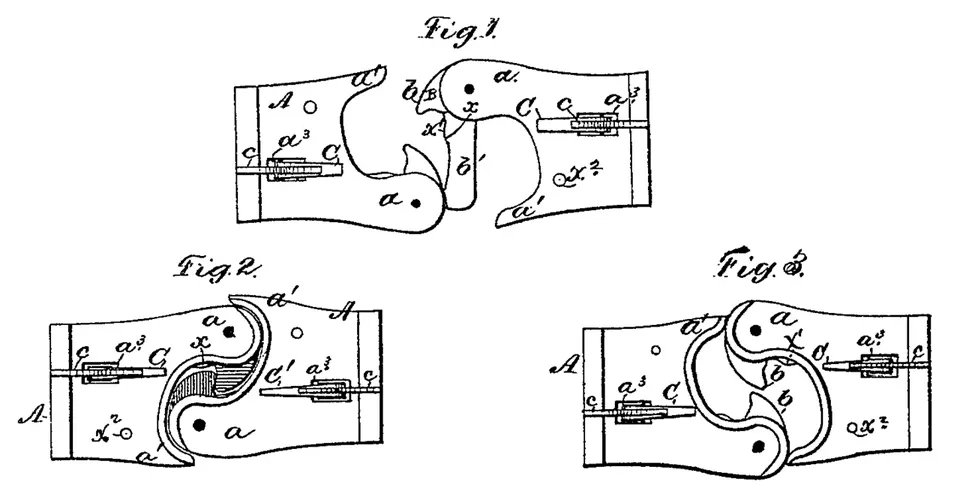
The knuckle coupler used on North American trains was invented by Eli H. Janney, who received a patent for it in 1873. The fail-safe air brake that modern trains rely on is based on a design George Westinghouse patented on April 13, 1869. Under the Safety Appliance Act, a federal law of the United States, every train in the country had to carry air brakes and automatic couplers.
Who invented the train coupler and the air brake
Who invented the train coupler?
Eli Hamilton Janney (November 12, 1831 to June 16, 1912) was the American inventor of the modern knuckle coupler, which replaced link and pin couplers on North American railroads. Janney patented his interlocking coupling system in the years after the Civil War, and it took over from the link and pin coupler.
Who invented the air brake for trains?
George Westinghouse received the first of many air brake patents in 1869. Westinghouse's design was fail-safe, and modern trains rely on an air brake system based on it.
The danger between railroad cars
The link-and-pin coupling was the original style of coupling on North American railways. A brakeman locked a link-and-pin coupler by dropping a pin between two iron loops as the cars came together.
The link and pin coupler made railroad workers stand between cars to join them, and that work was a major cause of injury and death. Before automatic couplers and brakes, men had to step in between moving cars to couple and uncouple them, and ride the cars to work the brakes. Mangled hands and missing fingers marked the experienced link-and-pin worker, who could lose a finger, a hand or his life in one careless moment while guiding the iron link into place.
Coupling work was involved in about 38 percent of all railworker accidents between 1877 and 1887. Brake work was dangerous too, since workers were often hurt while sitting on top of moving rail cars to set hand brakes.
The railroad air brake
George Westinghouse patented his first air brake in 1869. In 1872, Westinghouse had a working air brake, and it let a train be brought to a stop from the locomotive's controls. Westinghouse organized the Westinghouse Air Brake Company at the age of 22 to make and sell his invention. By 1880, the Westinghouse automatic air brake had been fitted to 2,211 locomotives and 7,224 cars in the United States.
In the air brake's simplest form, called straight air, compressed air goes to a brake cylinder whose piston pushes on a linkage known as the brake rigging. The brake rigging presses brake shoes against the wheel treads, though some passenger cars use disc brakes instead. To avoid the shortcomings of straight air, Westinghouse gave every piece of rolling stock its own dual-compartment compressed-air reservoir and a triple valve, also called a control valve.
How train air brakes work in four steps
- The locomotive's air compressor charges the main reservoir with air.
- A brake pipe fitted to each car carries the compressed air the system needs.
- The engineer's automatic brake valve lets reduced, regulated air from the main reservoir into the brake pipe, and that releases the train brakes.
- Emergency braking applies the brakes fast if the brake pipe fails, or if the engineer or a passenger alarm calls for an emergency stop.
The Westinghouse system is highly reliable, yet it can still fail. A brake failure is extremely dangerous because a train is so heavy, rolls with so little resistance and, in freight service, often carries hazardous materials.
Later railroad air brake refinements
Electro-pneumatic (EP) brakes are an air brake type that applies the brakes along the whole train at once, rather than car after car. One enhanced relay valve, with four diaphragms, magnet valves, electric controls and an axle-mounted speed sensor, applied full braking force above 60 mph and then cut it back in steps to bring the train to a gentle stop.
The Janney knuckle coupler for trains
Eli H. Janney was born in 1831 in Loudoun County, Virginia, to Daniel Janney and Elizabeth Avis Haines. Janney was a former Confederate Army officer and Civil War veteran with the rank of major. After the war, Janney worked as a dry goods clerk in Alexandria, Virginia.
Janney spent many lunch breaks carving a replacement for the railroads' widely used link and pin couplers out of a block of wood. Janney, a skilled whittler, made a wooden model of his knuckle coupler and paid a draftsman to draw it for his patent application.
On April 1, 1873, Janney filed a patent titled "Improvement in Car-Couplings" that described the knuckle-style coupler. The Janney coupler was first patented in 1873 as U.S. patent 138,405.
Janney's design was shaped like a curved human hand, held cars together firmly and removed slack, which made transport safer. The Janney coupler locked like two hands clasping.
Janney died in Alexandria, Virginia, on June 16, 1912, and was buried in Ivy Hill Cemetery. The City of Alexandria named a street in his honor, Janney's Lane.
How the knuckle coupler became the railroad standard
By one count, there were 8,000 patented alternatives when the Janney coupling was chosen as the American standard. Those who held the patents gave up their rights to the mating profile of the Janney coupler, whether on their own offer or after persuasion. In 1888, a slightly modified profile became the Master Car Builders (MCB) standard.
The MCB standards saw revisions and additions over the next two decades, with extensive updates in 1899. By then many variations of MCB couplers were in use, and an 1899 knuckle identification chart showed 78 knuckles that would not work with each other.
Around 1913, the MCB Coupler Committee worked with five of the main coupler makers to design a standard coupler for North American railroads that would mate with existing MCB couplers and stand up to the heaviest expected service. Revisions continued until 1916, the year the coupler today called the AAR type D became the recommended standard for North America. The Type D had interchangeable individual parts, which made maintenance simpler. In 1918, the design was upgraded to the No. 10 contour, which largely ended the MCB coupler's tendency to jackknife under buffing forces. The AAR coupler contour descends from the 1888 Master Car Builders Association design.
Lorenzo Coffin's railroad safety campaign
Lorenzo Stephen Coffin (April 9, 1823 to January 17, 1915) was an American farmer, politician and campaigner. Coffin served as Iowa's first Railroad Commissioner from 1883 until 1888. Coffin saw that railroad workers using link-and-pin couplers were being injured at a high rate. Railroads would not adopt Janney's coupler or Westinghouse's air brake at the time, since the devices cost too much money.
Coffin scheduled a series of tests of the Westinghouse air brake in 1886 and 1887, but the tests did not produce the results he hoped for. Later in 1887, Coffin scheduled another series of tests on a long grade outside Burlington, Iowa. In those Burlington tests, a Chicago, Burlington & Quincy steam locomotive started downgrade with 50 cars behind it. When the test train reached 40 mph, the engineer applied the air brakes.
In 1890, Coffin drafted the first railroad safety act, and the Iowa legislature passed it that same year. Coffin lobbied almost singlehandedly for six years for a federal Safety Appliance Act before Congress passed it in 1893.
The Safety Appliance Act of 1893 for railroad cars
Railroad safety requirements varied from state to state, which made them hard for interstate carriers to follow, and Congress passed the Safety Appliance Act in 1893 to set a uniform standard. President Benjamin Harrison signed the act, which was enacted on March 2, 1893.
The Safety Appliance Act required couplers "coupling automatically by impact". Those couplers also had to couple and uncouple "without the necessity of men going between the ends of the cars". From January 1, 1898, locomotives in interstate service needed a power driving-wheel brake and the appliances to operate the train-brake system. The act's sixth section set a penalty of $100 for every violation.
The act's coupler deadline made it unlawful, from January 1, 1898, for an interstate common carrier to haul any car without the required couplers. That deadline was later extended to 1900, after a seven-year grace period.
An amendment in 1903 applied the original act's rules on train brakes, automatic couplers and grab irons to all trains and cars on any railroad in interstate commerce, with a minor exception. By an order issued June 6, 1910, the Interstate Commerce Commission raised the minimum share of cars whose brakes had to be under the engineer's control to 85 percent. A 1910 amendment added more required equipment, including ladders, sill steps and hand brakes.
Coupling accidents made up only 4 percent of all employee accidents by 1902, two years after the act's effective date. Coupler-related accidents fell from around 11,000 a year in the early 1890s to just over 2,000 in 1902, even as the number of railroad employees kept rising.
Train coupler and air brake FAQ
Did Andrew J. Beard invent the Jenny train coupler?
Andrew J. Beard's device came to be called the "Jenny Coupler," and it was one of many inventions meant to improve the knuckle coupler Eli Janney invented in 1873. Beard's most important patent came in 1897 and covered an improved automatic coupler for railroad cars. Beard received three patents for his car-coupling technology and sold the patent rights to the railroad industry.
How do train couplers work?
A railway coupler is a mechanism, usually fitted at each end of a rail vehicle, that joins vehicles together to form a train. Following British tradition, the basic type of railway coupling is the buffer-and-chain coupling. Similar, compatible couplers often go by different makes, brands, regional names or nicknames, which can make standard designs confusing to describe.
Why were train air brakes so significant?
Risks to trainmen had fallen dramatically by 1900, once automatic couplers and air brakes were in wide use. Janney's coupler and the Westinghouse air brake are generally regarded as the two most significant safety inventions on U.S. railroads between the end of the Civil War and 1900.

Rails & Rivals, our game on Steam, is a turn-based railroad strategy board game for 2 to 6 players: each player runs a rail company, lays track across a hex map and carries goods between cities, and the wealthiest company wins. The how to play page has the rules.
Keep reading
Sources
- Eli H. Janney (Wikipedia)
- #267 Janney Coupler (ASME (American Society of Mechanical Engineers))
- Andrew J. Beard: Improving Safety in the Railroad Industry (National Inventors Hall of Fame)
- Andrew J. Beard (National Inventors Hall of Fame)
- George Westinghouse (National Inventors Hall of Fame)
- Janney coupler (Wikipedia)
- Safety Appliance Act (Wikipedia)
- Couplers & Brakes - The Transcontinental Railroad (Linda Hall Library)
- History of Workplace Safety in the United States, 1880-1970 (EH.net (Economic History Association))
- Railway coupling (Wikipedia)
- Railway air brake (Wikipedia)
- Railroad Safety Appliance Act (Wikipedia)
- Lorenzo Coffin (Wikipedia)