Articles · Railroad history
Union Pacific Railroad History: 1862 to Today
Union Pacific was created by the Pacific Railway Act of 1862 to build the eastern half of the first transcontinental railroad, which met the Central Pacific in Utah in 1869; the founding years are covered in how the line was built and mapped. Union Pacific later merged with the Southern Pacific Transportation Company in 1996.
Crédit Mobilier scandal, 1864 to 1873
Between 1864 and 1867, while laying the eastern stretch of the first transcontinental line between the Missouri River and the Utah Territory, Union Pacific and its construction firm, Crédit Mobilier of America, ran a fraud that had two parts. Thomas C. Durant, vice president of the Union Pacific Rail Road, set up Crédit Mobilier of America with George Francis Train in 1864. The heart of the scheme was a construction contract: Union Pacific hired Crédit Mobilier to build the railway at inflated prices. In 1867, Crédit Mobilier replaced Thomas Durant with Oakes Ames, a Massachusetts member of the House of Representatives.
The original Union Pacific was caught up in the scandal when it came to light in 1872. Henry Simpson McComb, an associate of Oakes Ames, leaked compromising letters to The New York Sun after a serious disagreement between the two men, and the Sun was a reformist paper highly critical of President Ulysses S. Grant. The Sun broke the story on September 4, 1872. According to the Sun, a railroad valued at just $53 million had brought Crédit Mobilier $72 million in contracts.
Henry Wilson, Grant's running mate, at first denied any involvement during the 1872 campaign. Questioned by the Senate in February 1873, Wilson changed course and conceded a role, explaining in a tangled account that he had bought stock under his wife's name using her funds, yet never took possession of the shares. Investigators learned that Crédit Mobilier shares had gone to more than 30 politicians across both parties, James A. Garfield, then sitting in the House, among them.
Historian Maury Klein reduced the whole affair to two questions. The first was whether the builders of the road defrauded the government. The second was whether they attempted to gain influence in Congress through bribery. On the evidence, the first question drew a no, while the second drew a yes with qualifications.
The financial crisis of 1873 that followed brought Union Pacific a credit crunch but not bankruptcy; the wider crash is told in the Panic of 1873.
Jay Gould, the 1880 consolidation and the 1893 receivership
A new company in which Jay Gould was the dominant stockholder bought the old Union Pacific on January 24, 1880. In January 1880, the original Union Pacific Rail Road was consolidated with the Kansas Pacific Railway and the Denver Pacific Railway & Telegraph Co. to form the Union Pacific Railway.
The Union Pacific Railway declared bankruptcy during the Panic of 1893. The Railway stayed in receivership from 1893 until July 1897, when Union Pacific Railroad was incorporated as its reorganization.
E.H. Harriman's Union Pacific, 1897 to 1906
In 1897, Union Pacific was sold for $110 million to a group of investors that included E.H. Harriman, then president of the Illinois Central, who spent the following decade reorganizing the company. The Lucin cutoff, which opened in 1904, reduced curvature and grades.
Union Pacific and Southern Pacific jointly created Pacific Fruit Express to ship perishable fruit from the West Coast. Pacific Fruit Express was founded in 1906 and soon became the world's largest lessee of refrigerated railcars.
Streamliners, Sun Valley and the last steam engines, 1933 to 1971
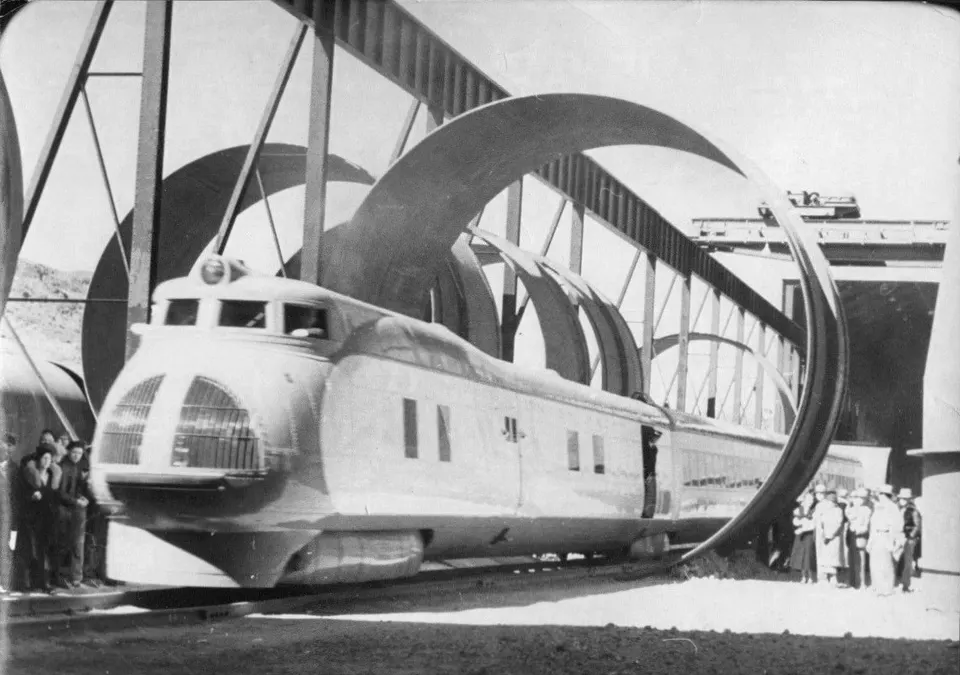
Union Pacific operated the M-10000, an early American streamlined passenger trainset, from 1934 to 1941. The Chicago, Burlington and Quincy Railroad's Pioneer Zephyr beat it into regular service, but the M-10000 was the first streamlined passenger train delivered in the United States. Union Pacific ordered the train from Pullman in May 1933 for $230,997, after a study of passenger traffic concluded that equipment cheaper to run than heavyweight cars and steam locomotives was needed to stay profitable, especially on lightly used routes.
The M-10000 trainset was delivered on February 12, 1934, and sent on a publicity tour of the United States, during which about a million people toured it. Billed as The Streamliner, the M-10000 covered 13000 mi on an exhibition tour of the US, reaching 110 mph (177 km/h) along the way and stopping in Washington DC so that Franklin Delano Roosevelt could inspect it. The M-10000 entered revenue service as The Streamliner between Kansas City, Missouri, and Salina, Kansas, on January 31, 1935. Renamed City of Salina when Union Pacific adopted the "City of..." naming for its streamliners, the M-10000 ran until December 1941, when its engine needed a replacement after about 995,000 miles that was judged too expensive.
Union Pacific commissioned five diesel-powered streamliners between 1934 and 1936 that grew out of the M-10000 design. In 1941, Union Pacific introduced its yellow and gray color scheme with red highlights.
Sun Valley Resort opened in December 1936, and with it Union Pacific put what the railroad calls "the world's very first chair lifts" into operation. Jim Curran, a young Union Pacific engineer, came up with the chairlift idea. Jim Curran took his inspiration from a system used to load bunches of bananas onto boats. Union Pacific finally sold the Sun Valley ski resort in central Idaho in 1964.
Union Pacific's Big Boy No. 4014 was built by the American Locomotive Company (ALCO) in Schenectady, New York, in 1941 to haul heavy freight trains in the Wasatch mountain range. On No. 4014, peak power was reached around 35 mph, while optimal tractive effort was maintained up to around 10 mph. In 1944, Union Pacific took delivery of its last steam locomotive, No. 844.
Union Pacific's last intercity passenger train was the westbound City of Los Angeles, which arrived at Los Angeles Union Station on May 2, 1971.
Union Pacific mergers, 1969 to 1996
A holding company, Union Pacific Corporation, came into being on January 30, 1969, to oversee both the railroad and the company's businesses outside rail. By 1993, Union Pacific had doubled its system to 17,385 route miles.
| Railroad | How and when it joined Union Pacific |
|---|---|
| Missouri Pacific | Acquired in 1982 |
| Western Pacific | Acquired in 1982 |
| Missouri-Kansas-Texas | Acquired in 1988 |
| Chicago & North Western Railway Co. | Absorbed effective October 1, 1995 |
| Southern Pacific Transportation Company | Merged in 1996 |
Burlington Northern and ATSF, the Santa Fe railroad, announced their own merger plans in 1995, the same year Union Pacific merged with the Chicago and North Western. Southern Pacific Transportation Company was itself a giant system that had been absorbed by the Denver and Rio Grande Western Railroad.
Union Pacific heritage steam fleet since 1960
In 1960, Union Pacific officials saw the benefits of a legacy steam program and kept No. 844 for special activities, the seed of what became the railroad's heritage fleet. After commercial steam operations ended in 1959, No. 844 was kept as an experimental snow melter while the rest of the FEF-3s were scrapped. Running at 120 mph was routine for the FEF-3, and reports say one of the engines hauled a passenger train of 1,000 tons at 100 mph. In 1981, the steam program added Challenger No. 3985, which shared top billing with No. 844 for more than three decades. For many years, No. 3985 was the only operating engine of its class in the world and the largest and most powerful operating steam locomotive, a title that later passed to Big Boy No. 4014. No. 3985 was donated in 2022 to the Railroading Heritage of Midwest America in Silvis, Illinois.
Big Boy No. 4014 was donated to the Railway & Locomotive Historical Society in 1961. In 2013, Union Pacific re-acquired the locomotive and began restoring it at its Steam Shop in Cheyenne, Wyoming. In 2019, No. 4014 moved under its own power after almost six decades idle, becoming the world's largest operating steam locomotive and the only working Big Boy of the eight that survived. In October 2025, Union Pacific announced that No. 4014 would make its first coast-to-coast tour, tied to the United States Semiquincentennial.
Union Pacific Railroad Museum in Council Bluffs
The Union Pacific Railroad Museum held its formal opening on May 10, 2003, a date that fell on the 134th anniversary of the transcontinental railroad's completion. The museum was set up in a Beaux Arts building that had housed the Council Bluffs Carnegie Free Public Library. The museum project came from an unusual partnership of local government, private business and concerned citizens.
Collisions with BNSF trains in the 21st century
On June 28, 2004, a Union Pacific train ran into a BNSF train that was standing idle in a suburb of San Antonio. Seven people were hurt and damages topped $10 million when a Union Pacific train and a BNSF train met at a level junction in Chaffee, Missouri, on May 25, 2013.
Norfolk Southern merger plan, 2025 to 2026
Union Pacific and Norfolk Southern unveiled an $85 billion deal on July 29, 2025, aimed at forming a transcontinental railroad. As of February 2026, the two railroads said they intended to refile their merger application with the Surface Transportation Board after its initial rejection.

Rails & Rivals, our game on Steam, is a turn-based railroad strategy board game for 2 to 6 players: each player runs a rail company, lays track across a hex map and carries goods between cities, and the wealthiest company wins. The how to play page has the rules.
Keep reading
Sources
- Union Pacific Railroad (Wikipedia)
- Union Pacific's History (Union Pacific Railroad)
- Union Pacific Corporate History (UtahRails.net)
- Surprising Railroad Inventions: The Ski Lift (Union Pacific Railroad)
- Challenger No. 3985 (Union Pacific Railroad)
- Museum History (Union Pacific Railroad Museum)
- Crédit Mobilier scandal (Wikipedia)
- M-10000 (Wikipedia)
- Union Pacific 844 (Wikipedia)
- Union Pacific 4014 (Wikipedia)
- Union Pacific, Norfolk Southern set new date to re-file merger application (FreightWaves)