Articles · Railroad history
New York Central Railroad History: 1914 to 1968
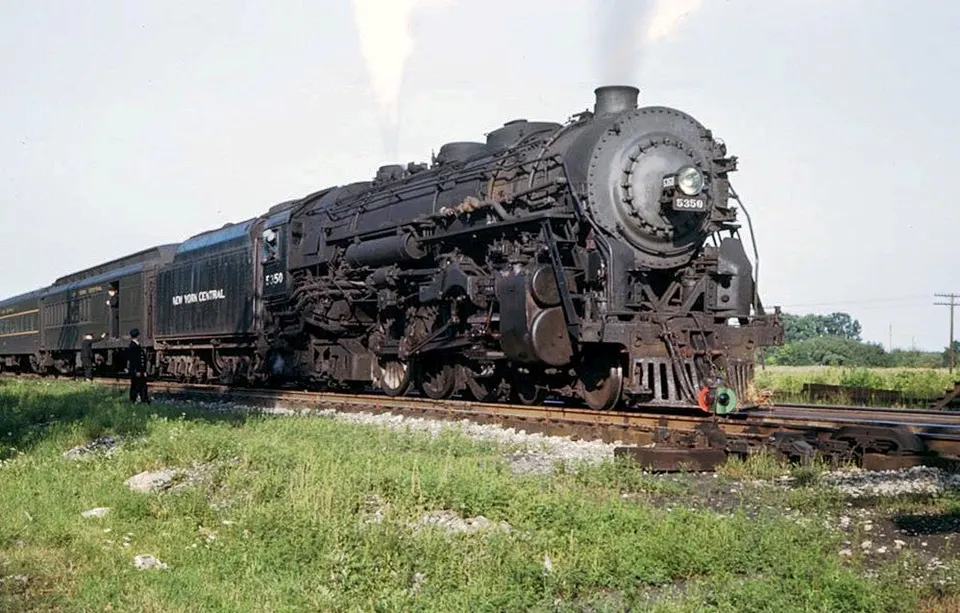
The New York Central Railroad no longer exists as a company: on February 1, 1968, it joined the Pennsylvania Railroad, long its competitor, and the combined company became Penn Central. Its tracks carried on, and when Conrail was broken up in 1999, CSX took most of the old New York Central eastern trackage and Norfolk Southern most of the western trackage. Amtrak reinstated the Lake Shore Limited between New York and Chicago in 1971.
From the Mohawk and Hudson to the 1914 merger
In 1853 Albany industrialist Erastus Corning merged ten railroads across New York State into the first New York Central Railroad, running between Albany and Buffalo. The merged company, formed on November 1, 1869, when Cornelius Vanderbilt joined the line to his own Hudson River Railroad, took the name New York Central and Hudson River Railroad.
The 1914 reorganization also brought in other subsidiaries once owned by the Vanderbilts, including the Michigan Central. The railroad was known as the New York Central Lines from the merger until summer 1935, when its name became the New York Central System.
The New York Central System and its lines
The New York Central Railroad had grown by the 1920s to more than 11,500 miles of workable track, with lines across more than half of the continental United States. The railroad's lines linked major cities including New York, Cleveland, Fort Wayne, Chicago, St. Louis, Mackinaw and Montreal.
The system included railroads that kept their own identities: the New York Central took control of the Pittsburgh and Lake Erie in 1887 and of the Boston and Albany in 1900, and both carried on as independently operated subsidiaries.
The Water Level Route
The Water Level Route was the New York Central Railroad's main line between New York and Chicago, used by the 20th Century Limited from 1902 to 1967. The 20th Century Limited's trip over the route was 960.7 miles. Long stretches of the line ran beside water: the Utica and Schenectady Railroad, opened to traffic in 1836, followed the north side of the Mohawk River from Schenectady to Utica, alongside the Erie Canal. Farther west, the direct line between Rochester and Syracuse, opened in 1853, ran roughly parallel to the Erie Canal. To the south, the Hudson River Railroad, chartered in 1846, extended the route down to New York City and opened in full in 1851.
Main line places, New York to Chicago
- Grand Central Terminal, New York City.
- Harmon, the New York area suburban stop.
- Albany, the eastern end of the 1853 New York Central.
- Schenectady.
- Utica.
- Syracuse.
- Rochester.
- Buffalo, the western end of the 1853 line.
- Cleveland, Ohio.
- Englewood, the Chicago area suburban stop.
- LaSalle Street Station, Chicago.
The 20th Century Limited
From 1902 to 1967 the 20th Century Limited ran as the New York Central Railroad's express passenger train, linking Chicago's LaSalle Street Station with Grand Central Terminal in New York City. The railroad started the train on June 15, 1902, to compete with the Pennsylvania Railroad, and it targeted business travelers and the upper class. The 20th Century Limited made few station stops and took on water at speed from track pans. For much of its history before 1957, the all-Pullman train stopped only at Grand Central Terminal and Harmon in the New York area and at LaSalle Street Station and Englewood in the Chicago area. In 1957 more stops were added to the schedule.
The 20th Century Limited's schedule returned to 20 hours in 1912 and stayed there until 1932. In the 1920s the New York to Chicago fare was $32.70, plus an extra fare of $9.60 and a Pullman charge such as $9 for a lower berth, for a total of $51.30.
Industrial designer Henry Dreyfuss was commissioned by the railroad in 1938 to design streamlined Art Deco train sets, with the locomotive and cars in blues and grays, the New York Central's colors. Henry Dreyfuss's streamlined sets entered service on June 15, 1938. Leaving New York City at 18:00 Eastern Time, the first of the new 20th Century Limited trains reached LaSalle Street Station in Chicago at 09:00 Central Time the next morning, covering the 960.7 miles at an average speed of 60 mph. Henry Dreyfuss's design was probably the most famous American passenger train.
20th Century Limited schedule by era
| Period | New York to Chicago schedule |
|---|---|
| 1912 to 1932 | 20 hours |
| After the June 15, 1938 streamlining | 16 hours for the 960.7-mile trip |
| A short period after World War II | 15 and a half hours with steam power |
Regular passengers on the 20th Century Limited included Theodore Roosevelt, William Jennings Bryan, Lillian Russell, "Diamond Jim" Brady, J. P. Morgan, Enrico Caruso and Nellie Melba. By the late 1960s the 20th Century Limited was in decline. The 20th Century Limited made its last run on December 2 to 3, 1967.
Grand Central Terminal in New York City was the eastern end of the 20th Century Limited's run. The engine change point for the train moved to Harmon in 1913, when the line south of there was electrified.
Hudson, Mohawk and Niagara locomotives
Hudson 4-6-4
Built for the New York Central Railroad, the Hudson was a steam locomotive type, and ALCO and the Lima Locomotive Works turned out 275 of them in three classes from 1927 to 1938. On February 7, 1930, J-1 class Hudson No. 5270 led the eastbound Advance 20th Century Limited out of Chicago. The 4-6-4 wheel arrangement came to be called the Hudson type in the United States, after the Hudson River, because these engines were the first of the arrangement built and used in North America.
Commodore Vanderbilt was the name given on December 27, 1934, to J-1e No. 5344, after it received a streamlined Art Deco casing, the work of designer Carl F. Kantola, as an answer to the diesel-powered Zephyr streamliner. The last ten J-3a Super Hudsons, Nos. 5445 to 5454, were built with streamlining designed by Henry Dreyfuss.
Mohawk 4-8-2 and Niagara 4-8-4
The Mohawk was the New York Central Railroad's name for the 4-8-2 type, and 600 Mohawks were built for its service. The first Mohawks, delivered by ALCO in 1916, were purely freight engines. Passenger work called for a locomotive able to run at 80 mph, against the 60 mph that freight service needed.
The Niagara was the railroad's 4-8-4, named after the Niagara River and Falls. In 1944 the War Production Board allowed the railroad to build a new high-speed 4-8-4 combining the advantages of the Hudson and the Mohawk. The first Niagara, S-1a No. 6000, was delivered in March 1945. Only 27 Niagaras were built, so they took over only the heaviest and most prestigious trains. Railfans often consider these fast 4-8-4 locomotives the epitome of their breed.
The 1946 steam versus diesel trials
The 1946 steam versus diesel trials gave results much closer than the diesel salesmen were comfortable with. The Niagaras were held back by a series of coal miners' strikes, aggressive diesel sales efforts and costly firebox-wrapper metal that failed in real service.
Hudson, Mohawk and Niagara at a glance
| Locomotive | Wheel arrangement | Years built | Number built | Builder | Fate |
|---|---|---|---|---|---|
| Hudson | 4-6-4 | 1927 to 1938 | 275 | ALCO and Lima Locomotive Works | Retired and scrapped by 1957, except the tender from J-1d No. 5313 |
| Mohawk | 4-8-2 | 1916 to 1942 | 600 | ALCO and Lima Locomotive Works | Retired 1936 to 1957; Nos. 2933 and 3001 saved for static display |
| Niagara | 4-8-4 | 1945 to 1946 | 27 | American Locomotive Company (Alco) | Retired and scrapped between late 1955 and July 1956 |
End of steam and scrapping
Diesels replaced steam on every New York Central line east of Cleveland, Ohio, in 1953: the Cleveland to Buffalo section changed over in September, following the lines east of Buffalo, which had switched on August 7. The last Niagara, No. 6015, was retired in July 1956. Reports name H7e class 2-8-2 Mikado No. 1977, withdrawn on May 3, 1957, as the final steam engine the New York Central took out of service.
No New York Central Hudson or Niagara was preserved: the railroad scrapped them all under its head, Alfred E. Perlman. Each Niagara had cost about $248,000 in 1945, yet Luria Brothers paid the railroad under $15,000 apiece for them as scrap. Only the tender from J-1d Hudson No. 5313 escaped, and it went to the Steamtown National Historic Site in Scranton, Pennsylvania.
Decline under Robert R. Young and Alfred E. Perlman
Robert Ralph Young, who led the Alleghany Corporation, won a proxy fight against the New York Central's management in June 1954. Unable to keep his promises, Robert R. Young had to suspend dividend payments in January 1958. After Young died by suicide, his role in management passed to Alfred E. Perlman, who had worked with the railroad under Young since 1954.
Alfred E. Perlman cut the railroad's operating deficits by $7.7 million in 1959. Alfred E. Perlman also oversaw the building or modernizing of many classification yards, notably the $20 million Selkirk Yard south of Albany, which opened in 1924 and was modernized in 1966.
The 1956 highway act helped create a network of government-subsidized highways that drew more travelers into cars and more freight onto trucks. The 1959 opening of the Saint Lawrence Seaway let container shipments go straight to Great Lakes ports, taking away railroad freight hauls between the East and the Midwest. A World War II tax of 15% on passenger fares also stayed in place until 1962.
Passenger service shrank in the Perlman years: in 1958 and 1959 the railroad suspended service on its Putnam Division and gave up its ferry across the Hudson to Weehawken Terminal. Service on the Empire Corridor between Albany and Buffalo was greatly reduced, and trains beyond Buffalo to Niagara Falls ended in 1961. On December 3, 1967, most of the railroad's great long-distance trains ended. The New York Central's last passenger timetable took effect on January 26, 1968, with a sharply cut schedule ahead of the merger with the Pennsylvania Railroad.
Penn Central, Conrail and where the lines went
Merger talks between the New York Central and the Pennsylvania Railroad began as early as 1955 but were delayed for over a decade by the Interstate Commerce Commission, union objections, rival railroads' concerns and the two companies' own failure to agree on a plan. The merger, formally an acquisition of the New York Central by the Pennsylvania Railroad, was completed on February 1, 1968. Alfred E. Perlman was elected president of the new Penn Central.
Penn Central was quickly loaded with debt when the Interstate Commerce Commission forced the money-losing New Haven into it. On June 21, 1970, Penn Central's board voted to file for bankruptcy. No private company in the United States had ever gone bankrupt on a larger scale before then. In response, President Richard Nixon signed the Rail Passenger Service Act of 1970, which created Amtrak.
Where the New York Central's lines went
- New York Central Railroad, independent until 1968.
- Penn Central, which operated from 1968 to 1976.
- Amtrak, which took over most intercity passenger trains in the United States on May 1, 1971.
- Conrail, which took over Penn Central's freight operations on April 1, 1976.
- Metro-North Railroad in New York and Connecticut and the Massachusetts Bay Transportation Authority, which took over the commuter services in 1983.
- CSX and Norfolk Southern, which absorbed Conrail's assets in 1999.
The Empire State Express, first run in 1891, carried on as Amtrak's Empire Service as far as Niagara Falls, New York. In 2023 two restored 20th Century Limited cars, Hickory Creek and Tavern-Lounge No. 43, ran on spring and fall day trips between New York City and Albany at the rear of an Amtrak Empire Service train.

Rails & Rivals, our game on Steam, is a turn-based railroad strategy board game for 2 to 6 players: each player runs a rail company, lays track across a hex map and carries goods between cities, and the wealthiest company wins. The how to play page has the rules.
Keep reading
Sources
- New York Central Railroad (Wikipedia)
- History (New York Central System Historical Society (NYCSHS))
- New York Central Railroad History (City of Elkhart, Indiana / National New York Central Railroad Museum)
- en.wikipedia.org (en.wikipedia.org)
- 20th Century Limited (Wikipedia)
- New York Central Hudson (Wikipedia)
- New York Central Niagara (Wikipedia)
- Penn Central Transportation Company (Wikipedia)
- american-rails.com (american-rails.com)
- american-rails.com (american-rails.com)