Articles · Railroad history
Great Locomotive Chase 1862: The Andrews Raid Explained
The Great Locomotive Chase was a Union raid in northern Georgia on April 12, 1862, during the American Civil War. Union Army volunteers under civilian scout James J. Andrews took the steam locomotive General and ran it north toward Chattanooga, Tennessee, damaging the Western and Atlantic Railroad between Atlanta and Chattanooga as much as they could on the way.
Confederates eventually captured the raiders, and the raid had no military effect.
The Western and Atlantic Railroad and Andrews' plan
The Western and Atlantic Railroad was owned and run by the state of Georgia, which was unusual for a railroad. The line was built from Atlanta, Georgia, to Chattanooga, Tennessee. The country north of Atlanta is very hilly, with steep ruling grades.
Born in Kentucky, the civilian James J. Andrews spent the spring of 1862 scouting and spying in Tennessee on behalf of a Union major general. Andrews, a civilian scout and part-time spy, proposed a raid that would ruin the Western and Atlantic as a supply and reinforcement link between Atlanta and Chattanooga.
The raiders Andrews recruited were a civilian, William Hunter Campbell, and 22 volunteer Union soldiers from the 2nd, 21st and 33rd Ohio Infantry. The men traveled in small groups and in civilian clothes so they would not attract suspicion. Andrews told them to be in Marietta, Georgia, by the night of April 10, 1862, but heavy rain put everything back by a day.
How the raiders took the General locomotive
On April 12, 1862, the regular morning passenger train out of Atlanta, with the General at its head, halted so its crew and passengers could have breakfast at the Lacy Hotel. The stop was at Big Shanty, a place now called Kennesaw, Georgia. The raiders steamed out of Big Shanty with the General, its tender and three empty boxcars.
The Union men cut the telegraph wires, so no warning could be wired ahead to Confederate troops along the line. The train's conductor, William Allen Fuller, and two other men went after the stolen train on foot, then took a handcar belonging to a work crew just north of Big Shanty.
The chase north to Ringgold
- Big Shanty (now Kennesaw, Georgia), where the General was taken.
- Etowah, where the General passed the Yonah, which Fuller then drove fifteen miles north at full steam.
- Kingston, where Fuller left the Yonah for the Rome Railroad's locomotive William R. Smith.
- Adairsville, where broken track two miles south of the town stopped the pursuers and sent Fuller's party on foot.
- Calhoun, south of which Fuller took command of the southbound Texas, which Andrews had passed there, and ran it backwards.
- Dalton and Tunnel Hill, which the two trains steamed through with the Texas still running tender-first.
- Ringgold, two miles north of which the General, low on water and wood, lost steam and came to a halt.
The raiders on the General saw that the Yonah had full steam up and proposed destroying it. Andrews refused, judging that it would do the railroad little harm and might draw attention to his men.
The Texas had been hauling 21 loaded freight cars south from Dalton toward Atlanta when Fuller took it over. Once the cars were dropped, the Texas ran in reverse and chased the General for more than 51 miles. From then on the raiders never got far ahead of Fuller and never had time to stop and pull up a rail to halt the Texas.
The raiders' sabotage fell short: they were too few, too poorly equipped with track tools and demolition gear, and the day's rain made the bridges hard to burn. Anthony Murphy, of the Atlanta railroad shops, and Fuller kept up the chase for seven hours and more than 87 miles. When the General stopped north of Ringgold, Andrews and his men abandoned it and tried to flee. Confederates then rounded up every one of the raiders.
Trials, escapes and the first Medal of Honor
Confederate forces charged all of the raiders with "acts of unlawful belligerency" and charged the civilians as unlawful combatants and spies. Eight raiders, Andrews among them, were tried as spies and executed in Atlanta. Andrews was hanged on June 7, 1862. On June 18, 1862, the seven others, who had been taken to Knoxville and convicted as spies, were brought back to Atlanta and hanged. Their bodies went into an unmarked grave and were later reburied in Chattanooga National Cemetery.
Eight raiders made it back safely to Union lines, traveling hundreds of miles in pairs. Slaves and Union sympathizers helped two of them, and two others floated down the Chattahoochee River until the Union blockade ship USS Somerset rescued them in the Gulf of Mexico. The other six stayed in Confederate hands as prisoners of war until March 17, 1863, when they were traded for captured Confederates.
The surviving raiders were the first to receive the newly created Medal of Honor. On March 25, 1863, the Army gave the first six medals to raiders, and Private Jacob Parrott was the first recipient. In 2008, the House of Representatives passed a bill to award the medal retroactively to two of the three raiders who had not received it, one of them George Davenport Wilson. On July 3, 2024, the medal was presented posthumously to descendants of both of those raiders.
The General locomotive and the Texas compared
The General was an American type steam locomotive that hauled freight and passengers between Atlanta and Chattanooga on the Western and Atlantic before the Civil War. Rogers, Ketchum & Grosvenor built the General in Paterson, New Jersey, in December 1855. In the 1870s the engine was completely rebuilt, with a new pilot, boiler and other parts. Its three domes were cut to two, and a diamond stack replaced its balloon stack, as the engine had been converted to burn coal.
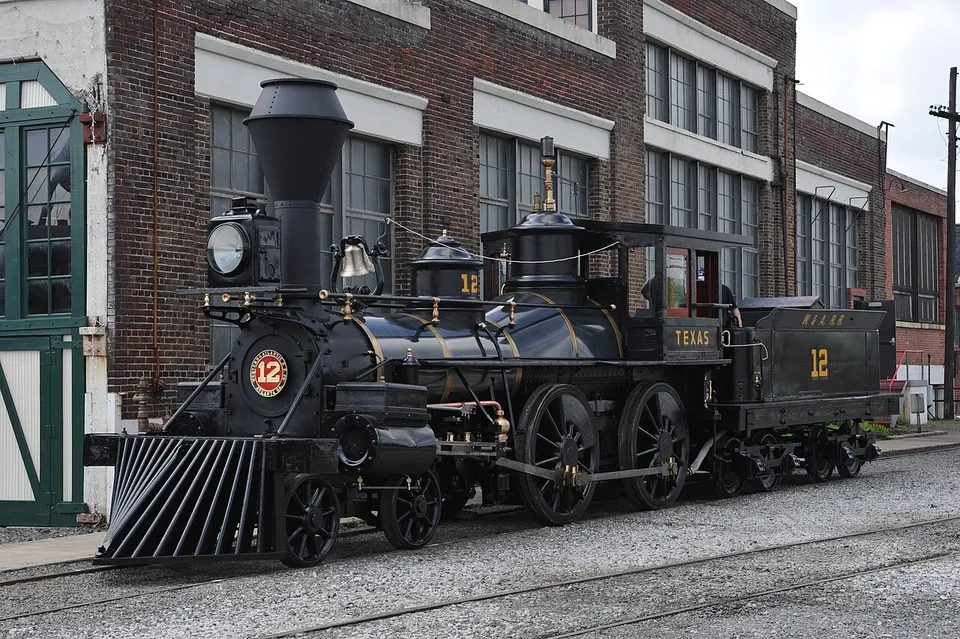
The Texas was built in October 1856 for the Western and Atlantic by Danforth, Cooke and Company of Paterson, New Jersey. The Texas had a 4-4-0 wheel arrangement in Whyte notation.
| Locomotive | Builder | Built | Wheel arrangement | Fleet numbers | Role on April 12, 1862 | Display |
|---|---|---|---|---|---|---|
| General | Rogers, Ketchum & Grosvenor, Paterson, New Jersey | December 1855 | American type | 39, renumbered 3 in 1880 | Taken by the raiders at Big Shanty | Big Shanty Museum in Kennesaw (later the Southern Museum of Civil War and Locomotive History), from its opening on April 12, 1972 |
| Texas | Danforth, Cooke and Company, Paterson, New Jersey | October 1856 | 4-4-0 | 49 in 1866, 12 in 1870, Nashville, Chattanooga and St. Louis no. 212 in 1890 | Chased the General running in reverse | Atlanta History Center railroads exhibit, opened November 17, 2018 |
Later lives of the two engines
| Year | Engine | Event |
|---|---|---|
| 1886 | General | Converted to fit U.S. standard gauge, since the northern gauge had been made compulsory by June 1, 1886 |
| 1886 | Texas | Regauged as the Western and Atlantic converted all its locomotives to the national standard gauge |
| 1891 | General | Retired and stored on a siding in Vinings, Georgia |
| 1892 | General | Restored by 1892, a year before an exposition |
| 1901 | General | Put on display in the Chattanooga Union Depot |
| 1907 | Texas | Retired and sent to the Western and Atlantic yard in Atlanta |
| 1908 | Texas | Donated on February 17, 1908, by the Nashville, Chattanooga and St. Louis to the "Ladies of Atlanta", who passed it to the city |
| 1927 | Texas | Placed, still unrestored, in the basement of the newly built Cyclorama |
| 1961 | General | Moved from the Chattanooga Union Depot to the South Louisville Shops and given modern air brakes, a modern coupler on the tender and oil firing |
| 2017 | Texas | Unveiled fully restored by the North Carolina Transportation Museum on April 28, 2017 |
Custody fight over the General locomotive
Many proposals for the General had been put forward since the 1930s, during its years on show in Chattanooga, such as displaying it in Underground Atlanta, at Kennesaw Mountain or at Stone Mountain Park. Many of those proposals drew press coverage, but none of them ever happened. Paterson, New Jersey, where the General was built, also showed interest, since many engines had been built there by Rogers and other firms and the city had none to display. Paterson later withdrew its proposal and looked for other engines.
The state of Georgia began to show interest in reclaiming the General in the mid-1960s. Georgia's interest soon raised tensions with Chattanooga, where the engine was displayed. In 1967, Kennesaw asked for the General to appear at a fundraiser held by the Big Shanty Historical Society. The engine was on its way there when a group led by Chattanooga's mayor stopped it. In the mayor's view the General was Chattanooga's property, and the L&N faced a lawsuit over who should keep it.
On January 4, 1969, a U.S. District Judge in Chattanooga ruled that the General belonged to the L&N, which could dispose of it as it wished. Chattanooga appealed, and the case went to a federal appeals court. That court upheld the ruling, and the city appealed again, to the Supreme Court of the United States. The Supreme Court dismissed the appeal on November 9, 1970, which made the ruling final. The General was kept in storage in Louisville while the case ran. Having won custody in 1970, the L&N moved the engine to Atlanta on a route that avoided Chattanooga altogether, running from Knoxville via Etowah to Marietta on what had once been the Atlanta, Knoxville and Northern Railway. In February 1972, at a ceremony in Atlanta, L&N president Kendall formally presented the General to Georgia's then governor, Jimmy Carter. The engine was later moved to Kennesaw, where a museum site was prepared.
Pittenger's book, Buster Keaton and Disney
William Pittenger, one of the Andrews Raiders, published the first account of the chase in 1863 under the title Daring and Suffering. The book was republished in 1881 as Capturing a Locomotive and in 1889 as The Great Locomotive Chase.
Buster Keaton's The General is a silent film, released in 1927, that Keaton both directed and starred in. The film is loosely based on Pittenger's memoirs. Keaton shot most of it in Oregon in the summer and fall of 1926. Unlike Disney's later film, Keaton's picture tells the story from a distinctly Southern point of view.
Walt Disney Productions released the drama The Great Locomotive Chase in 1956, also based on Pittenger's memoirs, with Fess Parker as Andrews and Jeffrey Hunter as Fuller. The tracks of the old Tallulah Falls Railroad were put back into use for its chase scenes. The Disney film closes with Andrews shaking Fuller's hand before his execution, a moment that never happened but stands for reconciliation between North and South.
Places linked to the chase
The Ohio monument to the Andrews Raiders stands in Chattanooga National Cemetery. A scale model of the General sits on top of the monument, along with a short history of the chase.
One marker shows where the chase began, near the Southern Museum of Civil War and Locomotive History in Kennesaw. A second marker stands at Milepost 116.3, north of Ringgold, at the spot where the chase came to an end.
The Calhoun Depot, a Western and Atlantic station, was built by the State of Georgia in 1852-53. The Calhoun Depot came through the Civil War intact despite being involved in it, as did the line's other depots built of brick or stone. Adairsville's Great Locomotive Chase Festival, a three-day event held in October, dates from at least 1979.

Rails & Rivals, our game on Steam, is a turn-based railroad strategy board game for 2 to 6 players: each player runs a rail company, lays track across a hex map and carries goods between cities, and the wealthiest company wins. The how to play page has the rules.
Keep reading
Sources
- Great Locomotive Chase (Wikipedia)
- Andrews Raid (New Georgia Encyclopedia)
- The Great Locomotive Chase (American Battlefield Trust)
- The General (film) (New Georgia Encyclopedia)
- The Great Locomotive Chase (film) (New Georgia Encyclopedia)
- The General (locomotive) (Wikipedia)
- Texas (locomotive) (Wikipedia)
- The Texas (locomotive) (Wikipedia)
- William Allen Fuller (Wikipedia)
- The Yonah (locomotive) (Wikipedia)
- Calhoun station (Wikipedia)
- The Andrews Raid (historical marker) (Georgia Historical Society)
- Great Locomotive Chase, The (film) (D23 (The Walt Disney Company))